Chemist explores ways to make hydrogen a viable fuel
A chemist at Washington University in St. Louis hopes to find the right stuff to put the element hydrogen in a sticky situation.
Lev Gelb, Ph.D., Washington University assistant professor of chemistry, prepares theoretical models of molecules that may be used to store and transport hydrogen gas.
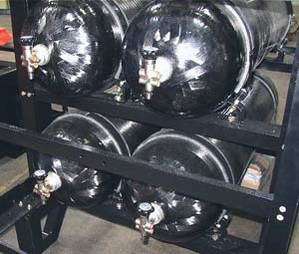
Image: Storing hydrogen is problematic. A WUSTL chemist and his colleagues are exploring different approaches to help make hydrogen fuel more practical.
Gaseous at room temperature, hydrogen is even lighter and less dense than natural gas and thus harder to store. So, while hydrogen has a high energy-per-weight, it has a low energy-per-volume.
"If you had a kilogram of hydrogen at atmospheric pressure, you'd have to store it in about 100 big balloons, if you can picture that," said Gelb. "A kilogram of gasoline, on the other hand — that would be a small container."
Gelb works on one possible solution to this storage problem, a process called gas physical adsorption.
"The idea here is to create materials composed of molecules hydrogen likes to stick to," said Gelb. "If hydrogen stuck to these particles you could carry around the substance, along with the hydrogen."
Such a substance would have to be relatively light-weight and very porous, having a high surface area, in order to adsorb as much hydrogen as possible. Then it is hoped that the hydrogen can be removed at the site of combustion by applying some low-energy force such as a vacuum.
"The problem is that as far as we know, nothing is sticky enough without being too heavy," said Gelb.
But this doesn't stop him: his theoretical chemistry work aims at calculating what the properties of such a material would be — what the material should be made of, what it should look like. Currently, Gelb and some of his post-doctoral researchers are looking at a class of materials called coordination polymers, recently synthesized, highly porous materials that have shown some promise in hydrogen gas adsorption.
Building molecular models
By focusing on building molecular models of such materials, Gelb can screen potentially promising molecules. This way he can have a good idea whether a certain material might be a good candidate before someone else devotes the time and energy involved in synthesizing it.
"Hydrogen gas has a lot of promise," said Gelb. "It has two basic advantages: it is an efficient fuel and produces no pollutant by-product."
Hydrogen, or H2, burns in the same way as natural gas. It is a promising alternative energy, however, because its chemical energy can be directly and efficiently converted to electricity in special fuel cells that are easily miniaturized. In burning natural gas, on the other hand, chemical energy first must be converted to mechanical energy in order to create electricity, an extra step that reduces efficiency.
Hydrogen also has a very high energy-to-weight ratio, higher than that of natural gas and gasoline. Most appealing, perhaps, is that hydrogen is clean burning — its combustion yields only water. Natural gas, along with all fossil fuels, burns to produce water and carbon dioxide, the most abundant greenhouse gas.
Unfortunately, there are many problems that have prevented and continue to prevent hydrogen from being used on a large scale, of which storage and transport is only one.
There are several other possible solutions to the storage/transport problem, but each has significant downsides.
Pressing matter
The most likely option in the near future, said Gelb, is to simply compress the gas at very high pressure. Hydrogen-powered car prototypes made by General Motors, for example, use this storage option. There are several drawbacks, however; storage tanks are expensive and inherently dangerous, especially since hydrogen is combustible. Additionally, it is energetically costly to compress the hydrogen, making a net efficient usage of energy difficult to achieve.
Another potential storage solution involves cooling the gas to extremely low temperatures until the gas becomes a liquid. This option, however, would also be energetically costly and presents the problem of evaporation.
A third idea involves chemically incorporating the hydrogen in a solid material, for instance in a class of materials called metal hydrides. Hydrogen can be stored in these materials at such high densities as to surpass the density of liquid hydrogen. Unfortunately, it is very difficult to get the hydrogen out of the material, requiring more energy. Also, these hydrides are often very reactive, dangerous materials — many react violently with both air and water and cease working.
But the biggest problem with hydrogen, according to Gelb, is producing it.
For one thing, considering hydrogen gas to be an energy 'source' is a misnomer — it does not naturally occur on the earth; it must be derived from something else. While hydrogen is the most abundant element in the universe, on our planet all of it is bound with other elements.
Water, for example, is two parts hydrogen, one part oxygen, and it is also bound up in hydrocarbons and a milieu of other compounds. Thus, hydrogen production is the larger problem that stands in the way of ever achieving a 'hydrogen economy.'
Currently, the vast majority of hydrogen gas is produced from natural gas in a process called steam reforming. Besides using up natural gas, this process also creates carbon dioxide — the byproduct absent in hydrogen combustion, which contributes to much of its promise as a 'green' fuel.
While there has been some progress in sequestering this carbon dioxide in places where it cannot seep into the atmosphere, such as deep underground, producing hydrogen via steam reforming has only limited promise for reducing greenhouse emissions, and is not a renewable strategy.
"The case has been made persuasively that you'd be better off just burning the natural gas, rather than going to the trouble of producing hydrogen from natural gas and going through all the problems associated with its storage and transport," said Gelb.
But that doesn't stop him from trying to solve these problems.
Gelb, in fact, is working in collaboration with several other Washington University researchers in energy-related science.
This work is supported by the recently established Washington University Center for Materials Innovation. His Washington University colleagues in this endeavor are: Pratim Biwas, William Buhro, Dewey Holten, Ramki Kalyanaraman, Kenneth Kelton, Richard Loomis, Thomas Vaid, and Amy Walker.
Source: Washington University in St. Louis (By Doug Main)


