Silver anomalies found in Jerusalem pottery hint at wealth during second Temple period
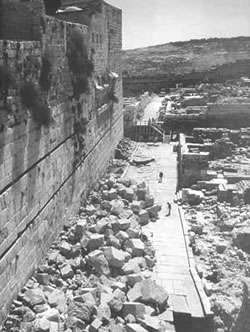
Scientists with the U.S. Department of Energy's Lawrence Berkeley National Laboratory and Bar-Ilan University have discovered unusually high concentrations of silver in samples of many different types of pottery from excavations in Jerusalem of the late Second Temple period, the first century BCE (Before the Common Era) through 70 CE (Common Era). This is the first study ever conducted on silver in archaeological ceramics.
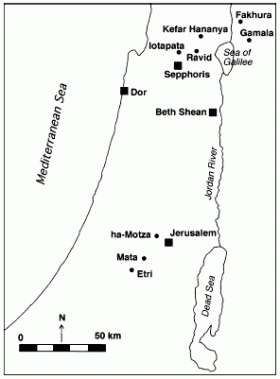
David Adan-Bayewitz, Associate Professor at Bar-Ilan in Ramat-Gan, Israel, and a guest at Berkeley Lab, and Frank Asaro and Robert D. Giauque of Berkeley Lab's Environmental Energy Technologies Division made their discovery of performing measurements on 1,200 pottery vessels from 38 sites in Roman Judea (present-day Israel). They used high-precision X-ray fluorescence (HPXRF) and instrumental neutron activation analysis (INAA). The Berkeley Lab team developed a variation of INAA, the INAA coincidence technique, specifically for measuring silver concentrations in archaeological samples, as a more accurate means of checking the results of HPXRF and conventional INAA.
The major finding is that samples of pottery from Jerusalem during this era showed anomalously higher concentrations of silver, as compared to samples from all other non-urban sites dated to the same period of time. Many of the samples from Jerusalem and other sampled sites were otherwise indistinguishable in date, shape and chemical composition. High silver abundances were also detected in pottery found at other urban sites. But many of the Jerusalem samples had higher silver values than any of the samples from the other cities.
"Because pottery samples containing higher amounts of silver were all recovered from sites in cities, and because the cities were distant from one another," says Asaro, "we concluded that the silver anomalies are associated with human activity." Natural causes do not explain the geographical distribution of samples with high silver content. The researchers also concluded that silver was washed into the pottery through the action of groundwater.
"One of the most important results of our silver work is that our findings suggest that the measurement of silver in pottery may be a useful tool for evaluating archaeological remains and patterns of urban contamination in antiquity," says Adan-Bayewitz.
Jerusalem In the Second Temple Period
The researchers note that Jerusalem and its temple was the religious and national focus of Jews throughout the Roman Empire during the Second Temple Period, leading to substantial growth and accumulation of wealth of the city's inhabitants. The Roman scholar Pliny the Elder, who lived during this time, called Jerusalem "by far the most famous city of the East." Jewish pilgrims to Jerusalem contributed to the city's wealth, and continual donations to the temple made it a target for plunder.
Josephus, the first-century Jewish historian, witnessed the siege and conquest of Jerusalem in 70 CE, and wrote "Of the vast wealth of the city, no small portion was still being discovered among the ruins. Much of this the Romans dug up, but the greater part they became possessed of through the information of the prisoners, gold and silver and other most precious articles, which the owners in view of the uncertain fortunes of war had stored underground."
The researchers suggest that the silver anomaly they measured in the Jerusalem pottery samples may be analytical evidence of the wealth of the city during the Second Temple Period.
The results of this research were published in the August 2006 issue of the journal Archaeometry. The article was titled "The discovery of anomalously high silver abundances in pottery excavated in Jerusalem."
Development of Coincidence INAA
Asaro and his colleagues have been applying neutron activation analysis and X-ray fluorescence techniques to studying the origin of archaeological artifacts for decades. He has collaborated with Adan-Bayewitz on artifacts from this region since the early 1990s. Asaro's work was also instrumental in finding the iridium anomaly that first hinted at the extinction of the dinosaurs through asteroid impact in 1985, and in providing evidence that "Drake's Plate" was an archaeological forgery.
In neutron activation analysis, a sample is bombarded by neutrons in a research reactor. Artificial radioactive isotopes of certain elements are formed, which can be identified by their characteristic gamma-ray signatures. In the X-ray fluorescence technique, a sample is exposed to x-rays. Atoms in the sample absorb the energy, knocking away an electron from an inner shell. The atom emits a unique x-ray signature when an outer shell electron drops to the inner shell to replace the missing electron.
When Asaro and Giauque began applying these techniques to the Second Temple-era samples, they measured anomalously high silver concentrations and began taking a closer look. "I was mistrustful of INAA measurements of abundances with a single detector and X-ray fluorescence measurements to measure silver accurately in archaeological samples," says Asaro, "so we developed a new and more reliable way of detecting silver using coincidence measurements with INAA."
Their method involves measuring the radiation emitted by samples subjected to neutron activation at two energy ranges of gamma rays with two detectors. When the single detector and coincidence INAA methods and the HPXRF method all agreed on the silver anomaly, the research team was satisfied that they had correct data.
Source: Lawrence Berkeley National Laboratory


