What makes glass break?
After 2,000 years of making and breaking glass, one might think there would be a definitive answer. But at the Third International Workshop on the Flow and Fracture of Advanced Glasses, held Oct. 2 to 5 at The Penn Stater Conference Center Hotel, 50 or so of the world's top glass scientists scratched their heads as researchers presented sharply conflicting views on the topic.
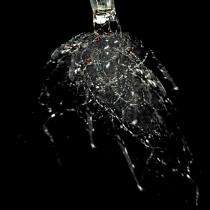
This image shows a simulation of glass shattering. Image courtesy of Matt Sprinsky, MRI
Glass is a versatile material that is ideally suited for any number of medical and optical uses in addition to its wide application in the building and automotive trades, said Carlo Pantano, director of Penn State's Materials Research Institute and one of the conference's organizers. Glass products, from microscope slides to optical fibers to space telescopes, are a $22 billion contributor to the U.S. economy. Glass is beautiful, but fragile.
"An understanding of the basic structure of glass, including how and why it breaks and how it can be strengthened to lessen its fragility, will extend the functionality of glass into new areas," Pantano said.
In the workshop's opening session, American Sheldon Wiederhorn of the National Institute of Standards and Technology disputed the findings of French glass scientists who, in 2003, published research proposing that glass fractures through submicroscopic cavities that form ahead of the crack tip. Wiederhorn and colleague Jean-Pierre Guin had compared fracture surfaces using an atomic force microscope, an exceedingly sensitive instrument that measures peaks and valleys at the atomic level with a tiny probe, and found no indication of the cavities that should appear if the French researchers were correct.
As Pantano recounted, "Wiederhorn argued in favor of the classical model, which says that glass fractures through the stretching and breaking of individual inter-atomic bonds one after another, and that this process is accelerated by the condensation of water at the tip of the crack."
Not so, replied the program's next speaker, Elizabeth Bouchaud of CEA, a French government-funded research organization in Saclay, France. A subscriber to the cavity model, Bouchard presented experimental evidence that both common silicate glasses and newly developed metallic glasses, as well as some ceramics, fracture via cavities that form and flow together ahead of the crack tip. The size of the cavities she observed ranged from a few nanometers in fast-moving cracks, to hundreds of nanometers in ultra-slow stress fractures, she said.
Wiederhorn interrupted: "If there are cavities, then they should be found in high concentration along the fracture surface." He had found none.
"Our difference is in how we measure the fractures," Bouchaud rejoindered, suggesting that a little more precision might set Wiederhorn straight.
"If experimentalists cannot solve their differences, then computer modelers and their simulations will have to come in," exclaimed Rajiv Kalia of the University of Southern California. Using video animations of molecular dynamics simulations conducted on ultra-fast computers, Kalia described how atoms under pressure slide across one another, causing friction and giving rise to cracks. In Kalia's model, these cracks extend through "nanovoids," cavities so small that they can be closed up or "healed" by the same pressure that caused the glass to fracture in the first place. Maybe this healing masks the true fracture process, he suggested.
Or is there another mechanism entirely, as J.J. Mecholsky Jr. of the University of Florida contended? "Mecholsky showed the fracture process as a series of changes in the atomic bonds at the crack tip," said Pantano. "His simulations showed the glass's atomic structure pulling apart like stretched rubber bands through the rearrangement of atoms -- not the rupture of bonds -- to propagate the growing crack."
A potential international fracas was averted during a coffee break, when Wiederhorn approached Bouchaud and complimented her on her eloquent presentation. Bouchaud, in turn, suggested collaboration between the two groups to settle their dispute experimentally.
Pending the results of this joint effort, they can always fall back on the empirical data. Some of the things that make glass break, after all, are beyond dispute. Just for starters, how about baseballs, broom handles and bricks?
Source: Research/Penn State (By Walt Mills)


