From Nanowires to Nanotubes
September 28, 2006 From Nanowires to Nanotubes

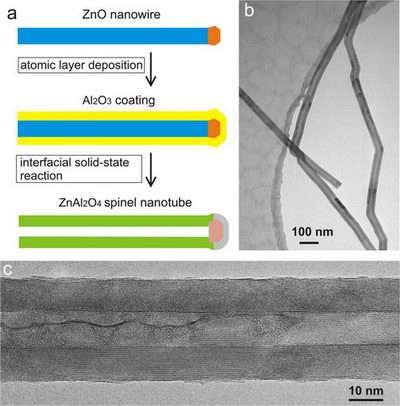
Steps in producing nanotubes from nanowires (a). A transmission electron microscope allows us to see how spinel nanotubes are created after thermally treating ZnO-Al2O3 core-shell-nanowires (b, c). Most of the one-dimensional nanostructures produced are hollow over the entire length of the previous nanowire. The researchers created free-standing nanotubes, 20 micrometres long, with a diameter of 30 to 40 nanometres and walls 10 nanometres thick. These nanotubes feature excellent crystallinity and uniformity. The results show how the Kirkendall effect can be used generally to produce all kinds of hollow nano-objects. Image: Max Plank Institute for Microstructure Physics

Hollow nanocrystals that can function as highly-efficient catalysers or transport containers for chemical agents are in great demand nowadays. Scientists from the Max Planck Institute of Microstructure Physics have created a procedure for combining chemicals to produce high quality nanotubes in large quantities.

The researchers took advantage of the Kirkendall effect, which occurs during inter-diffusion between two solids. They used the effect to take nanowires of a certain chemical composition in the core and the shell, and produce nanotubes of a more complex composition. The scientists showed that this method can also be used to efficiently produce nanowires themselves (Nature Materials, August 2006).

Compound nanotubes can be produced in various ways: rolling up layered materials, coating pores in templates, or eliminating the core of a core-shell nanowire. In the case of ternary compound nanotubes, most of these methods have limitations. They may need layered materials or templates (e.g., porous alumina). Or the nanotubes produced may have an insufficiently small aspect ratio. Frequently the crystallinity of the nanotubes produced is poor - that is, they consist of many grains that have different crystallographic orientations.

Scientists at the Max Planck Institute of Microstructure Physics in Halle, Germany, have devised a generic technique for generating nanotubes with very good crystallinity of a ternary compound (i.e., a compound that consists of three different chemical elements).

The scientists fabricated ultra-long single-crystalline ZnAl2O4 spinel nanotubes (total diameter: ~ 40 nm, wall thickness: ~10 nm). Spinels are ternary compounds of type AB2O4 that crystallise in a specific cubic structure. Nanotube formation is based on an interfacial solid-state reaction of core-shell ZnO-Al2O3 nanowires involving the Kirkendall effect.

This effect arises when the interdiffusion between two solids is realized via vacancy transport and an asymmetry of the related diffusion rates occurs which finally results in the formation of pores. The researchers have used this effect to produce hollow nanowires, i.e. nanotubes. The latter grow due to the fact that the generated pores cannot leave the nanowires, which is a consequence of the spatial confinement given by the specific reaction geometry involving cylindrical symmetry.

The method has a number of advantages. For example, the required voids need not be produced beforehand. This, in the end, allows scientists to fabricate three-dimensional nanostructures of complex shape. In addition, nanotubes with large aspect ratios can be obtained, and the method can be scaled up to produce large volume quantities useful for applications. Moreover, ZnO (part of medical salves) is very biocompatible. Finally, the method can be applied to many other types of ZnO- or MgO-based spinel nanostructures with adopted chemical composition and interesting properties.

Citation: H.J. Fan, M. Knez, R. Scholz, K. Nielsch, E. Pippel, D. Hesse, M. Zacharias; U. Gösele, Monocrystalline spinel nanotube fabrication based on the Kirkendal effect. Nature Materials 5 (2006) 627

Source: Max-Planck-Institute of Microstructure Physics


print this article email this article download pdf blog this article bookmark this article     Stumble it Digg this share on Facebook retweet share on Reddit add to delicious
Rate this story - 4.1 /5 (23 votes)


September 28, 2006 all stories

Comments: 0

4.1 /5 (23 votes)
  • Stumble this up

  • Digg this

  • share this

  • hide
  • Related Stories

  • Researchers create atomic-sized one-stop shop for nanoelectronics (Video)
    created Feb 19, 2009 | popularity not rated yet | comments 0
  • Nanowires may boost solar cell efficiency, engineers say
    created May 14, 2008 | popularity not rated yet | comments 0
  • New theory explains enhanced superconductivity in nanowires
    created Oct 18, 2006 | popularity not rated yet | comments 0
  • New instrument probes nanostructure growth for industry and research
    created Jul 05, 2006 | popularity not rated yet | comments 0
  • Nano World: Superior nanowire transistors
    created May 30, 2006 | popularity not rated yet | comments 0


  • hide
  • Relevant PhysicsForums posts

  • Polymer Properties Question
    created 23 hours ago
  • Fatigue Properties of Chinese steel
    created Nov 04, 2009
  • Finding Hardness values
    created Nov 04, 2009
  • Fluid flow, pressure drop simulation in Comsol
    created Nov 04, 2009
  • More from Physics Forums - Materials & Chemical Engineering

Other News

Engineers image nanostructure of a solid acid catalyst and boost its catalytic activity

Nanotechnology / Nanomaterials

created 4 hours ago | popularity 5 / 5 (1) | comments 2

The catalytic processes that facilitate the production of many chemicals and fuels could become much more environmentally friendly thanks to a breakthrough achieved by researchers from Lehigh and Rice Universities.


New transparent insulating film could enable energy-efficient displays

New transparent insulating film could enable energy-efficient displays

Nanotechnology / Nanomaterials

created 8 hours ago | popularity 4.9 / 5 (7) | comments 0

Johns Hopkins materials scientists have found a new use for a chemical compound that has traditionally been viewed as an electrical conductor, a substance that allows electricity to flow through it. By orienting ...


Ideal nanoparticle cancer therapies surf the bloodstream

Nanotechnology / Bio & Medicine

created 8 hours ago | popularity 5 / 5 (1) | comments 0

Eric Shaqfeh studies blood at Stanford University, using computer models that simulate how the fluid and the cells it contains move around. On November 11 at a meeting of the scientific society AVS, he will present his latest ...


New Digital 'Electronics' Concept May Continue Moore's Law

New Digital 'Electronics' Concept May Continue Moore's Law

Nanotechnology / Nanophysics

created Nov 05, 2009 | popularity 4.6 / 5 (56) | comments 9

(PhysOrg.com) -- Computers of the future could be operating not on electrons, but on tiny waves traveling through an electron "fluid," if a new proposal is successful. The new circuit design, recently introduced ...


Nanoparticles for gene therapy improve

Nanoparticles for gene therapy improve

Nanotechnology / Bio & Medicine

created Nov 06, 2009 | popularity 5 / 5 (5) | comments 3

(PhysOrg.com) -- About five years ago, Professor Janet Sawicki at the Lankenau Institute in Pennsylvania read an article about nanoparticles developed by MIT's Robert Langer for gene therapy, the insertion ...