Nanoparticles to aid brain imaging
September 28, 2006 Nanoparticles to aid brain imaging

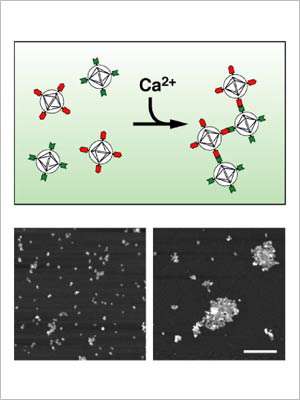
Sensing calcium as it flows into neurons following firing can potentially track information flow throughout the brain's circuitry. Now, an MIT team has developed a calcium contrast agent for non-invasive magnetic resonance imaging detection. At top, a schematic shows how nanoparticles coated with two proteins (red and green) form mixed aggregates in the presence of calcium. The bottom panel shows actual sensor particles in the absence (left) or presence (right) of calcium. Image courtesy / Alan Jasanoff, MIT

If you want to see precisely what the 10 billion neurons in a person's brain are doing, a good way to start is to track calcium as it flows into neurons when they fire.

To that end, Alan Jasanoff at the McGovern Institute for Brain Research at MIT has developed a new nano-sized calcium-sensing contrast agent that is detectable by magnetic resonance imaging (MRI) scanners, machines that can be used for detailed noninvasive brain imaging.

The work is reported in the early online edition of the Proceedings of the National Academy of Sciences the week of Sept. 25-29.

In an application known as functional MRI (fMRI), MRI machines are already increasingly used to observe brain functions as people--or animals--undertake various activities like reading or learning. But Jasanoff notes that current fMRI technology has limitations.

"Using conventional fMRI to study the brain is like trying to understand how a computer works by feeling which parts of it are hot because of energy dissipation in different components," said Jasanoff, who also holds appointments as an assistant professor in MIT's Department of Nuclear Science and Engineering, Department of Brain and Cognitive Sciences, and Biological Engineering Division.

The analogy is apt, because fMRI indirectly measures neural activity by detecting changes in blood flow to brain regions with increased energy requirements. But these hemodynamic changes occur several seconds after the neurons actually fire, too slow to study precise neural activity. Further, the spacing of tiny blood vessels limits the spatial resolution of the technique to volumes containing at least 1,000 neurons, too coarse for discrimination of highly specialized functional areas within a brain region.

Calcium, however, provides a direct measure of neural activity because calcium almost instantly enters neurons when they fire, and the faster the rate of firing, the higher the calcium level. Thus, tracking calcium levels in the brain actually follows information flow through the brain's circuitry.

MRI detects changes in magnetic properties, so to be visible to MRI, a calcium contrast agent must include a magnetically active "paramagnetic" component.

So Jasanoff designed the new sensor to incorporate so-called "superparamagnetic nanoparticles"--extra-strength molecular-sized magnets previously designed for ultrasensitive tumor imaging. They produce large MRI contrast changes capable of producing very high-resolution images.

Jasanoff's sensor is actually made from two similar types of superparamagnetic nanoparticles that stick to each other like Velcro-coated balls when calcium levels rise. This aggregation is reversible, which allows the sensor to indicate the temporal dynamics of calcium-related neural activity, such as the sequence in which populations of cells become active, or the synchronization of neurons during certain behaviors.

Graduate student Tatjana Atanasijevic of nuclear science and engineering, the lead author of the paper, is working on methods to apply the calcium sensor in living brain cells.

The contrast sensors Jasanoff is developing "will be tools for making the shift from imaging gross functional properties of the brain through its hemodynamic changes to a fine-tuned analysis based on information flow involving cells and circuits," he said. "There are many potential applications for studying learning, memory and behavior, and we need the new tools to get to the applications."

Source: MIT


print this article email this article download pdf blog this article bookmark this article     Stumble it Digg this share on Facebook retweet share on Reddit add to delicious
Rate this story - 4.4 /5 (17 votes)


September 28, 2006 all stories

Comments: 0

4.4 /5 (17 votes)
  • Stumble this up

  • Digg this

  • share this

  • hide
  • Related Stories

  • Epilepsy drugs could treat Alzheimer's and Parkinson's
    created Oct 27, 2009 | popularity not rated yet | comments 0
  • Scientists find 'molecular trigger' for sudden death in epilepsy
    created Oct 14, 2009 | popularity not rated yet | comments 0
  • Video camera that records at the speed of thought
    created Oct 12, 2009 | popularity not rated yet | comments 0
  • Calcium channels optimize learning
    created Sep 18, 2009 | popularity not rated yet | comments 0
  • Photoswitches shed light on spontaneous free swimming in zebrafish (w/ Video)
    created Sep 16, 2009 | popularity not rated yet | comments 0


  • hide
  • Relevant PhysicsForums posts

  • Super quick question about Starling forces?
    created Nov 22, 2009
  • Questions about diffusion
    created Nov 22, 2009
  • Human Leukocyte Antigen (HLA) typing
    created Nov 21, 2009
  • Breeding program
    created Nov 20, 2009
  • More from Physics Forums - Biology

Other News

Nanoparticles used in common household items caused genetic damage in mice

Nanotechnology / Bio & Medicine

created Nov 16, 2009 | popularity 4.8 / 5 (24) | comments 11

Titanium dioxide (TiO2) nanoparticles, found in everything from cosmetics to sunscreen to paint to vitamins, caused systemic genetic damage in mice, according to a comprehensive study conducted by researchers at UCLA's Jonsson ...


Nanotube defects equal better energy and storage systems

Nanotube defects equal better energy and storage systems

Nanotechnology / Nanomaterials

created Nov 19, 2009 | popularity 4.4 / 5 (10) | comments 2

(PhysOrg.com) -- Most people would like to be able to charge their cell phones and other personal electronics quickly and not too often. A recent discovery made by UC San Diego engineers could lead to carbon ...


Using superconducting probes to get a picture of what it's like inside CNTs

Nanotechnology / Nanophysics

created Nov 20, 2009 | popularity 4.9 / 5 (8) | comments 0

(PhysOrg.com) -- "Carbon nanotubes are exciting for fundamental physics, and for potential technological applications," Nadya Mason tells PhysOrg.com. "However, we are generally limited in the way that we can study them. ...


New study confirms exotic electric properties of graphene

New study confirms exotic electric properties of graphene

Nanotechnology / Nanomaterials

created Nov 17, 2009 | popularity 4.8 / 5 (23) | comments 1

(PhysOrg.com) -- First, it was the soccer-ball-shaped molecules dubbed buckyballs. Then it was the cylindrically shaped nanotubes. Now, the hottest new material in physics and nanotechnology is graphene: ...


Small optical force can budge nanoscale objects

Small optical force can budge nanoscale objects

Nanotechnology / Nanophysics

created Nov 17, 2009 | popularity 4.8 / 5 (12) | comments 0

(PhysOrg.com) -- Engineering researchers have used a very tiny beam of light with as little as 1 milliwatt of power to move a silicon structure up to 12 nanometers.