Strange Moonlight
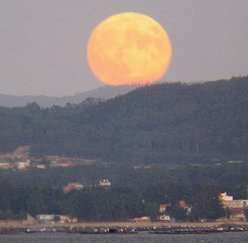
Not so long ago, before electric lights, farmers relied on moonlight to harvest autumn crops. With everything ripening at once, there was too much work to to do to stop at sundown. A bright full moon—a "Harvest Moon"—allowed work to continue into the night.
The moonlight was welcome, but as any farmer could tell you, it was strange stuff. How so? See for yourself. The Harvest Moon of 2006 rises on October 6th, and if you pay attention, you may notice a few puzzling things:
1. Moonlight steals color from whatever it touches. Regard a rose. In full moonlight, the flower is brightly lit and even casts a shadow, but the red is gone, replaced by shades of gray. In fact, the whole landscape is that way. It's a bit like seeing the world through an old black and white TV set.
"Moon gardens" turn this 1950s-quality of moonlight to advantage. White or silver flowers that bloom at night are both fragrant and vivid beneath a full moon. Favorites include Four-O'clocks, Moonflower Vines, Angel's Trumpets—but seldom red roses.
2. If you stare at the gray landscape long enough, it turns blue. The best place to see this effect, called the "blueshift" or "Purkinje shift" after the 19th century scientist Johannes Purkinje who first described it, is in the countryside far from artificial lights. As your eyes become maximally dark adapted, the blue appears. Film producers often put a blue filter over the lens when filming night scenes to create a more natural feel, and artists add blue to paintings of nightscapes for the same reason. Yet if you look up at the full moon, it is certainly not blue. (Note: Fine ash from volcanoes or forest fires can turn moons blue, but that's another story.)
3. Moonlight won't let you read. Open a book beneath the full moon. At first glance, the page seems bright enough. Yet when you try to make out the words, you can't. Moreover, if you stare too long at a word it might fade away. Moonlight not only blurs your vision but also makes a little blind spot.
This is all very strange. Moonlight, remember, is no more exotic than sunlight reflected from the dusty surface of the moon. The only difference is intensity: Moonlight is about 400,000 times fainter than direct sunlight.
So what do we make of it all? The answer lies in the eye of the beholder. The human retina is responsible.
The retina is like an organic digital camera with two kinds of pixels: rods and cones. Cones allow us to see colors (red roses) and fine details (words in a book), but they only work in bright light. After sunset, the rods take over.
Rods are marvelously sensitive (1000 times more so than cones) and are responsible for our night vision. According to some reports, rods can detect as little as a single photon of light! There's only one drawback: rods are colorblind. Roses at night thus appear gray.
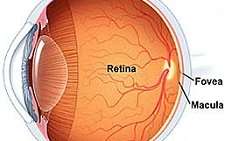
If rods are so sensitive, why can't we use them to read by moonlight? The problem is, rods are almost completely absent from a central patch of retina called the fovea, which the brain uses for reading. The fovea is densely packed with cones, so we can read during the day. At night, however, the fovea becomes a blind spot. The remaining peripheral vision isn't sharp enough to make out individual letters and words.
Finally, we come to the blueshift. Consider this passage from a 2004 issue of the Journal of Vision:
"It should be noted that the perception of blue color or any color for that matter in a purely moonlit environment is surprising, considering that the light intensity is below the detection threshold for cone cells. Therefore if the cones are not being stimulated how do we perceive the blueness?" --"Modeling Blueshift in Moonlit Scenes using Rod-Cone Interaction" by Saad M. Khan and Sumanta N. Pattanaik, University of Central Florida.
The authors of the study went on to propose a bio-electrical explanation--that signals from rods can spill into adjacent blue-sensitive cones under conditions of full-moon illumination (see the diagram, right). This would create an illusion of blue. "Unfortunately," they point out, "direct physiological evidence to support or negate the hypothesis is not yet available."
So there are still some mysteries in the moonlight. Look for them on Oct. 6th under the Harvest Moon.
Source: Science@NASA, by Dr. Tony Phillips


