Improbable 'buckyegg' hatched
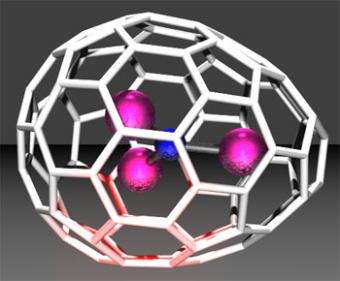
September 28, 2006 Buckyegg (Christine Beavers/graphic)

Buckyegg (Christine Beavers/graphic)

An egg-shaped fullerene, or "buckyball egg" has been made and characterized by chemists at UC Davis, Virginia Tech and Emory and Henry College, Va. The unexpected discovery opens new possibilities for structures for fullerenes, which could have a wide range of uses.

"It was a total surprise," said Christine Beavers, a chemistry graduate student working with Professors Alan Balch and Marilyn Olmstead at UC Davis. Beavers is first author on the paper, published this month in the Journal of the American Chemical Society.

Fullerenes, sometimes called "buckyballs," are usually spherical molecules of carbon, named after the futurist R. Buckminster Fuller, inventor of the geodesic dome. The carbon atoms are arranged in pentagons and hexagons, so their structures can resemble a soccer ball. An important rule -- until now -- is that no two pentagons can touch, but are always surrounded by hexagons.

The "buckyegg" compound was made by collaborating scientists at Virginia Tech, led by Professor Harry Dorn. They heated a mixture of carbon and other ingredients under special conditions to make a mixture of fullerenes, then shipped the products to UC Davis, where Balch's group worked on characterizing their structures.

When Beavers started to map out the structure, she found two pentagons next to each other, making the pointy end of the egg. Initially she thought that the results were a mistake, but she showed the data to Marilyn Olmstead, an expert on X-ray crystallography, and they decided that the results were real. The egg contains a molecule of triterbium nitride inside.

The experiment was actually part of a project to find new, more predictable ways to make fullerenes, Beavers said. The researchers were trying to make fullerenes with atoms of terbium, a metal from the lanthanide series of the periodic table, trapped inside. Metals similar to terbium are used as contrast agents for some medical scanning procedures. By putting these metals inside fullerenes, the researchers hope to make compounds that could be both medically useful and well-tolerated in the body.

Source: University of California - Davis


print this article email this article download pdf blog this article bookmark this article     Stumble it Digg this share on Facebook retweet share on Reddit add to delicious
Rate this story - 4.3 /5 (30 votes)


September 28, 2006 all stories

Comments: 0

4.3 /5 (30 votes)
  • Stumble this up

  • Digg this

  • share this

  • hide
  • Related Stories

  • Carbon molecule with a charge could be tomorrow's semiconductor
    created Sep 08, 2008 | popularity not rated yet | comments 0
  • Organic molecules transport strongest spectral signature of interplanetary dust particles
    created Feb 24, 2005 | popularity not rated yet | comments 0
  • Where do nanomaterials go in the body?
    created Nov 02, 2009 | popularity not rated yet | comments 0
  • Carbon nanoballs as data storage units
    created Sep 01, 2009 | popularity not rated yet | comments 0
  • Scientists Study How to Stack the Deck for Organic Solar Power
    created Jul 28, 2009 | popularity not rated yet | comments 0


  • hide
  • Relevant PhysicsForums posts

  • Polymer Properties Question
    created 18 hours ago
  • Fatigue Properties of Chinese steel
    created Nov 04, 2009
  • Finding Hardness values
    created Nov 04, 2009
  • Fluid flow, pressure drop simulation in Comsol
    created Nov 04, 2009
  • More from Physics Forums - Materials & Chemical Engineering

Other News

New transparent insulating film could enable energy-efficient displays

New transparent insulating film could enable energy-efficient displays

Nanotechnology / Nanomaterials

created 3 hours ago | popularity 4.8 / 5 (5) | comments 0

Johns Hopkins materials scientists have found a new use for a chemical compound that has traditionally been viewed as an electrical conductor, a substance that allows electricity to flow through it. By orienting ...


Ideal nanoparticle cancer therapies surf the bloodstream

Nanotechnology / Bio & Medicine

created 3 hours ago | popularity 5 / 5 (1) | comments 0

Eric Shaqfeh studies blood at Stanford University, using computer models that simulate how the fluid and the cells it contains move around. On November 11 at a meeting of the scientific society AVS, he will present his latest ...


New Digital 'Electronics' Concept May Continue Moore's Law

New Digital 'Electronics' Concept May Continue Moore's Law

Nanotechnology / Nanophysics

created Nov 05, 2009 | popularity 4.6 / 5 (56) | comments 9

(PhysOrg.com) -- Computers of the future could be operating not on electrons, but on tiny waves traveling through an electron "fluid," if a new proposal is successful. The new circuit design, recently introduced ...


Findings show nanomedicine promising for treating spinal cord injuries

Findings show nanomedicine promising for treating spinal cord injuries

Nanotechnology / Bio & Medicine

created Nov 08, 2009 | popularity 4.5 / 5 (4) | comments 0

(PhysOrg.com) -- Researchers at Purdue University have discovered a new approach for repairing damaged nerve fibers in spinal cord injuries using nano-spheres that could be injected into the blood shortly ...


Nanoparticles for gene therapy improve

Nanoparticles for gene therapy improve

Nanotechnology / Bio & Medicine

created Nov 06, 2009 | popularity 5 / 5 (5) | comments 3

(PhysOrg.com) -- About five years ago, Professor Janet Sawicki at the Lankenau Institute in Pennsylvania read an article about nanoparticles developed by MIT's Robert Langer for gene therapy, the insertion ...