Watching how planets form
September 28, 2006 Watching how planets form

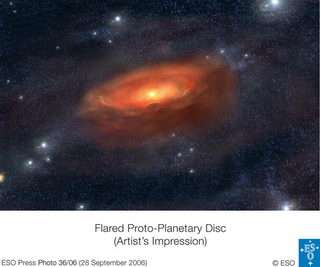
With the VISIR instrument on ESO's Very Large Telescope, astronomers have mapped the disc around a star more massive than the Sun. The very extended and flared disc most likely contains enough gas and dust to spawn planets. It appears as a precursor of debris discs such as the one around Vega-like stars and thus provides the rare opportunity to witness the conditions prevailing prior to or during planet formation.

"Planets form in massive, gaseous and dusty proto-planetary discs that surround nascent stars. This process must be rather ubiquitous as more than 200 planets have now been found around stars other than the Sun," said Pierre-Olivier Lagage, from CEA Saclay (France) and leader of the team that carried out the observations. "However, very little is known about these discs, especially those around stars more massive than the Sun. Such stars are much more luminous and could have a large influence on their disc, possibly quickly destroying the inner part."

The astronomers used the VISIR instrument on ESO's Very Large Telescope to map in the infrared the disc surrounding the young star HD 97048. With an age of a few million years, HD 97048 belongs to the Chameleon I dark cloud, a stellar nursery 600 light-years away. The star is 40 times more luminous than our Sun and is 2.5 times as massive.

The astronomers could only have achieved such a detailed view due to the high angular resolution offered by an 8-metre size telescope in the infrared, reaching a resolution of 0.33 arcsecond. They discovered a very large disc, at least 12 times more extended than the orbit of the farthest planet in the Solar System, Neptune. The observations suggest the disc to be flared. "This is the first time such a structure, predicted by some theoretical models, is imaged around a massive star," said Lagage.

Such a geometry can only be explained if the disc contains a large amount of gas, in this case, at least as much as 10 times the mass of Jupiter. It should also contain more than 50 Earth masses in dust.

The dust mass derived here is more than thousand times larger than what is observed in debris discs and Kuiper belt-like structures found around older, 'Vega-like' stars, such as Beta Pictoris, Vega, Fomalhaut and HR 4796. The dust around these stars is thought to be produced by collisions of larger bodies. The dust mass observed around HD 97048 is similar to the mass invoked for the (undetected) parent bodies in the more evolved systems. HD 97048's disc is thus most likely a precursor of debris discs observed around older stars.

"From the structure of the disc, we infer that planetary embryos may be present in the inner part of the disc," said Lagage. "We are planning follow-up observations at higher angular resolution with ESO's VLT interferometer in order to probe these regions.‚"

The scientists report their discovery in the 28 September issue of Science Express, the rapid online publication service of the journal Science: "Anatomy of a flaring proto-planetary disc around a young intermediate-mass star", by P.-O. Lagage et al.

Source: European Southern Observatory (ESO)


print this article email this article download pdf blog this article bookmark this article     Stumble it Digg this share on Facebook retweet share on Reddit add to delicious
Rate this story - 3.4 /5 (53 votes)


September 28, 2006 all stories

Comments: 0

3.4 /5 (53 votes)
  • Stumble this up

  • Digg this

  • share this

  • hide
  • Related Stories

  • Discovery of dwarf galaxy a big find for astronomy team
    created Oct 20, 2009 | popularity not rated yet | comments 0
  • 32 New Exoplanets Found (w/ Video)
    created Oct 19, 2009 | popularity not rated yet | comments 0
  • Sky merger yields sparkling dividends
    created Oct 13, 2009 | popularity not rated yet | comments 0
  • Astronomers unveil an amazing, interactive, 360-degree panoramic view of the entire night sky
    created Sep 14, 2009 | popularity not rated yet | comments 0
  • NGC 4945: The Milky Way's not-so-distant Cousin
    created Sep 02, 2009 | popularity not rated yet | comments 0


  • hide
  • Relevant PhysicsForums posts

  • The shape of our solar system's orbits.
    created Nov 07, 2009
  • Above or Below the Line of Nodes
    created Nov 07, 2009
  • Supernova vs. Nova?
    created Nov 07, 2009
  • Supernova's Gamma Rays and Comets
    created Nov 06, 2009
  • More from Physics Forums - General Astronomy

Other News

Planetary Society plans new 'solar sail'

Space & Earth / Space Exploration

created 18 minutes ago | popularity not rated yet | comments 0

(AP) -- Four years after its first solar sail ended up in the ocean instead of orbit, The Planetary Society announced Monday that by the end of 2010 it will try again to launch a spacecraft that will be propelled by the ...


Australian scientists call for urgent 'global cooling' to save coral reefs

Space & Earth / Environment

created 58 minutes ago | popularity not rated yet | comments 0

(PhysOrg.com) -- Australian marine scientists have issued an urgent call for massive and rapid worldwide cuts in carbon emissions, deep enough to prevent atmospheric CO2 levels rising to 450 parts per million (ppm).


L-R: Chiwetel Ejiofor, Amanda Peet and John Cusack at the premiere of "2012"

NASA on crusade to debunk 2012 apocalypse myths

Space & Earth / Space Exploration

created 5 hours ago | popularity not rated yet | comments 0

The world is not coming to an end on December 21, 2012, the US space agency insisted Monday in a rare campaign to dispel widespread rumors fueled by the Internet and a new Hollywood movie.


Antarctica glacier retreat creates new carbon dioxide store

Antarctica glacier retreat creates new carbon dioxide store

Space & Earth / Earth Sciences

created 10 hours ago | popularity 4.3 / 5 (3) | comments 0

Large blooms of tiny marine plants called phytoplankton are flourishing in areas of open water left exposed by the recent and rapid melting of ice shelves and glaciers around the Antarctic Peninsula. This ...


NASA satellites see Ida spreading out before landfall

NASA satellites see Ida spreading out before landfall

Space & Earth / Earth Sciences

created 1hour ago | popularity not rated yet | comments 0

NASA's Aqua and Terra satellites are keeping a close eye on Tropical Storm Ida, and both have instruments aboard that show her clouds and rains are already widespread inland over the U.S. Gulf coast states. ...