MIT laser method unveils ultrafast photochemical reactions
MIT researchers have made a fundamental advance in understanding how different environments affect chemical reactions by devising a novel way to observe ultrafast photochemical reactions--reactions induced by a pulse of laser light--in crystals.
The new MIT experiments show that the reaction dynamics, including whether the product molecules remain or recombine to reform the original compound, depend with exquisite sensitivity on the local "cage" environment formed by neighboring molecules in the crystal. Cage effects of this sort play crucial roles in many natural and industrial chemical processes.
The method they have developed allows them to observe other light-induced changes in solids, including those used to burn CDs and DVDs. For some materials, these transitions may be reversible, allowing information to be both written and erased.
"This is a very active area of research for both fundamental and practical reasons," said Keith Nelson, MIT professor of chemistry and leader of the team. "What we're able to see, in a simple and direct way, is how different local environments around the reacting species lead to extremely different dynamics and different outcomes."
The work was published in the Aug. 31 online issue of Science. Nelson's co-author on the paper is Peter Poulin, a former graduate student in his lab.
In their experiments, the researchers studied one simple reaction in different crystalline environments. When I3-, a chain of three iodine molecules with a negative charge, is struck with a pulse of ultraviolet light, the chain splits into two fragments--one of one iodine atom and one of two iodine atoms. However, what happens to the products after the initial splitting is wholly dependent on the environment in which the reaction occurs, Nelson and Poulin found.
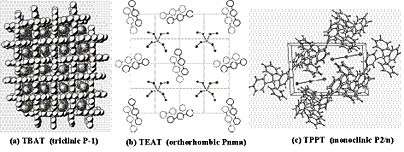
The researchers staged the reaction in three different crystals--one with a round, open cavity in which the separated products could move freely; another where the products were constrained to move within a two-dimensional plane; and another where the products could move in only one dimension, through a linear channel.
In all three crystals, a pulse of light splits the I3- molecule into two fragments almost instantly. But the researchers focused their attention on what happens in the picoseconds (one-millionth of one-millionth of a second) after the initial reaction.
In the crystal with a round, open cavity, the two fragments remain separate, exactly as they would if the reaction occurred in a liquid environment.
"The separate fragments aren't really interacting with each other on a fast time scale," Nelson said.
In contrast, in the more constrained environments of the other two crystals, the two fragments spent some time apart, then abruptly reformed. That suggests that the fragments flew apart but then bounced off the crystal walls and reattached to each other, Nelson said.
"They split up, move apart, crash into the neighboring molecules that form their 'cages,' bounce back, recombine and it's all over," he said. "The entire 'dance' is almost perfectly synchronized among millions of molecules throughout the irradiated region of the crystal."
Conducting such experiments in a crystalline environment proved much more technically challenging than studying reactions in liquids, as is normally done. In liquids, researchers can measure what is happening by firing an initial "excitation" pulse that sets off the reaction, then a "probe" pulse that monitors progress at a particular delay time. The measurement is repeated many times with different probe delays to get data for each point in time. Reaction products can be conveniently replaced with fresh material in between repetitions of the measurement by flowing a stream of reactants in the liquid.
However, the experiments in a crystal cannot be repeated over and over because the reaction products accumulate and cannot be flowed away. In fact, after just a single laser shot, the irradiated region of a crystal was visibly discolored due to the presence of the products.
Instead of repeating the measurement many times, the researchers used only one excitation pulse, then 400 different probe pulses, all arriving with different delays. The probe pulses were formed from one pulse which was passed through a glass echelon (stairstep structure) so that different parts of the beam went through different thicknesses of glass and therefore were delayed by different amounts. That way, all of the necessary data could be gathered from a single measurement.
This allows the effects of the surroundings on reaction dynamics to be studied incisively, unlike in liquids where the reactants have widely varying local environments that give rise to very different dynamics.
"The effects we observed in the different crystals surely occur all the time in liquids and in partially ordered systems like biological media, but directly observing them and comparing them to simple models is normally impossible," according to Nelson.
"What we did is develop a way to get all of the time-dependent data in one shot of the laser," Nelson said. "The method allows us to study ultrafast chemical and structural change even in materials that are permanently altered or destroyed in the measurement. Materials subjected to high-pressure shock waves or other extreme conditions are also in our sights."
Source: MIT


