Einstein's magnetic effect is measured on microscale
September 30, 2006 Einstein's magnetic effect is measured on microscale

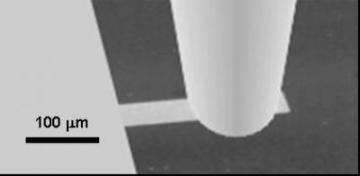
In NIST's Einstein-de Haas experiment, the movements of a cantilever were measured with an optical-fiber laser interferometer. The optical fiber is 125 micrometers in diameter, and the end is positioned less than 10 micrometers from the cantilever surface. Credit: Credit: John Moreland/NIST

A gyromagnetic effect discovered by Albert Einstein and Dutch physicist Wander Johannes de Haas--the rotation of an object caused by a change in magnetization--has been measured at micrometer-scale dimensions for the first time at the National Institute of Standards and Technology.

The new method may be useful in the development and optimization of thin film materials for read heads, memories and recording media for magnetic data storage and spintronics, an emerging technology that relies on the spin of electrons instead of their charge as in conventional electronics.

The Einstein-de Haas effect was first observed in experiments reported in 1915, in which a large iron cylinder suspended by a glass wire was made to rotate by an alternating magnetic field applied along the cylinder's central axis. By contrast, the NIST experiments, described in the Sept. 18 issue of Applied Physics Letters, measured the Einstein-de Haas effect in a ferromagnetic thin film only 50 nanometers thick deposited on a microcantilever--a tiny beam anchored at one end and projecting into the air. An alternating magnetic field induced changes in the magnetic state of the thin film, and the resulting torque bent the cantilever up and down by just a few nanometers.

Using a laser interferometer to measure the movements of the cantilever and comparing those data to changes in the magnetic state of the material, researchers were able to determine the "magnetomechanical ratio," or the extent to which the material twists in response to changes in its magnetic state. The magnetomechanical ratio is related to another important parameter, the "g-factor," a measure of the internal magnetic rotation of the electrons in a material in a magnetic field.

The magnetomechanical ratio and the g-factor are critical in understanding magnetization dynamics and designing magnetic materials for data storage and spintronics applications, but they are extremely difficult to determine accurately because of many potential complicating effects.

The NIST experiments provide a proof-of-concept for using the Einstein-de Haas effect to determine the magnetomechanical ratio and the related g-factor in thin ferromagnetic films. The researchers note that a number of improvements are possible, such as operating the cantilever system in a vacuum to reduce the effects of any changes in temperature.

Citation: T.M. Wallis, J. Moreland and P. Kabos. 2006. Einstein-de Haas effect in a NiFe film deposited on a microcantilever. Applied Physics Letters. Sept. 18.

Source: National Institute of Standards and Technology


print this article email this article download pdf blog this article bookmark this article     Stumble it Digg this share on Facebook retweet share on Reddit add to delicious
Rate this story - 4.5 /5 (45 votes)


September 30, 2006 all stories

Comments: 0

4.5 /5 (45 votes)
  • Stumble this up

  • Digg this

  • share this

  • hide
  • Related Stories

  • The Stars My Destination
    created Nov 10, 2009 | popularity not rated yet | comments 0
  • NASA on crusade to debunk 2012 apocalypse myths
    created Nov 09, 2009 | popularity not rated yet | comments 0
  • Early scents really do get 'etched' in the brain
    created Nov 05, 2009 | popularity not rated yet | comments 0
  • Drug that increases good cholesterol reduces clogging of arteries
    created Nov 04, 2009 | popularity not rated yet | comments 0
  • Pinning Down Superconductivity to a Single Layer
    created Oct 29, 2009 | popularity not rated yet | comments 0


  • hide
  • Relevant PhysicsForums posts

  • Fresnel Biprism
    created 1hour ago
  • If light has mass, and is a wave...
    created 9 hours ago
  • How do you get a mousetrap car to go forward and then backward?
    created 13 hours ago
  • Expanding Universe
    created 14 hours ago
  • More from Physics Forums - General Physics

Other News

Building a more versatile laser

Building a more versatile laser

Physics / Optics & Photonics

created 2 hours ago | popularity 4.5 / 5 (4) | comments 0

(PhysOrg.com) -- One of the drawbacks associated with using semiconductor lasers is that many of them can only produce a beam of a single wavelength, and can only send that beam in one direction at a time. ...


Measuring Electron Orbitals

Measuring Electron Orbitals

Physics / General Physics

created 4 hours ago | popularity 5 / 5 (3) | comments 0

(PhysOrg.com) -- For the first time, it has been possible to measure electron density in individual molecular states using what is known as the photoelectric effect. Now published in Science, this method repres ...


Scientists demonstrate 'universal' programmable quantum processor

Scientists demonstrate 'universal' programmable quantum processor

Physics / Quantum Physics

created 22 hours ago | popularity 4.7 / 5 (16) | comments 11

Physicists at the National Institute of Standards and Technology have demonstrated the first "universal" programmable quantum information processor able to run any program allowed by quantum mechanics -- th ...


Do we need dark matter?

Do we need dark matter?

Physics / General Physics

created Nov 12, 2009 | popularity 4.2 / 5 (17) | comments 33

It's the biggest problem in physics: the matter we can see in the universe accounts for just five per cent of the observed gravity that holds galaxies together.


The LHC tunnel

Peckish bird briefly downs big atom smasher

Physics / General Physics

created Nov 09, 2009 | popularity 4.2 / 5 (13) | comments 23

A peckish bird briefly knocked out part of the world's biggest atom smasher by causing a chain reaction with a piece of bread, the European Organisation for Nuclear Research (CERN) said Monday.