No Longer Just For Biology, RNA Can Now Be Built Into 3-D Arrays
August 11, 2004
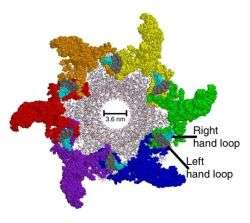
Three dimensional structure of the DNA packaging nanomotor of bacterial virus phi29 that contains six RNA molecules.(PU)

Biomaterial to be girders for nanoscale construction projects

Researchers have coaxed RNA to self-assemble into 3-D arrays, a potential backbone for nanotech scaffolds. These RNA structures can form a wider variety of shapes than double-stranded DNA can and are easier to manipulate than many protein alternatives.

Peixuan Guo of Purdue University and his colleagues report the findings in the August 11, 2004, issue of the journal Nano Letters.

RNA (ribonucleic acid) molecules are best known for implementing the genetic information encoded in DNA (deoxyribonucleic acid). However, instead of using the long molecular strings to carry information, the researchers have achieved new control over RNA and created novel arrays.

By mixing the custom-made RNA strands with other substances, such as magnesium chloride, the researchers were able to get the strands to join into 3-D shapes.

In 1987, Guo discovered that a bacteria-infecting virus possesses a biomolecular nanomotor that requires RNA molecules to function. While determining how RNA works in that motor, he learned to manipulate and control RNA assembly.

Now, Guo and his colleagues have applied that knowledge to building artificial RNA nanostructures, including “large” 3-D arrays formed from identical RNA building blocks. Because these arrays extend to several micrometers, far larger than individual RNA strands, they may potentially link nanofabrication with current microfabrication processes.

The researchers hope that the arrays, while still in the earliest stages of development, will one day serve as the scaffolding on which diagnostic chips, tiny sensors, gene delivery vehicles and other nanoscale devices will be mounted or constructed.

From the researchers:

“Living systems contain a wide variety of nanomachines and ordered structures, including motors, pumps and valves. Our research is devoted to making these machines function outside their native environment.” – Peixuan Guo, Purdue University

“We have discovered a particular type of RNA molecule known as pRNA, or packaging RNA, that forms six-unit rings that can drive a tiny but powerful molecular motor.” – Peixuan Guo

“Our future research will focus on incorporating these nanomachines into nanodevices for such applications as drug or gene delivery, gears for nano-equipment, and intricate arrays and chips for diagnostic devices, sensors and electronics.” – Peixuan Guo
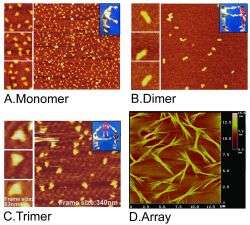
Atomic Force Microscope image showing pRNA as single strands folded into

(a), sets of two strands that form rod shapes (B), sets of three strands that form triangle shapes (C) and multi-strand arrays forming bundles (D). The figures in the insets help illustrate how the RNA molecules in each shape are bonded to each other.

“This report demonstrates that RNA can be used to form a variety of artificial shapes and that we can assemble these shapes into arrays tens of microns in size. Using RNA’s tendency to self-assemble, we have built the arrays from many thousands of connected RNA building blocks. The arrays are stable and resistant to a wide range of environmental conditions, such as temperature, salt concentration, and pH.” – Peixuan Guo

From experts at NSF:

“The discovery of this viral RNA machine is quite remarkable and provides yet another example of the flexibility and versatility of RNA. Dr. Guo is exploiting the properties of RNA in a new and potentially important way.” – Patrick Dennis, Program Director for Microbial Genetics at the National Science Foundation and the officer who oversees Dr. Guo’s award.

For more information see:
Peixuan Guo -- Research Homepage: http://www.vet.pur … /PeixuanGuo/

Source: NSF


Rank not rated yet
Tags

Relevant PhysicsForums posts

More news stories

Harnessing plasmonics, engineers weld nanowires with light

At the nano level, researchers at Stanford have discovered a new way to weld together meshes of tiny wires. Their work could lead to exciting new electronics and solar applications. To succeed, they called ...

Nanotechnology / Nanophysics

created 18 hours ago | popularity 4.8 / 5 (10) | comments 1 | with audio podcast

The right recipe: Engineering research improves laser detectors, batteries

Think of it as cooking with carbon spaghetti: A Kansas State University researcher is developing new ways to create and work with carbon nanotubes -- ultrasmall tubes that look like pieces of spaghetti or string.

Nanotechnology / Nanomaterials

created 16 hours ago | popularity 5 / 5 (7) | comments 0 | with audio podcast

Nanorod-assembled order affects diffusion rate and direction

Some of the recent advancements in nanotechnology depend critically on how nanoparticles move and diffuse on a surface or in a fluid under non-ideal to extreme conditions. Georgia Tech has a team of researchers ...

Nanotechnology / Bio & Medicine

created 16 hours ago | popularity 5 / 5 (2) | comments 0 | with audio podcast

The butterfly effect in nanotech medical diagnostics

Tiny metallic nanoparticles that shimmer in the light like the scales on a butterfly's wing are set to become the color-change components of a revolutionary new approach to point-of-care medical diagnostics, according to ...

Nanotechnology / Bio & Medicine

created 17 hours ago | popularity 5 / 5 (4) | comments 0

Engineers build first sub-10-nm carbon nanotube transistor

(PhysOrg.com) -- Engineers have built the first carbon nanotube (CNT) transistor with a channel length below 10 nm, a size that is considered a requirement for computing technology in the next decade. Not ...

Nanotechnology / Nanophysics

created Feb 01, 2012 | popularity 4.9 / 5 (28) | comments 26 | with audio podcast feature


Nicira promises virtual networks will transform networking

(PhysOrg.com) -- For the past four years, founders of the start-up company Nicira have been developing cutting-edge software that they predict will transform the networking technology underlying the Internet. ...

Navy to begin tests on electromagnetic railgun prototype launcher

The Office of Naval Research (ONR)'s Electromagnetic (EM) Railgun program will take an important step forward in the coming weeks when the first industry railgun prototype launcher is tested at a facility ...

Study of diving beetles suggest sperm evolution may be driven by changes in female reproductive organs

Studying female reproductive tracts and sperm in diving beetles (Dytiscidae), researchers from the University of Arizona and Syracuse University have obtained a glimpse into a bizarre and amazing world of spe ...

Fossil cricket: Jurassic love song reconstructed

Some 165 million years ago, the world was host to a diversity of sounds. Primitive bushcrickets and croaking amphibians were among the first animals to produce loud sounds by stridulation (rubbing certain body parts together). ...

New insight from whole-genome sequencing of Europe's 2011 E. coli outbreaks

Using whole-genome sequencing, a team led by researchers from Harvard School of Public Health (HSPH) and the Broad Institute has traced the path of the E. coli outbreak that sickened thousands and killed over 50 people in Ger ...

Redder ladybirds more deadly, say scientists

A ladybird's colour indicates how well-fed and how toxic it is, according to an international team of scientists. Research led by the Universities of Exeter and Liverpool directly shows that differences between ...