From Shuttle to Orion
October 2, 2006 From Shuttle to Orion

Photo credit: NASA

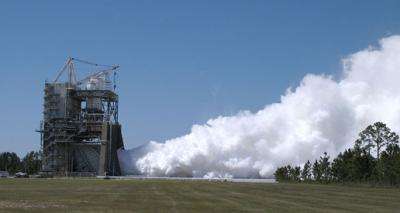
NASA is marking a historic moment in the life of the nation's largest rocket engine test complex. The Stennis Space Center conducted the final space shuttle main engine test on its A-1 Test Stand on Friday, Sept. 29. Although this ends the stand's work on the Space Shuttle Program, it will soon be used for the rocket that will carry America’s next generation human spacecraft, Orion.

The A-1 Test Stand was the site of the first test on a shuttle main engine in 1975. Stennis will continue testing shuttle main engines on its A-2 Test Stand through the end of the Space Shuttle Program in 2010.

The A-1 stand begins a new chapter in its operational history in October. It will be temporarily decommissioned to convert it for testing the J-2X engine, which will power the upper stage of NASA's new crew launch vehicle, the Ares I. The J-2X will also power the Earth departure stage of the Ares V new cargo launch vehicle. The Ares I and V vehicles will provide the thrust, while the Orion crew capsule will be future astronauts’ home in space.

"This is truly an important milestone for Stennis," said Don Beckmeyer, space shuttle main engine project manager in the Test Projects Office of Stennis’ Project Directorate. "As we transition the A-1 Test Stand from testing shuttle main engines to testing J-2X engines, we are entering into some exciting years ahead where our work force and the center as a whole will be key in the development of this new engine. Until the shuttle engines are retired in 2010, we will have two critical test programs running side by side."

Beckmeyer and other engineers have praised the foresight of NASA's early management, whose vision still allows the rugged structures to meet current and future rocket engine testing needs.

"Reaching these milestones is really a testament to the designers and builders of the test stands back in the 1960s," Beckmeyer said. "They were built to last, and their longevity and flexibility are key assets to the agency. We are about to embark on the third generation of rocket engines to be tested on A-1, and we fully expect this test stand to be instrumental in developing and certifying these engines for years to come."

A-1 and its sister stand A-2 were built in the 1960s to test the stages of the Apollo Program's rocket engines, then modified in the 1970s to test-fire and prove flight-worthy all main engines for NASA's space shuttle fleet.

According to Beckmeyer and Gary Benton, Stennis’ J-2X engine project manager, A-1 is set to be reactivated in the spring of 2007.

The J-2X is a modification of the Apollo Program's J-2 engine, which helped send the first Americans to the moon. The original J-2s were also tested at Stennis.

As the A-1 Test Stand moved into the shuttle era, it handled more than 1,000 shuttle main engine tests, which have been crucial to the flight record of the orbiter’s powerful engines. In the 116 launches logged by the shuttle fleet, no main engine has ever experienced a major problem.

Source: NASA


print this article email this article download pdf blog this article bookmark this article     Stumble it Digg this share on Facebook retweet share on Reddit add to delicious
Rate this story - 3 /5 (6 votes)


October 2, 2006 all stories

Comments: 0

3 /5 (6 votes)
  • Stumble this up

  • Digg this

  • share this

  • hide
  • Related Stories

  • New aluminum-water rocket propellant promising for future space missions
    created Oct 07, 2009 | popularity not rated yet | comments 0
  • Used frying oil to power MIT shuttles
    created Sep 23, 2009 | popularity not rated yet | comments 0
  • To the moon, NASA? Not on this budget, experts say
    created Aug 26, 2009 | popularity not rated yet | comments 0
  • Era Ends for Space Shuttle Main Engine Test Program
    created Jul 31, 2009 | popularity not rated yet | comments 0
  • NASA Completes Review Milestone for Ares I First Stage
    created Jun 13, 2008 | popularity not rated yet | comments 0


  • hide
  • Relevant PhysicsForums posts

  • Black hole confusion
    created 20 hours ago
  • Moon tied to Earth
    created Nov 13, 2009
  • Water on the Moon!
    created Nov 13, 2009
  • Is it possible for a single super-massive black hole...
    created Nov 13, 2009
  • More from Physics Forums - General Astronomy

Other News

NASA on track for Monday space shuttle launch (AP)

NASA on track for Monday space shuttle launch

Space & Earth / Space Exploration

created 4 hours ago | popularity not rated yet | comments 0

(AP) -- NASA has cleared space shuttle Atlantis for liftoff Monday on a trip to stock up the International Space Station with several years' worth of spare parts.


Wind power turbines in Dali, in China's southwestern Yunnan province

China tipped as global leader in green tech

Space & Earth / Environment

created 16 hours ago | popularity 3.3 / 5 (3) | comments 5

China can become the world's top exporter of "green technology" if it carries out crucial energy and ecological reforms, leading environmental campaigners said here Saturday.


French Research Institute for Exploitation of the Sea (IFREMER) team prepares to put in water the robot BOB

Underwater robot probes depths for Istanbul quake clues

Space & Earth / Earth Sciences

created 16 hours ago | popularity 4.8 / 5 (4) | comments 0

A state-of-the-art underwater robot called BOB may hold the key to protecting millions of people around Turkey's biggest city against a massive earthquake scientists say is all but inevitable.


LCROSS Impact Data Indicates Water on Moon

LCROSS Impact Finds Water on the Moon

Space & Earth / Space Exploration

created Nov 13, 2009 | popularity 4.9 / 5 (25) | comments 9

(PhysOrg.com) -- The argument that the moon is a dry, desolate place no longer holds water. Secrets the moon has been holding, for perhaps billions of years, are now being revealed to the delight of scientists ...


Controversial new climate change results

Controversial new climate change results

Space & Earth / Environment

created Nov 10, 2009 | popularity 4.1 / 5 (37) | comments 78

(PhysOrg.com) -- New data show that the balance between the airborne and the absorbed fraction of CO2 has stayed approximately constant since 1850, despite emissions of CO2 having risen from about 2 billion ...