Largest 3D Map of Galaxies
October 3, 2006
Largest 3D Map of Galaxies

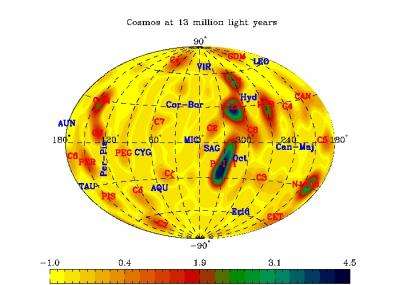
The reconstructed density field, evaluated on a thin shell at 13 million light years. The overdense regions (shown in red) are C6, Perseus (Per), Cd, C?, Ce, C7, C?, Coma (Com), Virgo (Vir), The Great Attractor Clusters [C2, Centaurus (Cen), Pavo-Indus-Telescopium (P-I-T), C8, Hydra (Hyd), C3, C4], Cancer (Can), NGC 1600 (N1600), Cetus (Cet) and C5. The voids (shown in blue) are Aunga (Aun), Taurus (Tau), Perseus-Pisces (Per-Pis), Cygnus (Cyg), Aquarius (Aqu), Corona Borealis (Cor-Bor), Microscopium (Mic), Virgo (Vir), Sagittaurus (Sag), Hydra (Hyd), Octans (Oct), Leo, Eridanus (Erid) and Canis Major (Can - Maj).

A team of American, Australian and British astronomers has released maps from the largest full-sky, three-dimensional survey of galaxies ever conducted.

Their detailed maps show the ‘local’ cosmos out to a distance of 600 million light years, identifying all the major superclusters of galaxies and voids. They also provide important clues regarding the distribution of the mysterious ‘dark matter’ and ‘dark energy’ which are thought to account for up to 96% of the apparent mass of the Universe.

Within this vast volume, the most massive galaxy supercluster is 400 million light years away. It was named after its identifier, the American astronomer Harlow Shapley. The Shapley supercluster is so big that it takes light at least 20 million years to travel from its one end to the other. However, Shapley is not the only massive supercluster in our vicinity.

The Great Attractor supercluster, which is three times closer than Shapley, plays a bigger role in the motion of our Galaxy. According to the team, our Milky Way galaxy, its sister galaxy Andromeda and other neighbouring galaxies are moving towards the Great Attractor at an amazing speed of about a million miles per hour. The researchers also established that the Great Attractor is indeed an isolated supercluster and is not part of Shapley.
Largest 3D Map of Galaxies

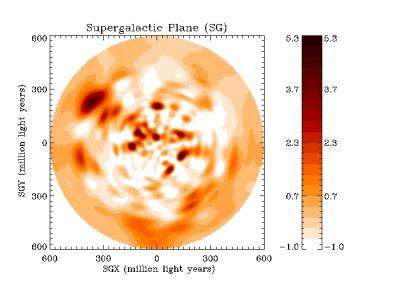
The reconstructed density fields in the supergalactic coordinates (SGX, SGY). In this coordinate system, the equator is aligned with the Virgo Cluster, Great Attractor and Perseus-Pisces superclusters. The main overdensities are Hydra-Centaurus (centre-left), Perseus-Pisces (centre-right), Shapley Concentration (upper left), Coma (upper-middle).

The new maps are based on the observation that, as the Universe expands, the colours of galaxies change as their emitted light waves are stretched or “redshifted”. By measuring the extent of this redshift, astronomers are able to calculate approximate distances to galaxies.

The new survey, known as the 2MASS Redshift Survey (2MRS), has combined two dimensional positions and colours from the Two Micron All Sky Survey (2MASS), with redshifts of 25,000 galaxies over most of the sky. These redshifts were either measured specifically for the 2MRS or they were obtained from an even deeper survey of the southern sky, the 6dF Galaxy Redshift Survey (6dFGS).

The great advantage of 2MASS is that it detects light in the near-infrared, at wavelengths slightly longer than the visible light. The near-infrared waves are one of the few types of radiation that can penetrate gases and dust and that can be detected on the Earth’s surface. Although the 2MRS does not probe as deeply into space as other recent narrow-angle surveys, it covers the entire sky.

Galaxy redshift surveys are only able to detect luminous matter. This luminous matter accounts for no more than a small fraction of the total matter in the Universe. The remainder is composed of a mysterious substance called ‘dark matter’ and an even more elusive component named ‘dark energy’.

“We need to map the distribution of dark matter rather than luminous matter in order to understand large-scale motions in our Universe,” explained Dr. Pirin Erdogdu (Nottingham University), lead author of the paper. “Fortunately, on large scales, dark matter is distributed almost the same way as luminous matter, so we can use one to help unravel the other.”

Her collaborator, Dr. Thomas Jarrett from Caltech, added, “The other advantage of observing in the near-infrared wavelength is the fact that it traces directly the luminous matter, and thus the dark matter, as well.”

“Our nearly two decade effort has produced the absolute best ever map of the nearby Universe,” said Prof. John Huchra of Harvard University. “With this we hope to elucidate the nature and disposition of dark matter and understand much, much more about our cosmological model and about galaxies themselves.”

In order to map the dark matter probed by the survey, the team used a novel technique borrowed from image processing. The method was partly developed by Prof. Ofer Lahav, a co-author of the paper and head of the astrophysics group at University College London. The technique utilizes the relationship between galaxy velocities and the total distribution of mass.

“It is like reconstructing the true street map of London just from a satellite image of London taken at night. The street lights, like the luminous galaxies, act as beacons of the underlying roads,” said Prof. Lahav.

"This extraordinarily detailed map of the Milky Way’s cosmic neighbourhood provides a benchmark against which theories for the formation of structure in the Universe can be tested,” commented Prof. Matthew Colless, director of the Anglo-Australian Observatory and leader of the 6dF Galaxy Survey.

“In the near future, the predicted motions derived from this map will be confronted with direct measurements of galaxies’ velocities obtained by the 6dF Galaxy Survey, providing a new and stringent test of cosmological models.”

The findings are presented in a paper entitled “Reconstructed Density and Velocity Fields from the 2MASS Redshift Survey”, which has been accepted for publication by the journal Monthly Notices of the Royal Astronomical Society. This paper is available on the physics preprint server at: http://arxiv.org/P … /0610005.pdf

Source: University of Nottingham

4.3 /5 (115 votes)  

Rank 4.3 /5 (115 votes)
Tags

Relevant PhysicsForums posts
  • Titan's lack of impact craters
    created8 hours ago
  • Real pictures of black hole eating a star?
    createdFeb 08, 2012
  • Hypothetical way to travel faster than light, but not technically exceed lightspeed
    createdFeb 06, 2012
  • How do scientists monitor the Sun's activity?
    createdFeb 05, 2012
  • Search patterns in observational studies
    createdFeb 05, 2012
  • Derivation of Pogson's law
    createdFeb 03, 2012
  • More from Physics Forums - General Astronomy

More news stories

Deconstructing a mystery: What caused Snowmaggedon?

In the quiet after the storms, streets and cars had all but disappeared under piles of snow. The U.S. Postal Service suspended service for the first time in 30 years. Snow plows struggled to push the evidence ...

Space & Earth / Earth Sciences

created 4 hours ago | popularity 4.7 / 5 (3) | comments 1 | with audio podcast

NASA's TRMM satellite sees Cyclone Jasmine in 3-D

Data from NASA's TRMM satellite was used to create a 3-Dimensional look at Cyclone Jasmine, currently moving through the South Pacific Ocean.

Space & Earth / Earth Sciences

created 2 hours ago | popularity not rated yet | comments 0

Researchers create 3-D laser maps that show how earthquake changes landscape

Geologists have a new tool to study how earthquakes change the landscape down to a few inches, and it's giving them insight into how earthquake faults behave. In the Feb. 10 issue of the journal Science, a team ...

Space & Earth / Earth Sciences

created 6 hours ago | popularity 5 / 5 (2) | comments 0 | with audio podcast

Ocean microbe communities changing, but long-term environmental impact is unclear

As oceans warm due to climate change, water layers will mix less and affect the microbes and plankton that pump carbon out of the atmosphere – but researchers say it's still unclear whether these processes ...

Space & Earth / Earth Sciences

created 6 hours ago | popularity not rated yet | comments 0 | with audio podcast

NASA sees Tropical Storm 12S - a possible threat to Madagascar

The twelfth tropical depression formed in the Southern Indian Ocean today and quickly became a tropical storm, dubbed Tropical Storm 12S. NASA's Aqua satellite passed over the storm and captured infrared data that revealed ...

Space & Earth / Earth Sciences

created 4 hours ago | popularity not rated yet | comments 0


'Dark plasmons' transmit energy

Microscopic channels of gold nanoparticles have the ability to transmit electromagnetic energy that starts as light and propagates via "dark plasmons," according to researchers at Rice University.

Anyone can learn to be more inventive, cognitive researcher says

There will always be a wild and unpredictable quality to creativity and invention, says Anthony McCaffrey, a cognitive psychology researcher at the University of Massachusetts Amherst, because an "Aha moment" is rare and ...

Ultraviolet protection molecule in plants yields its secrets

Lying around in the sun all day is hazardous not just for humans but also for plants, which have no means of escape. Ultraviolet (UV) radiation from the sun can damage proteins and DNA inside cells, leading ...

New method makes culture of complex tissue possible in any lab

Scientists at the University of California, San Diego have developed a new method for making scaffolds for culturing tissue in three-dimensional arrangements that mimic those in the body. This advance, published online in ...

Cell biologists describes mechanism by which some people may be more susceptible to colon cancer

An international research team led by cell biologists at the University of California, Riverside has uncovered a new insight into colon cancer, the third leading cause of cancer-related deaths in the United ...

Hydrogen from acidic water: Researchers develop potential low cost alternative to platinum for splitting water

A technique for creating a new molecule that structurally and chemically replicates the active part of the widely used industrial catalyst molybdenite has been developed by researchers with the Lawrence Berkeley ...