'Killer' B cells provide new link in the evolution of immunity
October 3, 2006 'Killer' B cells provide new link in the evolution of immunity

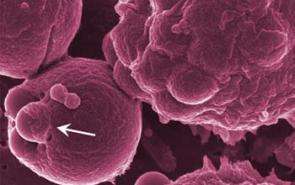
In the adaptive immune system in mammals, B cells produce antibodies to fight infection. In the more-primitive innate immunity in fish, scientists found that B cells take part in a process known as phagocytosis, by which immune system cells ingest foreign particles and microbes. The round cell in the lower left is B-cell ike from a trout. It is in the process of engulfing three latex beads, each (arrow) about 1 micron in diameter. Credit: J. Oriol Sunyer, School of Veterinary Medicine, University of Pennsylvania; image taken with the assistance of R. Meade, Biomedical Imaging Core Laboratory of the School of Medicine, University of Pennsylvania.

Researchers from the University of Pennsylvania School of Veterinary Medicine have discovered a unique evolutionary link between the most primitive innate form of immune defense, which has survived in fish, to the more advanced, adaptive immune response present in humans and other mammals.

The finding, which appears in the online version of the October issue of Nature Immunology, represents an evolutionary step for the mammalian immune system and offers a potential new strategy for developing much-needed fish vaccines.

In the adaptive immune system in mammals, B cells produce antibodies to fight infection. In the more-primitive innate immunity in fish, the scientists found that B cells take part in a process known as phagocytosis, by which immune system cells ingest foreign particles and microbes.

In modern mammals, the B cell is a highly adapted part of the immune system chiefly responsible for, among other things, the creation of antibodies that tag foreign particles and microbes for destruction.

"When examining fish B cells we see them actively attacking and eating foreign bodies, which is a behavior that, according to the current dogma, just shouldn't happen in B cells," said J. Oriol Sunyer, a professor in Penn Vet's Department of Pathobiology and leader of the research team.

The researchers determined that these attack B cells account for more than 30-40 percent of all immune cells in fish, whereas phagocytic cells make up only a small portion of the total number of immune cells in mammals.

According to Sunyer, the findings are important for not only understanding the evolution and function of immune cells in fish but also may point to novel roles of B cells in mammals. Their findings also have an agricultural implication. Vaccines currently given to farmed salmon, for example, appeal to the fish's adaptive immune response, which this research now shows to be a small part of the overall fish immune system.

Source: National Science Foundation


print this article email this article download pdf blog this article bookmark this article     Stumble it Digg this share on Facebook retweet share on Reddit add to delicious
Rate this story - 4.3 /5 (4 votes)


October 3, 2006 all stories

Comments: 0

4.3 /5 (4 votes)
  • Stumble this up

  • Digg this

  • share this

  • hide
  • Related Stories

  • Why fish oils help and how they could help even more
    created Oct 28, 2009 | popularity not rated yet | comments 0
  • Fish fend off invading germs with an initial response similar to the one found in people
    created Sep 24, 2009 | popularity not rated yet | comments 0
  • How HIV cripples immune cells
    created Sep 16, 2009 | popularity not rated yet | comments 0
  • Sea lampreys jettison one-fifth of their genome
    created Jul 20, 2009 | popularity not rated yet | comments 0
  • Dioxins in food chain linked to breastfeeding ills
    created Jun 10, 2009 | popularity not rated yet | comments 0


  • hide
  • Relevant PhysicsForums posts

  • 23 Years in a Vegetative State....or not?
    created Nov 25, 2009
  • Has the H1N1 vaccine been scientifically proven to work?
    created Nov 24, 2009
  • nesfatin
    created Nov 22, 2009
  • Obsessive Compulsive Disorder
    created Nov 20, 2009
  • More from Physics Forums - Medical Sciences

Other News

Coma recovery case attracts doubters

Medicine & Health / Other

created 9 hours ago | popularity 5 / 5 (1) | comments 1

(AP) -- Rom Houben's mother remembers her son's amazement when he finally started communicating again after spending 23 years locked in a paralyzed body that was misdiagnosed as vegetative.


Girl's progress after pioneering brain surgery gives hope to other parents

Medicine & Health / Other

created 10 hours ago | popularity 5 / 5 (3) | comments 0

Lexi Haas is awakening into a world of new possibilities. Miracle by tiny miracle, she is making her body do what she wants -- instead of her body always controlling her. She looked up at her mother a few weeks ago, pursed ...


Physician-scientist proves stem cells heal lungs of newborn animals

Medicine & Health / Research

created 10 hours ago | popularity 5 / 5 (1) | comments 0

Dr. Bernard Thébaud lives in two very different worlds. As a specialist in the Stollery Children's Hospital's Neonatal Intensive Care Unit at the Royal Alexandra Hospital, he cares for tiny babies, many of whom struggle ...


Heavy drinkers exercise to burn off alcohol: British study

Medicine & Health / Health

created 11 hours ago | popularity not rated yet | comments 0

More than a quarter of drinkers in England who exercise regularly do so in an attempt to make up for bingeing on alcohol, according to a survey published Thursday.


WHO says Tamiflu still works against swine flu

Medicine & Health / Medications

created 12 hours ago | popularity not rated yet | comments 0

(AP) -- The World Health Organization says isolated cases of drug-resistant swine flu in Britain and the United States have not changed the agency's assessment of the disease.