Manipulating light with a tiny needle
October 3, 2006 Manipulating light with a tiny needle

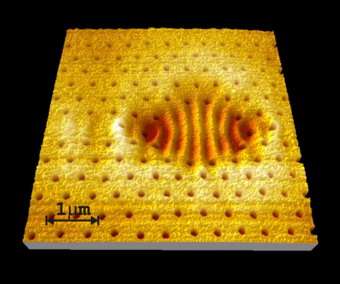
The wave pattern within an optical resonator, mapped by scanning it with an AFM microscope.

Using the tip of an Atomic Force Microscope (AFM), it is possible to map the wave pattern of light, trapped in a so called optical resonator, with unprecedented precision. Apart from that, the AFM is also capable of playing with the light, to optimize the performance of the resonator.

If the optical crystal doesn’t work at the correct colour of light, for example, this mechanical correction works out well. It is even possible to build a mechanical-optical switch in this way. Wico Hopman, a PhD-researcher within the Integrated Optical MicroSystems group of the MESA+ Institute for Nanotechnology (Netherlands), published his results in the online journal Optics Express.

With the AFM-tip, about ten nanometer in size, Hopman is able to manipulate light that is locked up in an optical crystal; a sort of cage in which light is trapped. An optical crystal has a pattern of holes at which all light reflects and comes together in a cavity where no holes are present. In this cavity the light resonates at a specific colour. This makes optical crystal highly suitable to act as selective filters for certain colours of light. Whenever Hopman scans the cavity with the AFM-tip, the light ‘feels’ the presence of the needle, the colour is influenced lightly and the filter is going to do its work for the new colour. In this very precise way, Hopman can demonstrate the way the light is divided in the cavity.

Thanks to this extremely high precision, Hopman can locate the ‘hot spots’ at which he can manipulate the light best. Within these hot spots, the colour can be modified in the best way and also the selectivity of the filter is manipulated: how well will it distinguish one colour from another? If the crystal has small defects, it may not perform optimally, and the AFM-method is capable of compensating for these defects. Building a fast optical-mechanical on/off switch is possible in this way to. The distance the needle has to travel is just some nanometers, this can be done in nanoseconds time.

In this research project, Hopman has closely collaborated with the Biophysical Engineering Group, of the University of Twente as well. This group investigates the properties of fluorescent proteins. Manipulating the light properties of these proteins within an optical crystal could be an interesting option, which is to be investigated into more detail.

Source: University of Twente


print this article email this article download pdf blog this article bookmark this article     Stumble it Digg this share on Facebook retweet share on Reddit add to delicious
Rate this story - 4.4 /5 (49 votes)


October 3, 2006 all stories

Comments: 0

4.4 /5 (49 votes)
  • Stumble this up

  • Digg this

  • share this

  • hide
  • Related Stories

  • Hunting for Planets in the Dark
    created Nov 19, 2009 | popularity not rated yet | comments 0
  • NASA Provides Venerable Hubble Hardware to Smithsonian
    created Nov 19, 2009 | popularity not rated yet | comments 0
  • Gadgets: Digital photo gift ideas
    created Nov 19, 2009 | popularity not rated yet | comments 0
  • Small nanoparticles bring big improvement to medical imaging
    created Nov 18, 2009 | popularity not rated yet | comments 0
  • China Joins Thirty Meter Telescope Project
    created Nov 17, 2009 | popularity not rated yet | comments 0


  • hide
  • Relevant PhysicsForums posts

  • Laser spots
    created 3 hours ago
  • Do you know elementary physics?
    created 5 hours ago
  • Bicycles and their mad skillz
    created 5 hours ago
  • Clarification of doubts on rolling motion
    created 9 hours ago
  • More from Physics Forums - General Physics

Other News

Nanoparticles used in common household items caused genetic damage in mice

Nanotechnology / Bio & Medicine

created Nov 16, 2009 | popularity 4.7 / 5 (23) | comments 11

Titanium dioxide (TiO2) nanoparticles, found in everything from cosmetics to sunscreen to paint to vitamins, caused systemic genetic damage in mice, according to a comprehensive study conducted by researchers at UCLA's Jonsson ...


Using superconducting probes to get a picture of what it's like inside CNTs

Nanotechnology / Nanophysics

created Nov 20, 2009 | popularity 4.9 / 5 (8) | comments 0

(PhysOrg.com) -- "Carbon nanotubes are exciting for fundamental physics, and for potential technological applications," Nadya Mason tells PhysOrg.com. "However, we are generally limited in the way that we can study them. ...


Nanotube defects equal better energy and storage systems

Nanotube defects equal better energy and storage systems

Nanotechnology / Nanomaterials

created Nov 19, 2009 | popularity 4.4 / 5 (10) | comments 2

(PhysOrg.com) -- Most people would like to be able to charge their cell phones and other personal electronics quickly and not too often. A recent discovery made by UC San Diego engineers could lead to carbon ...


New study confirms exotic electric properties of graphene

New study confirms exotic electric properties of graphene

Nanotechnology / Nanomaterials

created Nov 17, 2009 | popularity 4.8 / 5 (23) | comments 1

(PhysOrg.com) -- First, it was the soccer-ball-shaped molecules dubbed buckyballs. Then it was the cylindrically shaped nanotubes. Now, the hottest new material in physics and nanotechnology is graphene: ...


When It Comes to Drug Delivery, Size Matters

Nanotechnology / Bio & Medicine

created Nov 20, 2009 | popularity 5 / 5 (1) | comments 0

(PhysOrg.com) -- One of the great promises of nanotechnologies lies in its ability to create drug-containing nanoparticles decorated with targeting molecules that recognize and bind to cancer cells, providing drug delivery ...