US scientist Roger Kornberg wins Nobel, 47 years after his father
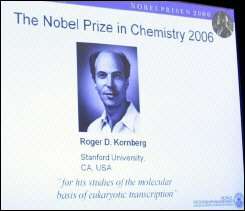
Roger Kornberg of the United States has won the Nobel Chemistry Prize for work on a key process of life called genetic transcription, building on Nobel prizewinning discoveries by his own father.
Kornberg, 59, received the distinction "for his fundamental studies concerning how the information stored in the genes is copied, and then transferred to those parts of the cells that produce proteins", the Royal Swedish Academy of Sciences said in its citation Wednesday.
Understanding the transcription process is vital for coaxing stem cells into different kinds of specific cells -- the dream that, one day, scientists will be able to grow transplant tissue in a lab.
Kornberg's award wraps up a clean sweep for the United States in the Nobel science prizes, with four other Americans taking home the medicine and physics awards earlier this week.
Now a professor at Stanford University School of Medicine, in California, Kornberg was only 12 when he came to Stockholm to see his father, Arthur Kornberg, honoured with the 1959 Nobel Prize for Medicine.
Kornberg senior, 88, was honoured for advancing understanding on how genetic information is transferred from a mother cell to its daughters.
The younger Kornberg's achievement was to portray how the genetic code, DNA, is copied by an enzyme and the copy is then stored in the outer part of the cell.
Like computer software, this copy is then used as an instruction to cellular machinery to make proteins, the molecules that comprise and repair the body's tissues.
The 2006 prize is for "eukaryotic transcription" -- eukaryotes are a biological term for a vast category of organisms whose cells have a well-defined nucleus. Human beings come into this category.
Kornberg was the first to create a molecular picture of how transcription works in eukaryotes, thus providing a snapshot of one of the cornerstone processes of life.
"The truly revolutionary aspect of the picture Kornberg has created is that it captures the process of transcription in full flow," the Nobel jury said.
The pictures are so detailed that separate atoms can be distinguished, showing the cogs that drive the transcription process and regulate it.
"Transcription is necessary for all life," the jury said. Problems with the transcription process are linked to many human illnesses such as cancer, heart disease and various kinds of inflammation.
"If transcription stops, genetic information is no longer transferred into different parts of the body. Since these are no longer renewed, the organism dies within a few days," the jury said.
Kornberg and his father are the sixth father and son to win Nobel prizes.
While the Nobel committee drew a link between their research, Kornberg junior said: "I don't honestly believe there's a connection."
"My father's work was in a very different subject at a very different time... The methods and the direction of the work today is very far removed," he said.
But he said his father had given him his interest in science.
"What I doubtless acquired from him, at least in part, was my passion for science. But beyond that I think the rest is up to each of us as individuals."
His father told AFP he was "very happy that this honour was given by the Nobel committee".
"They take their awards very seriously and I felt for a long time that my son Roger deserved that kind of recognition."
The 2006 laureate will receive a gold medal and a cheque for 10 million Swedish kronor (1.07 million euros, 1.37 million dollars) at the formal prize ceremony. This is held, as tradition dictates, on December 10, the anniversary of the death in 1896 of the prize's creator, Alfred Nobel.
On Monday, the Medicine Prize went to US research duo Andrew Fire and Craig Mello for their discovery of how to silence malfunctioning genes, a breakthrough which could lead to an era of new therapies to reverse crippling diseases.
And on Tuesday the Physics Prize went to US space scientists John Mather and George Smoot for a pioneering space mission which supports the "Big Bang" theory about the origins of the Universe.
The winners of the Economics Prize, the Literature Prize and the Peace Prize will all be announced next week.
Dad's Nobel Prize 'had no influence on my work': Kornberg
This year's winner of the Nobel Chemistry Prize, Roger Kornberg of the United States, said Wednesday that his father's 1959 Nobel Medicine Prize had had no influence on his work but recognized that his dad had given him his interest in science.
"I can't really say that his receiving the prize had a direct influence," Roger Kornberg told Swedish public radio Wednesday, just minutes after being informed that he had won the coveted award.
"What I doubtless acquired from him, at least in part, was my passion for science. But beyond that I think the rest is up to each of us as individuals," he said.
"I wanted to be a scientist for as long as I could remember, from before he won the prize and for my entire period of education and work in science to this time," Roger Kornberg said.
Yet the Nobel committee made a direct link between the two in its citation Wednesday, noting that Kornberg, now 59 and a professor at Stanford University School of Medicine, was just 12 when he came to Stockholm to see his father accept the prestigious award at a gala ceremony.
Arthur Kornberg was honored for advancing understanding on how genetic information is transferred from a mother cell to its daughters.
The younger Kornberg's achievement was to portray how the genetic code, DNA, is copied by an enzyme and the copy is then stored in the outer part of the cell, in a process called transcription.
The newest Nobel laureate in the family insisted however that the work of father and son was very different.
"I don't honestly believe there's a connection. My father's work was in a very different subject at a very different time... The methods and the direction of the work today is very far removed," he said.
Asked how he had reacted to the telephone call from the Nobel committee informing him of the prize, he said he was "simply stunned."
"I'm still shaken by it, I must tell you. It's difficult to describe."
"My first thought is of all those who participated in this and made it possible. I have so many gifted and hardworking colleagues and I think I don't need to tell you how much I owe to them," he said.
He said he had been aware that the Nobel Prize was within his reach.
"I was aware it was a possibility but it would have been impossible to expect such a thing," he said.
List of Nobel Chemistry laureates for past 10 years
2006: Roger D. Kornberg (US)
2005: Yves Chauvin (France), Robert H. Grubbs and Richard R. Schrock (US)
2004: Aaron Ciechanover and Avram Hershko (Israel) and Irwin Rose (US)
2003: Peter Agre and Roderick MacKinnon (US)
2002: John Fenn (US), Koichi Tanaka (Japan) and Kurt Wuethrich (Switzerland)
2001: William Knowles, K. Barry Sharpless (US) and Ryoji Noyori (Japan)
2000: Alan Heeger, Alan MacDiarmid (US) and Hideki Shirakawa (Japan)
1999: Ahmed Zewail (Egypt-US)
1998: Walter Kohn (US), John Pople (Britain)
1997: Paul Boyer (US), John E. Walker (Britain), Jens Skou (Denmark)
© 2006 AFP


