Phase diagram of water revised
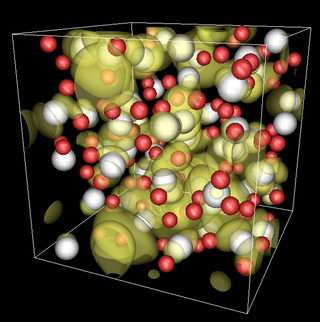
Supercomputer simulations by two Sandia researchers have significantly altered the theoretical diagram universally used by scientists to understand the characteristics of water at extreme temperatures and pressures.
The new computational model also expands the known range of water’s electrical conductivity.
The Sandia theoretical work showed that phase boundaries for “metallic water” — water with its electrons able to migrate like a metal’s — should be lowered from 7,000 to 4,000 kelvin and from 250 to 100 gigapascals.
(A phase boundary describes conditions at which materials change state — think water changing to steam or ice, or in the present instance, water — in its pure state an electrical insulator — becoming a conductor.)
The lowered boundary is sure to revise astronomers’ calculations of the strength of the magnetic cores of gas-giant planets like Neptune. Because the planet’s temperatures and pressures lie partly in the revised sector, its electrically conducting water probably contributes to its magnetic field, formerly thought to be generated only by the planet’s core.
The calculations agree with experimental measurements in research led by Peter Celliers of Lawrence Livermore National Laboratory.
Surprising results were not the intent of Sandia co-investigators Thomas Mattsson and Mike Desjarlais.
“We were trying to understand conditions at [a powerful Sandia accelerator known as] Z,” says Mattsson, a theoretical physicist, “but the problems are so advanced that they hopscotched to another branch of science.”
In July 2007, Z is undergoing an extensive renovation that will increase the machine’s pulse from 20 to 26 million amps — a 30 percent rise. The question to researchers: How will water behave, subjected to these more extreme conditions?
The power Z emits in X-rays when it fires is equivalent to many times the entire world’s generation of electricity — but only for a few nanoseconds. The machine creates high temperatures and pressures in water because of the 20-million-amp electrical pulses it sends through a row of water switches. First, the water acts as an insulator, restraining the incoming electric charge. Then, overcome by the buildup, water transmits the pulse, shortening it from microseconds to approximately 100 nanoseconds. This compression in time is a key element of what makes the Z accelerator so powerful.
It is known that so much electricity passing through water vaporizes it, causing surrounding water pressures to rise as the shock wave from vaporization travels outward. But how much is the increase? How big a cavity does the ionized region form to transmit what amounts to a giant spark? And what are the best sizes for these channels, and for the switches themselves, to optimize the transmission of electrical pulses in future upgrades?
“The concern was that ZR [Z Refurbishment] or its successors might go beyond the ability of a water switch to function as designed and carry the required current,” says Keith Matzen, director of Sandia’s Pulsed Power Sciences Center. “More efficient, larger machines may run into a limit and their switches not meet design requirements. So the question is, how does a water switch really work from first principles?”
One aspect of this knowledge is to model water to get a better understanding of its behavior under these extreme conditions, he says.
Mattsson and Desjarlais first found the standard water-phase diagram out of whack when they ran an advanced quantum molecular simulation program on Sandia’s Thunderbird supercomputer that included “warm” electrons instead of unrealistic cold ones, says Desjarlais.
The molecular modeling code VASP (Vienna Ab-initio Simulation Package), based on density functional theory (DFT), was written in Austria. Desjarlais extended it to model electrical conductivity and Mattsson developed a model for ionic conductivity based on calculations of hydrogen diffusion. An accurate description of water requires this combined treatment of electronic and ionic conductivity.
The adaptation of VASP to high-energy-density physics (HEDP) work at Sandia was motivated by earlier experimental measurements of the conductivity of exploding wires by Alan DeSilva at the University of Maryland. DeSilva found a considerable disparity between his data and theoretical models of materials in the region of phase space called warm dense matter. Desjarlais’ early VASP conductivity calculations immediately resolved the discrepancy. In recent years, a team of Sandia researchers has been extending one of Sandia’s own DFT codes (Socorro) to go beyond the capabilities of VASP for HEDP applications.
“Mike [Desjarlais] was the first to pioneer this capability for warm dense matter six years ago,” says Sandia manager Tom Mehlhorn, “and Mattsson has come on to be a near-perfect complement as the work enters more complex areas.”
As it turns out, the newly discovered regime will not adversely affect Sandia’s water switches on ZR. But water switches not yet designed for future upgrades may require the more accurate understanding of the phases of water discovered by the Sandia researchers.
Because of Z’s success in provoking fusion neutrons from deuterium pellets, it is thought of as a possible (if dark-horse) contender in the race for high-yield controlled nuclear fusion, which would provide essentially unlimited power to humanity.
Z is immediately useful for US defense purposes — data from its firing is used to validate physics models in computer simulations that are used to certify the safety and reliability of the US nuclear weapons stockpile.
The work on water phases was initially published July 7 in Physical Review Letters and most recently reported at the 12th International Workshop on the Physics of Non-Ideal Plasmas, held in Darmstadt, Germany.
Source: Sandia National Nuclear Laboratories


