Arctic sea ice declines again in 2006, researchers say
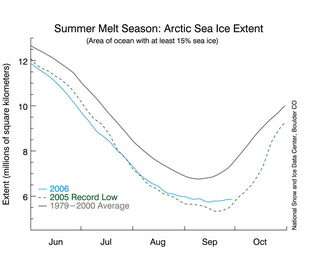
While cool August temperatures prevented sea ice in the Arctic from reaching its lowest summer extent on record, 2006 continued a pattern of sharp annual decreases due to rising temperatures probably caused by greenhouse warming, according to University of Colorado at Boulder researchers.
The latest measurements indicate the Arctic sea ice minimum reached on Sept. 14 was the fourth lowest on record in 29 years of satellite record-keeping, said CU-Boulder Research Professor Mark Serreze of the CU-Boulder's National Snow and Ice Data Center. The ice has been declining at about 8.6 percent per decade, or at about 23 million square miles per year -- an area more than half the size of Ohio, he said.
The sea ice extent is the total area of all artic regions where ice covers at least 15 percent of the ocean surface, Serreze said.
The record low, which occurred in 2005, was marked by an extent of sea ice 20 percent lower than the average ice extent from 1978 to 2001, or a 500,000 square-mile decrease equal to an area about twice the size of Texas, the team reported. The 2006 low is about 400,000 square miles less than the average, the research group said.
"If fairly cool and stormy conditions hadn't appeared in August and slowed the rate of summer ice loss, I feel certain that 2006 would have surpassed last year's record low for September sea ice," said Serreze.
"At this rate, the Arctic Ocean will have no ice in September by the year 2060," said CU-Boulder researcher Julienne Stroeve of NSIDC, which is part of the Cooperative Institute for Research in Environmental Sciences, a joint institute of CU-Boulder and the National Oceanic and Atmospheric Administration. "The loss of summer sea ice does not bode well for species like the polar bear, which depend on the ice for their livelihood."
Average air temperatures across most of the Arctic Ocean from January 2006 to August 2006 were about 2 degrees to 7 degrees Fahrenheit warmer than the long-term average across the region over the past 50 years, the team said.
Ice extent from January to the middle of July 2006 was well below 2005 conditions and was consistent with the unusually warm air temperatures scientists have been tracking in the arctic in recent years, said Serreze. High winter temperatures contributed to limited ice growth, and much of the ice that did form was thinner than normal. "Unusually high temperatures through most of July then fostered rapid melt," he said.
The arctic "heat wave" broke in August and slowed the melt, and storm conditions led to wind patterns that helped spread existing ice over a larger area, Serreze said. But in September temperatures returned to above-normal patterns, which has meant a slow recovery from last month's minimum and indicates the sea ice extent this month could set a new record for the lowest October minimum.
One of the most notable features of the 2006 season was the development of a large polynya -- an area of persistent open water surrounded by sea ice -- that is visible north of Alaska, said Walt Meier of CU-Boulder's NSIDC. Calculations show that in early September, the polynya was the size of the state of Indiana, a huge feature never seen in the Arctic before, Meier said.
How it formed it still not clear, although unusual wind patterns might have forced the ice cover to spread apart, Meier speculated. The team also hypothesized that that thin ice moved into the area over the winter, melting out over the summer and creating the polynya. Warm ocean waters may also have risen to the surface in recent months, helping to melt the ice, Meier said.
While the polynya is not directly attributable to greenhouse warming, continued weakening and thinning of sea ice with increased warming could make such features more common in the future, said Meier.
According to CU-Boulder scientist Ted Scambos, sea-ice melting in response to rising temperatures creates a positive feedback loop. "Melting ice means more of the dark ocean is exposed, allowing it to absorb more of the sun's energy, further increasing air temperatures, ocean temperatures, and ice melt," he said. "It seems that this feedback, which is a major reason for the pronounced effects of greenhouse warming in the arctic, is really starting to kick in."
The research team used satellite data from NASA, NOAA and the U.S. Department of Defense, as well as data from Canadian satellites and weather observatories for the study.
"I'm not terribly optimistic about the future of the ice," Serreze said. "As greenhouse gases continue to rise, the Arctic will continue to lose its ice. You just can't argue with the physics."
Source: University of Colorado at Boulder


