Method could help carbon nanotubes become commercially viable
October 4, 2006 Method could help carbon nanotubes become commercially viable

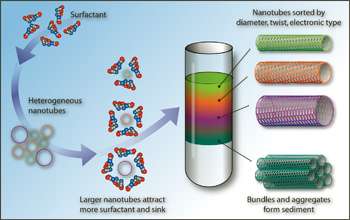
Single-walled carbon nanotubes are coated in soap-like molecules called surfactants, then spun at tens of thousands of rotations per minute in an ultracentrifuge. The resulting density gradient sorts the nanotubes according to diameter, twist and electronic structure. Credit: Zina Deretsky (adapted from Arnold et al.), NSF

Carbon nanotubes are intriguing new materials which have been highly touted for their exceptional mechanical, thermal, optical and electrical properties.

Researchers worldwide are striving to apply these nanostructures in electronics, high-resolution displays, high-strength composites and biosensors. A fundamental problem relating to their synthesis, however, has limited their widespread use.

Current methods for synthesizing carbon nanotubes produce mixtures of tubes that differ in their diameter and twist. Variations in electronic properties arise from these structural differences, resulting in carbon nanotubes that are unsuitable for most proposed applications.

Now, a new method developed at Northwestern University for sorting single-walled carbon nanotubes promises to overcome this problem. The method works by exploiting subtle differences in the buoyant densities of carbon nanotubes as a function of their size and electronic behavior. The results will be published online Wednesday, Oct. 4, in the inaugural issue of the journal Nature Nanotechnology (October 2006).

"Carbon nanotubes, because of their ultra-small size and excellent materials properties, have excited the scientific community for the last decade," said Mark Hersam, professor of materials science and engineering at Northwestern's McCormick School of Engineering and Applied Science, who led the research team.

"However, due to their inherent heterogeneity, they have not yet realized their full commercial potential," he said. "A scalable and economical method for producing monodisperse carbon nanotubes will enable the proposed applications for these nanomaterials to be explored at an industrially relevant scale."

Using the Northwestern method, carbon nanotubes first are encapsulated in water by soap-like molecules called surfactants. Next, the surfactant-coated nanotubes are sorted in density gradients which are spun at tens of thousands of rotations per minute in an ultracentrifuge. By carefully choosing the surfactants utilized during ultracentrifugation, the researchers found that carbon nanotubes could be sorted by diameter and electronic structure.

As a part of their study, the researchers demonstrated the fabrication of electrical devices that displayed either semiconducting or metallic behavior, depending on the sorted nanotubes used. The researchers also maintain that their technique can be translated to an industrial scale.

"The technique is especially promising for commercial applications," said Hersam, "because large-scale ultracentrifuges have already been developed and shown to be economically viable in the pharmaceutical industry. We anticipate that this precedent can be straightforwardly translated to the production of monodisperse carbon nanotubes."

Source: Northwestern University


print this article email this article download pdf blog this article bookmark this article     Stumble it Digg this share on Facebook retweet share on Reddit add to delicious
Rate this story - 4.4 /5 (57 votes)


October 4, 2006 all stories

Comments: 0

4.4 /5 (57 votes)
  • Stumble this up

  • Digg this

  • share this

  • hide
  • Related Stories


  • hide
  • Relevant PhysicsForums posts

  • Theoretical air URGENT
    created 10 hours ago
  • photoconductivity of polymers
    created Nov 25, 2009
  • Heat pipe for high temperature
    created Nov 24, 2009
  • Robot built out of acrylic
    created Nov 24, 2009
  • More from Physics Forums - Materials & Chemical Engineering

Other News

Nanowire Formation

Nanowires key to future transistors, electronics

Nanotechnology / Nanophysics

created 11 hours ago | popularity 4.8 / 5 (5) | comments 1

(PhysOrg.com) -- A new generation of ultrasmall transistors and more powerful computer chips using tiny structures called semiconducting nanowires are closer to reality after a key discovery by researchers ...


Nanotube defects equal better energy and storage systems

Nanotube defects equal better energy and storage systems

Nanotechnology / Nanomaterials

created Nov 19, 2009 | popularity 4.4 / 5 (10) | comments 2

(PhysOrg.com) -- Most people would like to be able to charge their cell phones and other personal electronics quickly and not too often. A recent discovery made by UC San Diego engineers could lead to carbon ...


Water droplets direct self-assembly process in thin-film materials

Nanotechnology / Nanomaterials

created Nov 23, 2009 | popularity 5 / 5 (4) | comments 2

You can think of it as origami - very high-tech origami. Researchers at the University of Illinois have developed a technique for fabricating three-dimensional, single-crystalline silicon structures from thin films by coupling ...


Using superconducting probes to get a picture of what it's like inside CNTs

Nanotechnology / Nanophysics

created Nov 20, 2009 | popularity 4.4 / 5 (9) | comments 0

(PhysOrg.com) -- "Carbon nanotubes are exciting for fundamental physics, and for potential technological applications," Nadya Mason tells PhysOrg.com. "However, we are generally limited in the way that we can study them. ...


Fast, easy, and highly sensitive arsenic detection with gold nanoparticles

Nanotechnology / Nanomaterials

created Nov 25, 2009 | popularity 5 / 5 (1) | comments 0

(PhysOrg.com) -- Mention of arsenic poisoning usually brings to mind underhanded murder. However, the danger of arsenic poisoning from contaminated drinking water is far greater. Low concentrations of arsenic are found in ...