Why can't a woman bid more like a man? U-M study asks
Henry Higgins isn't the only one to wonder why a woman can't be more like a man. A University of Michigan study contributes a new answer to the age-old question, adding to the debate on gender differences and the extent to which biology shapes destiny.
Part of a program of work funded by the National Science Foundation, the experiments were based on auction models commonly used in economic game theory that assess both tolerance for risk and ability to figure out the strategy likely to result in the greatest possible earnings.
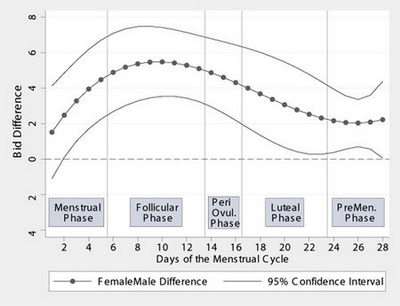
The study finds that women bid about 5 percent more than men, on average, in experimental first-price sealed bid auctions. As a result, women earned 39 percent less than men over the course of the experiment. In this type of auction, all bidders simultaneously submit sealed bids so that no bidder knows the bid of any other participant. The highest bidder gets the object and pays the price she submitted.
The findings of a gender gap are consistent with other research showing that women are more risk averse than men in competitive bidding situation.
But the study also finds that the gender gap in competitive bidding disappears during certain times of the month.
"We found that during menstruation, when levels of estrogen are the lowest, women do not bid any differently from men," said Yan Chen, research professor at the U-M Institute for Social Research (ISR). "The gender difference in bidding is driven by the behavior of women in other phases of their menstrual cycles, which are associated with higher levels of sex hormones."
Chen, who is also an associate professor at the U-M School of Information, and colleagues Peter Katuscak of Prague's Charles University and Emre Ozdenoren, a U-M economist, conducted the experiments in a networked computer laboratory at ISR. They ran 40 experimental sessions, each consisting of 30 rounds. In the sessions, 400 undergraduate and graduate students from a wide range of disciplines, excluding economics, were randomly assigned as bidders or auctioneers.
In each round, a group of participants bid on an abstract object with a randomly assigned value, and the winning bidder received the difference between the assigned value and the bid. The points were converted to cash at a fixed exchange rate. Each session of 30 rounds lasted from 40 minutes to an hour and the average earning was $15.36. The average earning of men was $18.14, and the average earning of women was $12.28.
After the experimental session, each participant filled out a questionnaire that inquired about demographic information, including gender and race, educational background and menstrual cycle.
"Our experimental results are consistent with findings from survey data showing that women tend to make safer choices than men," Chen said. Even when the researchers controlled for educational background, including the number of math, statistics, economics and other science courses taken, the gender difference remained for women at stages in their menstrual cycles linked with higher levels of estrogen and progesterone.
Chen, who has been invited to present her findings at the annual meeting of the Allied Social Science Association early next year, sees the research as part of the new wave of behavioral economics.
"It used to be that neoclassical economists saw economic behavior as perfectly rational," she said. "But now, the reunion of economics and psychology clearly shows that people's economic choices are affected by factors not included in neoclassical models, such as menstrual phases.
"We weren't looking for this effect, but the results are there, robust to our methods of analysis. Women bid significantly more than men in the first price auction during menstrual phases characterized by high levels of sex hormones, so they wound up earning less than men."
To Chen, the findings that menstrual cycle affects economic decision-making in a systematic way have some important practical implications: Women should take their menstrual cycles into account when engaging in competitive economic activities. "Simply know that you're likely to take less risks at certain points in your cycle is important," she said. "If you're in a competitive situation, such as engaging in negotiations, for example, it's probably wise to do so during or right after menstruation."
Chen also believes that high-stakes, standardized tests should be offered at various times, giving women the opportunity to select the optimal time of the month to take them.
But Chen cautions that no matter a woman's age or hormonal status, biology is just one of many factors that influence one's tolerance for taking risks and likelihood of making sound economic decisions. At least as important are education, experience, personality and cultural issues.
Source: University of Michigan


