Chandra reviews black hole musical: Epic but off-key
October 5th, 2006 Chandra reviews black hole musical: Epic but off-key

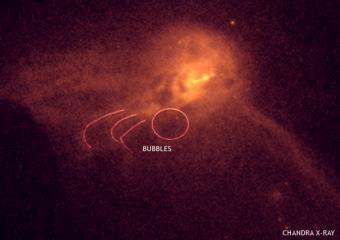
A long Chandra exposure of M87 has revealed a shock wave in high-energy X-rays as well as evidence for a series of outbursts from the central supermassive black hole. The image shows a series of loops and bubbles in the hot, X-ray emitting gas. These are relics of small outbursts from close to the black hole. Other remarkable features are seen in M87 for the first time including narrow filaments of X-ray emission, which may be due to hot gas trapped to magnetic fields. One of these filaments is over 100,000 light years long, and extends below and to the right of the center of M87 in almost a straight line. Credit: NASA/CXC/CfA/W.Forman et al.

A gigantic sonic boom generated by a supermassive black hole has been found with NASA's Chandra X-ray Observatory, along with evidence for a cacophony of deep sound.

This discovery was made by using data from the longest X-ray observation ever of M87, a nearby giant elliptical galaxy. M87 is centrally located in the Virgo cluster of galaxies and is known to harbor one of the Universe's most massive black holes.

Scientists detected loops and rings in the hot, X-ray emitting gas that permeates the cluster and surrounds the galaxy. These loops provide evidence for periodic eruptions that occurred near the supermassive black hole, and that generate changes in pressure, or pressure waves, in the cluster gas that manifested themselves as sound.

"We can tell that many deep and different sounds have been rumbling through this cluster for most of the lifetime of the Universe," said William Forman of the Harvard-Smithsonian Center for Astrophysics (CfA).

The outbursts in M87, which happen every few million years, prevent the huge reservoir of gas in the cluster from cooling and forming many new stars. Without these outbursts and resultant heating, M87 would not be the elliptical galaxy it is today.

"If this black hole wasn't making all of this noise, M87 could have been a completely different type of galaxy," said team member Paul Nulsen, also of the CfA, "possibly a huge spiral galaxy about 30 times brighter than the Milky Way."

The outbursts result when material falls toward the black hole. While most of the matter is swallowed, some of it was violently ejected in jets. These jets are launched from regions close to the black hole (neither light nor sound can escape from the black hole itself) and push into the cluster's gas, generating cavities and sound which then propagate outwards.

Chandra's M87 observations also give the strongest evidence to date of a shock wave produced by the supermassive black hole, a clear sign of a powerful explosion. This shock wave appears as a nearly circular ring of high-energy X-rays that is 85,000 light years in diameter and centered on the black hole.

Other remarkable features are seen in M87 for the first time including narrow filaments of X-ray emission -- some over 100,000 light years long -- that may be due hot gas trapped by magnetic fields. Also, a large, previously unknown cavity in the hot gas, created by an outburst from the black hole about 70 million years ago, is seen in the X-ray image.

"We can explain some of what we see, like the shock wave, with textbook physics," said team member Christine Jones, also of the CfA. "However, other details, like the filaments we find, leave us scratching our heads."

Sound has been detected from another black hole in the Perseus cluster, which was calculated to have a note some 57 octaves below middle C. However, the sound in M87 appears to be more discordant and complex. A series of unevenly spaced loops in the hot gas gives evidence for small outbursts from the black hole about every 6 million years. These loops imply the presence of sound waves, not visible in the Chandra image, which are about 56 octaves below middle C. The presence of the large cavity and the sonic boom gives evidence for even deeper notes -- 58 or 59 octaves below middle C -- powered by large outbursts.

Source: Chandra X-ray Center


print this article email this article download pdf blog this article bookmark this article     Digg this Stumble it share on Facebook share on Reddit add to delicious save to Yahoo! bookmarks
4.5/5 after 22 votes


October 5th, 2006 all stories
Space & Earth / Astronomy

Comments: 0
Rank: 4.5/5 after 22 votes

  • Stumble this up

  • Digg this

  • Share it:
  • share on Facebook
  • share on MySpace
  • share on Slashdot
  • rss-newsfeed
  • share on Google
  • share on Reddit
  • add to delicious
  • save to Yahoo! bookmarks
  • share on Windows Live
  • Add to Mixx!
Rating: 4.5/5 after 22 votes

  • Related Stories

  • VLBA locates superenergetic bursts near giant black hole
    created Jul 02, 2009 | popularity not rated yet | comments 0
  • Computer Finds Massive Black Hole in Nearby Galaxy
    created Jun 09, 2009 | popularity not rated yet | comments 0
  • Hubble Witnesses Spectacular Flaring in Gas Jet from M87's Black Hole
    created Apr 14, 2009 | popularity not rated yet | comments 0
  • Fifty Times sharper than Hubble
    created Oct 05, 2007 | popularity not rated yet | comments 0
  • Physical reality of string theory demonstrated
    created 34 minutes ago | popularity not rated yet | comments 0

Tags


  • Physicists Demonstrate Quantum Memory with Matter Qubits
    Physicists Demonstrate Quantum Memory with Matter Qubits
    Physics / General Physics
    created Jul 03, 2009 | popularity 4.4 / 5 (17) | comments 1
  • 'Holey' Nanosheets for Wastewater Dye Removal
    Nanotechnology / Nanomaterials
    created Jul 01, 2009 | popularity 5 / 5 (5) | comments 1
  • Jellyfish Robot Swims Like its Biological Counterpart
    Jellyfish Robot Swims Like its Biological Counterpart
    Electronics / Robotics
    created Jun 26, 2009 | popularity 4.4 / 5 (8) | comments 1
  • Could Maxwell's Demon Exist in Nanoscale Systems?
    Could Maxwell's Demon Exist in Nanoscale Systems?
    Physics / General Physics
    created Jun 24, 2009 | popularity 4.4 / 5 (18) | comments 29
  • Living Safely with Robots, Beyond Asimov's Laws
    Living Safely with Robots, Beyond Asimov's Laws
    Electronics / Robotics
    created Jun 22, 2009 | popularity 4.6 / 5 (53) | comments 40
  • Other News

    China environmental phenomena monitored from space

    Space & Earth / Earth Sciences

    created 58 minutes ago | popularity not rated yet | comments 0

    China is in a very seismically active area and has had many catastrophic earthquakes during its history. A joint European-Chinese team is using satellite radar data to monitor ground deformation across major continental faults ...


    California to require sun-blocking car windows

    Space & Earth / Environment

    created 2 hours ago | popularity 2.3 / 5 (3) | comments 4

    New cars sold in California must include windshields that block or absorb the sun's rays beginning in 2012, the state's Air Resources Board recently ruled.


    Scientists: Silent tremors may foretell next Big One

    Space & Earth / Earth Sciences

    created 2 hours ago | popularity not rated yet | comments 0

    The seismometer is snugged in its hole and tamped over with dirt. Now it's time for the stomp test.


    Steam billows from the cooling towers at a nuclear power generating station in Byron

    Tropical zone expanding due to climate change: study

    Space & Earth / Earth Sciences

    created 5 hours ago | popularity 3 / 5 (4) | comments 1

    Climate change is rapidly expanding the size of the world's tropical zone, threatening to bring disease and drought to heavily populated areas, an Australian study has found.


    The least sea ice in 800 years

    The least sea ice in 800 years

    Space & Earth / Earth Sciences

    created Jul 01, 2009 | popularity 4.1 / 5 (65) | comments 60

    New research, which reconstructs the extent of ice in the sea between Greenland and Svalbard from the 13th century to the present indicates that there has never been so little sea ice as there is now. The ...