Study Pinpoints Tropics as Biodiversity Spawning Ground
A team of scientists has completed a study that explains why the tropics are so much richer in biodiversity than higher latitudes. And they say that their work highlights the importance of preserving those species against extinction.
"If you came from outer space and you started randomly observing life on Earth, at least before people were here, the first thing you'd see was this incredible profusion of life in the tropics," said the report's lead author, David Jablonski, the William Kenan Jr. Professor in Geophysical Sciences at the University of Chicago. "This is the single most dramatic biodiversity pattern on this planet."
Jablonski and his co-authors, Kaustuv Roy, of the University of California, San Diego, and James Valentine, of the University of California, Berkeley, present their new findings on the origins of this global diversity trend in the Oct. 6 issue of the journal Science.
Why the tropics are so much richer in species and evolutionary lineages than elsewhere on Earth has loomed as one of the largest questions facing biologists for more than a century. Biologists have proposed virtually every possible combination of origination, extinction and immigration to explain the pattern at one time or another. But for the past 30 years, they have tended to view the tropics either as a cradle of diversity, where new species originate, or as a museum of diversity, where old species persist. And no resolution has been in sight.
The fossil data of the past 11 million years has broken this logjam. It shows that it's not an either/or proposition. The new study is the first to amass enough data to dissect the roles of extinction, origination and immigration directly. "I think we've killed the idea that the tropics is either a cradle or a museum of biodiversity. It's both," said Valentine, professor emeritus of integrative biology at UC Berkeley.
As the engine of global biodiversity, the tropics are where new species evolve and persist while spreading to higher latitudes, said Roy, a UCSD biology professor. "The world is connected. It's a global village, even for organisms. Along the California coast here, most of the marine species belong to lineages that originated in the tropics."
The Science study underscores the need to avert a tropical diversity crises, its authors said.
"Human-caused extinctions in the tropics will eventually start to affect the biological diversity in the temperate and high latitudes," Roy said. "This is not going to be apparent in the next 50 years, but it will be a long-term consequence."
Noted Valentine: "We should preserve the tropics, because without them, we've lost a key source for diversity in higher latitudes."
The fossil record indicates that the tropics have enjoyed a richness of biodiversity spanning at least 250 million years. Jablonski compared the population of species on Earth to the population of a modern town. To understand how that population mix came about would entail an examination of birth records, cemetery records and immigration records.
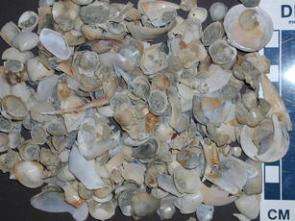
The team acquired its data for the Science study by analyzing bivalves, a class of marine life that includes clams, scallops and oysters. "They live everywhere," Jablonski said. "They're found from the Arctic Ocean to the hottest part of the tropics, and they have left a great fossil record."
This record permitted the team to track more than 150 bivalve lineages back through time and answer a series of key questions: where do they start? How long do they last? Where do they persist? And where do they spread?
As the paleontologists traced the lineages back into geologic time, they found a consistent pattern in each slice of time, regardless of the prevailing climatic conditions. Over the entire 11-million-year period, they found that more than twice as many bivalve lineages started in the tropics than at higher latitudes. Meanwhile, only 30 varieties of organisms that lived only in the tropics went extinct, compared to 107 that lived outside the tropics, or at all latitudes.
"It's a really striking, surprising pattern," Jablonski said. "And it appears that other animals and plants were playing the same game, even on land," now that previous studies are looked at with new eyes.
The three paleontologists began working on the problem more than a decade ago. The first step involved completing a massive standardization of all living and many fossil bivalve species to ensure their consistent and proper classification.
To accomplish the task, Jablonski churned through stacks of monographs, some dating back to the 19th century, and combed drawer after drawer of bivalve specimens in the Smithsonian Institution and other natural history museums in Chicago; London, Brussels, Belgium; and Leiden, The Netherlands.
The forces behind the flood of evolutionary activity that flows from the tropics remain a mystery. "But now that we have a handle on the dynamics that set up this spectacular planet-sized gradient, we can begin to get at the underlying processes in a whole new way," Jablonski said.
Jablonski, Roy and Valentine will attempt to address this and related questions as they push their analysis further back in time.
Source: University of Chicago


