Images develop clinical applications for new DESI technology
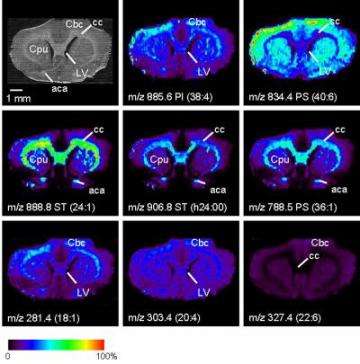
Purdue University researchers have created the first two-dimensional images of biological samples using a new mass spectrometry technique that furthers the technology's potential applications for the detection of diseases such as cancer.
The technology, desorption electrospray ionization, or DESI, measures characteristic chemical markers that distinguish diseased from non-diseased regions of tissue samples within a few seconds and has eliminated the need for samples to be treated with chemicals and specially contained.
This tool has a wide range of applications and could be used in the future to address many medical issues, said Graham Cooks, Purdue's Henry B. Hass Distinguished Professor of Analytical Chemistry in whose lab DESI was developed.
"This technology could be used to aid surgeons in precisely and completely removing cancerous tissue," he said. "With these images, we can see the exact location of tumor masses and can detect cancerous sites that are indistinguishable to the naked eye."
Current surgical methods rely on the trained eye of a pathologist who views stained tissue slices under a microscope to assess what tissue must be removed.
This study was the first to take the graphical data presented by DESI mass spectrometry and turn it into a two-dimensional image of the tissue, said Demian Ifa, a member of Cooks' research team.
"The ability to produce an image is a great advance," he said. "It is much more practical to have an image that can quickly and easily be interpreted. It brings the technology much closer to being ready for the clinical setting."
A paper detailing the study has been selected as a "very important paper" by the journal Angewandte Chemie and is currently posted online. Cooks, Ifa, Justin Wiseman, and Qingyu Song, all from Purdue's Department of Chemistry, authored the paper, which will be featured on the cover of the print publication. Less than 5 percent of the journal's manuscripts earn the very important paper designation, according to the journal.
Several technical papers have been published about DESI experiments since the method was announced two years ago as an alternative to traditional mass spectrometry techniques.
Conventional mass spectrometry requires chemical separations, manipulations of samples and containment in a vacuum chamber for assessment. DESI researchers modified a mass spectrometer, which is commonly used in biological sciences, to speed and simplify the time-consuming and labor-intensive analytical process, Ifa said.
Mass spectrometry works by first turning molecules into ions, or electrically charged versions of themselves, so they have mass and can be detected and analyzed. The DESI procedure does this by positively charging water molecules by spraying a stream of water in the presence of an electric field. These charged molecules contain an extra proton and are called ions. When the charged water droplets hit the surface of the sample being tested, they transfer their extra proton to molecules in the sample, turning them into ions. The ionized molecules are then vacuumed into the mass spectrometer, where the masses of the ions are measured and the material analyzed.
"Through analysis of the abundance of certain ions and mass ratios, the contents of the sample can be identified," Cooks said. "This information can be used to precisely determine the location of cancerous tissue and borders of tumors."
In this study, researchers mapped the distribution of fatty substances called lipids in a rat brain. The team was able to create a high-resolution image with a spatial resolution of less than 500 micrometers, meaning the image distinguishes small details separated by less than 1/100th of an inch. The researchers evaluated the sample by spraying small sections of it with the charged water droplets, obtaining data for each section and then combining the data sets to create an analysis of the sample as a whole, Ifa said. Software was used to map the information and create a two-dimensional image showing the distribution and intensity of selected ions.
The team is now working on the technique to improve the image resolution and has placed an instrument in the Indiana University School of Medicine, Cooks said.
Cooks' research team has also designed and built a portable mass spectrometer using the DESI technology. It is roughly the size of a shoebox and weighs about 40 pounds, compared to around 600 pounds for a conventional mass spectrometer. The portable instrument runs on batteries and can be carried anywhere, allowing the technology to more easily be used for field applications like explosives detection.
Source: Purdue University


