Scientists Determine the Nature of Black Hole Jets
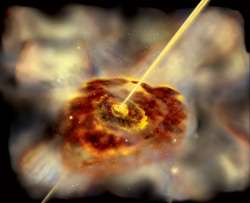
NASA and Italian scientists using Swift have for the first time determined what the particle jets streaming from black holes are made of.
Black hole particle jets are commonly seen in quasars and other celestial objects, shooting off at nearly light speed. According to the Swift team, these jets appear to be made of protons and electrons, solving a mystery as old as the discovery of jets themselves in the 1970s. The jets observed by Swift contain about the mass of Jupiter if it were pulverized and blasted out into intergalactic space.
Black hole particle jets typically escape the confines of their host galaxies and flow for hundreds of thousands of light years. They are a primary means of redistributing matter and energy in the universe. They are a key to understanding galaxy formation and are tied to numerous cosmic mysteries, such as the origin of ultrahigh-energy cosmic rays.
"Black hole jets are one of the great paradoxes in astronomy," said Rita Sambruna of NASA's Goddard Space Flight Center, Greenbelt, Md. "How is it that black holes, so efficient at pulling matter in, can also accelerate matter away at near light speed? We still don't know how these jets form, but at least we now have a solid idea about what they're made of."
The composition of black hole jets has been the topic of heated debate for several decades. Scientists generally agree that the jets must be made either of electrons and their antimatter partners, called positrons, or an even mix of electrons and protons. Recent theoretical and observational advances have pointed in the direction of the latter. The Swift data provides the most compelling evidence to date that the jets must have protons.
Most quasars have jets. A quasar is bright galaxy core fueled by a supermassive black hole containing the mass of millions to billions of suns confined within a region about the size of our solar system. The particle jets, usually in opposing pairs, shoot off perpendicularly from the flat disk of gas that swirls around the black hole.
Sambruna's team, comprising researchers at Goddard and the Merate Observatory, Merate, Italy, studied a type of quasar called a blazar. Blazars are quasars with their particle jets aimed in our direction, as if we are staring down the barrel of the gun. The team studied two blazars, called 0212+735 and PKS 0537-286, both over 10 billion light years away.
Previously, telescopes have not been able to capture much detail of black hole jets in a wavelength region between X-rays and gamma rays, corresponding to an energy range of 10 kiloelectron volts (keV) and above. This range, however, is precisely where Swift is most sensitive.
Sambruna's team found a peak in the detection rate of light particles, called photons, at 10 keV and then a downturn. That is, the number of X-ray photons climbed steadily until 10 keV and then declined. From this information and new computer modeling led by Fabrizio Tavecchio and Gabriele Ghisellini at Merate Observatory, the team could rule out the presence of electron-positron pairs.
The analysis took several steps. The Swift data provided enough information to determine the jet was moving at 99.9 percent light speed and contained 200 billion trillion trillion trillion trillion particles. From this, the scientists could determine the total kinetic energy, which is a first. Comparing the kinetic energy of motion with the radiated energy of light, the scientists could determine the mass of the jet and ultimately its content.
"The jet contains about the same mass as Jupiter, which means the central black hole is like a cannon firing a massive pulverized planet at near light speed clear out of the galaxy," said Tavecchio. "That's an enormous amount of energy leaving the black hole system, and this is happening throughout the universe."
The finding is a major step towards determining how jets are created, a goal for the Gamma-ray Large Area Space Telescope, or GLAST, planned for launch in the fall 2007.
Launched in November 2004, Swift is a NASA mission in partnership with the Italian Space Agency and the Particle Physics and Astronomy Research Council, United Kingdom, and is managed by Goddard. Penn State University, University Park, Pa., personnel control science and flight operations from the Mission Operations Center.
Researchers are presenting their findings today at the High Energy Astrophysics Division of the American Astronomical Society meeting in San Francisco.
Source: by Christopher Wanjek, NASA/Goddard Space Flight Center


