Research to illuminate inner workings of 'protein nanomachines'
Development of new instrumentation and methods for studying the molecular mechanisms of enzymes are the goals of a three-year, $1.5 million contract awarded to Pacific Northwest National Laboratory by the Department of Energy's energy biosciences program.
Enzymes—the protein nanomachines of cells—have potential energy applications such as hydrogen production, fuel cell development and environmental remediation. However, to develop these applications, researchers must fill gaps in the fundamental understanding of enzymatic processes. Redox enzymes, those targeted in the new project, are essential to all life forms because they enable reaction cycles of reduction and oxidation through electron transfer within cells.
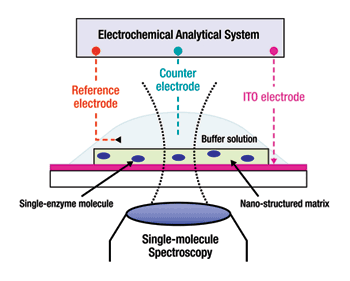
As a first step, PNNL researchers will couple an electrochemical method called "cyclic voltammetry" with single-molecule spectroscopy into a new electrochemical single-molecule spectrometer, or CVSMS. The new equipment will allow dynamic studies of fundamental enzymatic redox reactions.
Enzymes typically are unstable outside the cell, making them hard to study. In earlier work, the PNNL investigators discovered a way to stabilize enzymes and extend their lifespan by entrapping them into a nano-structured matrix.
The enzymes will be stabilized in the nano-structured matrix and then placed inside a miniature electrochemical cell that will deliver controlled electrical currents. As the tiny jolts of electricity affect catalytic reactions of the enzymes, the researchers will observe the single enzyme molecules in action. Using chemical signatures that the CVSMS generates, they will study the catalytic electron transfer processes.
To obtain the necessary enzyme variants, the research team will use a new cell-free process, rather than traditional cellular methods for protein production. The unique robotic instrument can produce up to 384 proteins or protein variants a day.
"We expect insights gained from this research to provide fundamental knowledge needed to understand the role of electron transfer in catalytic reactions," said principal investigator Eric Ackerman, adding that the research could be useful in a number of directions, including bioenergy and environmental remediation.
The research team also includes co-principal investigators Chenghong Lei, Dehong Hu and Chuck Windisch.
Source: PNNL


