Toward Terahertz Detectors on a Single, Conventional Chip
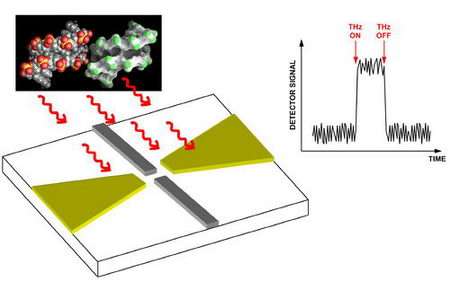
Sensors and detectors that would work in the terahertz range of the electromagnetic spectrum promise a range of tantalizing properties, from precise identification of concealed weapons to the ability to distinguish between different tissue types for disease screening. But because signals in the terahertz range have traditionally been incompatible with conventional microelectronics, this potential has been slow to realize.
Now, University at Buffalo researchers and their collaborators at other institutions have been awarded a four-year, $1.2 million National Science Foundation grant, under the NSF Nanoscale Interdisciplinary Research Teams (NIRT) initiative, to develop semiconductor-based terahertz detectors that can be integrated seamlessly with conventional electronics. The grant is one of only 10 that the NSF has funded from more than 400 applications received.
Applications for the detectors are wide-ranging: from more secure signal-processing in telecommunications and precise imaging of real-time protein-binding in pharmaceutical research, to more powerful homeland defense technologies.
"We are developing new types of sensitive, electro-magnetic detectors that can be used at frequencies where no reliable technology currently exists," said Andrea Markelz, Ph.D., principal investigator and associate professor of physics in the UB College of Arts and Sciences.
These detectors, which could be integrated into large-scale arrays, would provide sophisticated signal processing capabilities, providing widely tunable response frequency, low power consumption and enhanced sensitivity.
Among the devices the UB team will develop are those based on quantum dot arrays and hybrid devices. A quantum point contact terahertz detector likely will be furthest along in development at the end of the grant, according to Markelz.
"The biggest advantage to this quantum point contact terahertz detector that we are developing is that it will provide spectral information, revealing many wavelengths at once, allowing for far more precise distinctions among similar objects," she said.
Such a powerful detector could assist potentially in detecting illegal or dangerous materials hidden in baggage or parcels; the terahertz range of the spectrum also is especially useful in detecting the binding of inhibitors with protein targets, allowing for rapid drug screening.
Markelz's expertise lies in characterizations of terahertz optical systems and materials at these frequencies while co-principal investigator Jonathan Bird, Ph.D., professor of electrical engineering in the UB School of Engineering and Applied Sciences, focuses on fabrication and characterization of semiconductor nanodevices.
"Interdisciplinary collaborations of this sort will enable the translation of theoretical and experimental physics to design engineering of new and useful detectors for homeland security applications among others," said Jorge José, Ph.D., UB vice president for research. "This is exactly the type of outcome we are hoping for from the university's UB 2020 strategic strength initiative on integrated nanostructured systems."
Related research by Markelz and Bird will be published soon in Applied Physics Letters.
Bird, who studies the behavior of electrons in nanostructures, noted that the fundamental science of terahertz radiation will be enhanced by the research.
"We will gain a detailed understanding of how the electrical properties of semiconductor nanodevices are modified in the presence of terahertz radiation," he said.
This NIRT collaboration especially is noteworthy because it provides an opportunity for experimental physicists and theoretical physicists, as well as electrical engineers, to tackle the same scientific problem.
"What is so wonderful about this grant is that the experimentalists will be able to say to the theorists, 'This is what we don't understand' and the theorists can then reconsider their models, based on what's happening with the real-world device," Markelz said.
The grant provides important avenues for outreach to underserved populations, since the theorists are based at Queens College and Kingsborough Community College, units of the City University of New York, which do not have graduate programs. The collaboration will provide state-of-the-art research opportunities to students at these institutions and encourage them to pursue higher degrees in science and engineering.
Source: University at Buffalo


