'Flu Chip' May Help Combat Future Epidemics, Pandemics
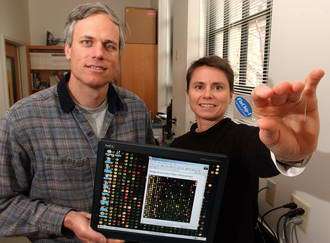
A novel "Flu Chip" developed at the University of Colorado at Boulder that can determine the genetic signatures of specific influenza strains from patient samples within hours may help world health officials combat coming epidemics and pandemics.
Image: CU-Boulder Professors Robert Kuchta and Kathy Rowlen display a scanner and the Flu Chip, which is inserted and read by the scanner to determine specific genetic subtypes of flu viruses within 11 hours.
Tests last month on the new technology by the Centers for Disease Control and Prevention in Atlanta showed the CU-Boulder Flu Chip can determine the genetic make-up of types and subtypes of the flu virus in about 11 hours, said CU-Boulder Professor Kathy Rowlen of the chemistry and biochemistry department. Current methods for characterizing flu subtypes infecting patients take about four days.
The Flu Chip is expected to be in wide use in laboratories within a year, said Rowlen, who has led the two-year CU-Boulder research effort.
Rowlen, who is working on the Flu Chip development with CU-Boulder chemistry Professor Robert Kuchta and a team of postdoctoral researchers and students, said they are conferring with CU's Technology Transfer Office and plan to make the Flu Chip genetic sequences freely available to interested researchers.
There currently are less than 200 facilities worldwide that provide detailed strain analysis of influenza, said Rowlen. Strain identification is critical for tracking emerging strains and in determining which flu strains are most likely to infect people the following year in order to develop annual, preventative vaccines, she said.
"This new technology should help provide better global influenza surveillance by making it easier for more laboratories to swiftly identify severe flu strains, which in turn may aid health officials to stem potential flu epidemics and even pandemics," Rowlen said.
The chip, which can be configured to test for all known flu virus strains as well as new variant strains, was evaluated for three primary subtypes of flu in the October CDC test -- the avian flu strain H5N1, and two of the most common human flu types worldwide in recent winters, H1N1 and H3N2. The chip was more than 90 percent accurate and will be tested again "side by side" with standard flu-virus culturing methods for accuracy and speed at the CDC's Atlanta headquarters next month.
"This was the first time a version of the Flu Chip was tested outside of our lab, and it exceeded our expectations," she said. The technology was developed with a $2 million, five-year grant to CU from the National Institute of Infectious Diseases.
The Flu Chip fits on a microscope slide and contains an array of microscopic spots, Rowlen said. Genetic bits of information that are complimentary to known, individual influenza strains are "spotted" robotically in an array, where each row of three spots contains a specific sequence of "capture" DNA. Each spot is approximately one-hundredth of an inch in diameter. The microarray is then immersed in a wash of influenza gene fragments obtained from the fluid of an infected individual.
RNA fragments from the infected fluid bind to specific DNA segments on the microarray like a key in a lock, indicating both a match and that the virus signature is present, she said. The captured RNA is then labeled with another complimentary sequence that also contains a fluorescent dye, and such "hits" light up like a pinball machine when the chip is inserted into a laser scanner.
The Flu Chip also should be able to recognize mutations that might occur in avian flu H5N1, which has been spreading rapidly from bird to bird in Asia, Russia and parts of Europe, said Kuchta. While the avian virus does not now spread effectively from person to person, world health officials are fearful the strain will mutate and become transmittable between humans, possibly triggering a worldwide pandemic.
"If an unusual flu subtype surfaces that has characteristics of both avian and human flu types, we could detect it rapidly using this technology," Kuchta said.
Standard laboratory culturing techniques by the CDC and WHO currently take four days to five days to determine flu strains afflicting patients, said Kuchta. While commercial tests like rapid antigen testing can detect influenza in less than an hour, none provide genetic information about various flu subtypes, he said.
Rowlen said that within a few years, the technology could be downsized to fit into a hand-held portable device the size of a cell phone or PDA and taken into remote areas around the world to test for lethal strains of flu.
"We can make it small and simple enough to take into rural areas in places like the Congo, Cambodia or Indonesia that may lack lab facilities," she said. "One of our goals has been to address the needs of developing nations by providing an inexpensive, field-portable test kit for respiratory illnesses to the World Health Organization for global screening of respiratory illness."
Kuchta said the team hopes to cut down on the 11-hour virus identification process. "We are now looking at ways to amplify the fluorescent signal after we capture the RNA on the microarray, which could shorten the identification time to just a couple of hours," he said.
Rowlen said the Flu Chip could also play a significant role in alerting government officials to an "engineered" influenza virus arising from terrorism.
Hurricane Katrina displayed the vulnerability of the United States to natural catastrophes, she said. "A flu pandemic is inevitable since the virus continually mutates and is naturally spread by migratory birds. Whether this year or 10 years from now, it is important to be prepared for such an event."
Most experts agree that preparations for a flu pandemic include early identification, vaccine development, the wide availability of pharmaceuticals and planning for possible local quarantine events. During the "Spanish Flu" pandemic of 1918-1919, between 20 million and 40 million people died from influenza in less than a year and an estimated one-fifth of the world's population became infected.
The flu chip also could be used to swiftly test for the avian flu virus at large, remote bird farms in Asia, Europe and Russia, said Kuchta. The chip also could be easily reconfigured to use for the global surveillance of any RNA virus, including SARS, measles, HIV and hepatitis C, the researchers said.
Other members of the Flu Chip team include CU-Boulder postdoctoral researchers Erica Dawson, Daniela Dankbar, Martin Mehlman and Chad Moore, graduate students James Smagala and Michael Townsend and undergraduate Amy Reppert. The group has been working on the project with CDC Influenza Branch Chief Dr. Nancy Cox and CDC researcher Catherine Smith.
Image: University of Colorado at Boulder


