Archaeologists Find 18th-Century Store
(AP) -- This history-rich Hudson River community has yielded a museum's worth of 18th-century military artifacts over the decades, from musket balls to human skeletons. But a colonial soldier's daily lot wasn't all fighting and bloodshed. They had their share of down time, and that's where the sutler came in, offering for sale two of the few diversions from frontier duty: alcohol and tobacco.
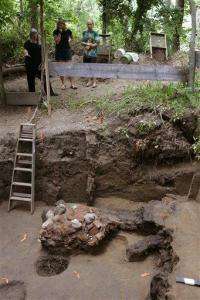
A five-year-long archaeological project has unearthed the 250-year-old site of a merchant's establishment that sold wine, rum, tobacco and other goods to the thousands of soldiers who passed through this region during the French and Indian War, when Fort Edward was the largest British military post in North America.
Sutler, derived from the Dutch word for someone who performs dirty work, was the name given to the merchants who arrived on the heels of the British army and sold what the redcoats wouldn't - or couldn't - provide at a frontier outpost. With the permission of military officials, sutlers set up shop near a fort's gates, taking advantage of the isolated location to do a brisk trade with off-duty soldiers and officers.
With Albany located some 40 miles down river, the sutlers doing business here served as a precursor to today's convenience stores, said archaeologist David Starbuck.
"For your merchants of the day, this is your big captive audience," he said recently while giving a tour of the site. "Booze and tobacco were the big things. I guess things don't change with the years."
Starbuck said "huge numbers" of artifacts have been found at the sutler site, located in a wooded area on private property on the Hudson's east bank, just south of where the fort stood.
"It's definitely the richest one we've ever found in Fort Edward," said Starbuck, a New Hampshire college professor who has led a series of summertime excavations here and elsewhere in the region since the early 1990s.
High school history teacher Matt Rozell, a veteran of many of Starbuck's digs, found the sutler site in the 1990s after hearing stories of treasure hunters sneaking onto the property to loot artifacts. But the illegal digging only scratched the surface. The real treasures, Rozell said, were buried a foot or more below ground.
After receiving permission from the property owners to excavate the site, Starbuck's team of students, volunteers and professional archaeologists began digging in 2001. Over the next five summers, they uncovered remnants of a least one sutler's store, including fireplace bricks and a charred staircase and beams in what was the dirt-floor basement of the structure. Scattered about the site were various coins, thousands of broken and intact clay pipes and glass fragments from wine and rum bottles, evidence that the store doubled as a tavern.
Among the biggest finds: a 19-inch British bayonet in nearly pristine condition and an intact bottle.
"You don't find too many of them like that," said Rozell as he gently held a squat, dark-green bottle inside the work room at the Rogers Island Visitors Center, where the artifacts have been catalogued and stored.
Back at the site, the top half of a broken bottle protruded from the dirt at the edge of the pit, waiting to be excavated, cleaned up and catalogued.
This stretch of the upper Hudson has long been a source of artifacts dating back to the 1700s and earlier. American Indians referred to it as the "Great Carrying Place" because the nearby falls forced travelers to make a 15-mile portage to reach the southern end of Lake George to the north.
The first white settlement here was established in the early 1730s, when John Henry Lydius, a Dutch trader from Albany, opened a trading post. His business thrived until it was destroyed during a French and Indian raid in the 1740s.
In 1755, as the last of the French and Indian wars heated up, the English arrived in force and built Fort Edward. Within a few years, 15,000 British and colonial soldiers were based here, including the famed Rogers' Rangers.
Starbuck said the sutler site probably isn't the original Lydius trading post. It's more likely the sutler's store that appears on maps from the late 1750s, and possibly the same one mentioned in contemporary records as belonging to a "Mr. Best." The building apparently burned down around 1760, after the bulk of the British army had advanced on French-held Canada.
Starbuck has spent most of the past 15 years conducting digs at 18th-century military sites here and in Lake George. Those excavations tended to focus on places made famous by massacres and battles. He concedes that finding the cellar of a merchant's storehouse may not carry the same cachet with history buffs.
But the sutler site does offer a rare glimpse into an important aspect of frontier life in colonial America.
"Sutlers tend to be overlooked but they're a huge part of the (settlement) process," he said. "This is where a community begins. It's like a prelude to the founding of the towns up here."
Starbuck said the Fort Edward sutler site could wind up being second in terms of significance only to Michigan's Fort Michilimackinac, another 18th-century outpost where archaeologists have found hundreds of thousands of artifacts over the past 45 years.
By CHRIS CAROLA, Associated Press Writer
© 2006 The Associated Press. All rights reserved. This material may not be published, broadcast, rewritten or redistributed.


