Bacteria to run our cars, warm our homes
The United States Department of Energy has devoted $1.6 million to sequencing the DNA of six photosynthetic bacteria that Washington University in St. Louis biologists will examine for their potential as one of the next great sources of biofuel that can run our cars and warm our houses.
That's a lot of power potential from microscopic cyanobacteria (blue-green algae) that capture sunlight and then do a variety of biochemical processes. One potential process, the clean production of ethanol, is a high priority for DOE.
Himadri Pakrasi, Ph.D., Washington University Endowed Professor of Biology in Arts & Sciences, and Professor of Energy in the School of Engineering and Applied Science, will head a team of biologists at Washington University and elsewhere in the analysis of the genomes of six related strains of Cyanothece bacteria. One additional Cyanothece strain, 54112, already has been sequenced by the Joint Genome Institute in Walnut Creek, Calif., DOE's sequencing facility, the largest DNA sequencing facility in the world , that also will sequence the additional six.
The amazing Cyanothece 54112 is a one-celled marine cyanobacteria, which is a bacterium with a well-defined circadian rhythm, or biological clock. In particular, Cyanothece has the uncanny ability to produce oxygen and assimilate carbon through photosynthesis during the day while fixing nitrogen through the night, all within the same cell. Incredibly, even though the organism has a circadian rhythm, its cells grow and divide in 10 to 14 hours.
Why sequence six? The strains, two isolated from rice paddies in Taiwan, one in a rice paddy in India, and three others from the deep ocean, are related, but each one comes from different environmental backgrounds and might metabolize differently. Thus, one or more strains might have biological gifts to offer that the others don't , or else combining traits of the different strains could provide the most efficient form of bioenergy.
A natural at fermentation
"The Department of Energy is very interested in the production of ethanol or hydrogen and other kinds of chemicals through biological processes," said Pakrasi, who also is director of the University's Bioenergy Initiative. "Cyanobacteria have a distinct advantage over biomass, such as corn or other grasses, in producing ethanol, because they use carbon dioxide as their primary cellular carbon source and emit no carbons and they naturally do fermentation. In biomass, yeast needs to be added for fermentation, which leads to the production of ethanol. Cyanobacteria can offer a simpler, cleaner approach to ethanol production." Pakrasi heads a group of nearly two dozen researchers who will do a lengthy, painstaking manual annotation of the gene sets of each organism to figure out what each gene of each strain does.
"The diversity in those sequences will give us the breadth of what these organisms do, and then we can pick and choose and make a designer microbe that will do what we want it to do," Pakrasi said. "We want to tap into the life history of these organisms to find the golden nuggets."
One possible way to produce ethanol using Cyanothece strains is a hybrid combination of the microbe and plant matter where the cyanobacteria coexist with plants and enable fermentation. The model exists in nature where cyanobacteria form associations with plants and convert nitrogen into a useful form so that plants can use the nitrogen product.
Extracting ethanol
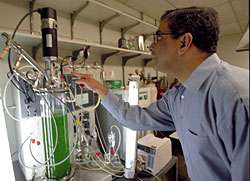
At Washington University, Pakrasi and his collaborators have designed a photobioreactor to watch Cyanothece convert available sunlight into thick mats of green biomass, from which liquid ethanol can be extracted.
Pakrasi led the sequencing of Cyanothece 54112 as the focus of a Department of Energy "grand challenge project" that resulted in the sequencing and annotation of a cyanobacterium gene that could yield clues to how environmental conditions influence key carbon fixation processes at the gene-mRNA-protein levels in an organism.
Two of the most critical environmental and energy science challenges of the 21st century are being addressed in a systems biology program as part of a Grand Challenge project at the W.R. Wiley Environmental Molecular Sciences Laboratory (EMSL), a national facility managed by the Pacific Northwest National Laboratory (PNNL) for the Department of Energy. This program features an elaborate international collaboration involving six university laboratories and 10 national laboratory groups, Washington University being one of them.
Pakrasi is leading a grand challenge project in membrane biology that is using a systems approach to understand the network of genes and proteins that governs the structure and function of membranes and their components responsible for photosynthesis and nitrogen fixation in two species of unicellular cyanobacteria, specifically Cyanothece and Synechocystis.
The Cyanothece sequencing is the second Joint Genome Institute project involving Washington University. In 2004, the university was directly involved in sequencing the entire genome of the moss Physcomitrella patens at the Joint Genome Institute.
Source: By Tony Fitzpatrick, Washington University in St. Louis


