The day LISA Pathfinder hung in the balance
October 11, 2006 The day LISA Pathfinder hung in the balance

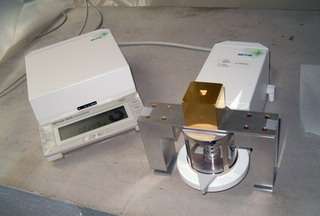
This photograph shows the LISA Pathfinder gold-platinum proof-mass being placed over the high sensitivity balance used at the International Bureau of Weights and Measures (BIPM, France) to measure the proof-mass´s magnetic susceptibility. Once in space, LISA Pathfinder´s proof-masses will be used to detect forces as small as the weight of a typical bacterium, and test the theory of General Relativity. The perfect proof-mass is one that responds only to the force of gravity. Therefore, scientists needed to precisely measure how the LISA Pathfinder proof-masses respond to magnetic forces so that they can compensate for this in their calculations. Credits: Courtesy of M. Hueller (University of Trento)/R. Davis (BIPM)

At the core of ESA's LISA Pathfinder mission sit two small hearts. Each is a cube, just 5 centimetres across. Together they will allow LISA Pathfinder to lay the foundations for future space-based measurements that investigate the very core of Einstein's General Relativity.

A cornerstone of relativity is the concept of a frame of reference. This is a set of bodies relative to which any motion can be measured. Without a reference frame, no motion through space can be detected. Scientists call a frame of reference 'inertial' if unperturbed objects appear in that frame, either at rest or moving at a constant velocity. For a reference frame to be perfectly inertial, the bodies that are used to mark it must be completely free of any force.

Einstein's General Relativity predicts that the gravity from celestial bodies warps our measurement of distances in such a frame. Once scientists can build an exact inertial frame of reference, they will be able to measure this warping. LISA Pathfinder will test a technique designed to measure a frame of reference much more precisely than ever before. "This will provide the foundation stone for any future mission in General Relativity, if not also in gravitation and navigation at large" says Stefano Vitale, the mission's Principal Investigator.

To make this measurement, LISA Pathfinder uses two 'proof-masses'. Each is a small cube of a gold and platinum alloy, whose relative motion is measured by a laser beam. Once in space, the proof-masses will float freely within the spacecraft. When subtle forces act on the proof-masses, the laser beam will detect the way they change position to within a few thousandths of a billionth of a meter, and will be able to detect forces as small as the weight of a typical bacterium.
The day LISA Pathfinder hung in the balance

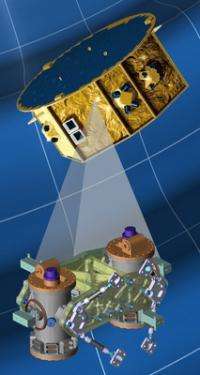
Artist's impression of the LISA Pathfinder spacecraft, due for launch in 2009. LISA Pathfinder is a precursor to ESA's LISA mission, to detect gravitational waves and test General Relativity in space. At the core of the mission is the LISA Technology package, containing proof-masses and an accurate metrology system. Credits: ESA/ASTRIUM

Such precision measurements belong to metrology, a highly specialised science in its own right. "This makes the mission not just the pathfinder for gravitational wave astronomy missions like LISA, but also the first mission in the field of advanced metrology," says Vitale.

The perfect proof-mass is one that responds only to the force of gravity. That means the proof-masses should not be susceptible to stray magnetic fields, which can move them around and mimic the action of gravity. "On LISA Pathfinder, there are magnetic components that the proof-masses could respond to," says Laurent Trougnou, an electromagnetic engineer on LISA Pathfinder, at the European Space Agency.

To compensate, the test masses are made of gold and platinum. It turns out that a magic mixture of these two metals has almost no magnetic susceptibility, yet even that was not good enough for LISA Pathfinder. The scientists still needed to precisely measure how the proof-masses respond to magnetic forces so that they can compensate for this in their calculations.

They turned to Richard Davis, head of the mass section at the International Bureau of Weights and Measures (BIPM), located in France. The BIPM is the custodian of the kilogramme and Davis is an expert at measuring magnetic properties so that precise standards of mass can be created.

"We used a very sensitive balance to measure the force on a proof-mass due to the magnetic field produced by a small magnet," says Davis. From this, they teased out the magnetic properties of the proof-mass. "We had never before looked for a signal that small, or manipulated a delicate 2 kilogramme cube," he adds.

The measurements were conducted successfully over two days and take the LISA Pathfinder team one step closer to its scheduled launch date of 2009. LISA Pathfinder paves the way for LISA, three spacecraft that will work together to detect Einstein's predicted ripples, known as gravitational waves, in the fabric of spacetime.

Source: ESA


print this article email this article download pdf blog this article bookmark this article     Stumble it Digg this share on Facebook retweet share on Reddit add to delicious
Rate this story - 4.4 /5 (17 votes)


October 11, 2006 all stories

Comments: 0

4.4 /5 (17 votes)
  • Stumble this up

  • Digg this

  • share this

  • hide
  • Related Stories

  • 'Monsters vs. Aliens' creates another dimension
    created Mar 25, 2009 | popularity not rated yet | comments 0
  • ESA designs its smallest ever space engine to push back against sunshine
    created Mar 10, 2009 | popularity not rated yet | comments 0
  • Spin cycle: a new kind of washer (Video)
    created Feb 19, 2009 | popularity not rated yet | comments 0
  • ESA and NASA sign agreement on James Webb Space Telescope, LISA Pathfinder
    created Jun 18, 2007 | popularity not rated yet | comments 0
  • Cosmic Vision 2015-2025: ready to launch
    created Feb 26, 2007 | popularity not rated yet | comments 0


  • hide
  • Relevant PhysicsForums posts

  • Why are Horizontal Axis Wind Turbines used other than Vertical Axis?
    created 6 hours ago
  • Reverse Universe
    created 10 hours ago
  • Self Study From Books
    created 10 hours ago
  • Fresnel Biprism
    created 14 hours ago
  • If light has mass, and is a wave...
    created 22 hours ago
  • How do you get a mousetrap car to go forward and then backward?
    created Nov 15, 2009
  • More from Physics Forums - General Physics

Other News

Building a more versatile laser

Building a more versatile laser

Physics / Optics & Photonics

created 15 hours ago | popularity 4.1 / 5 (10) | comments 0

(PhysOrg.com) -- One of the drawbacks associated with using semiconductor lasers is that many of them can only produce a beam of a single wavelength, and can only send that beam in one direction at a time. ...


Engineer Discovers Why Particles Like Flour Disperse on Liquids

Engineer Discovers Why Particles Like Flour Disperse on Liquids

Physics / General Physics

created 6 hours ago | popularity 4.3 / 5 (6) | comments 1

(PhysOrg.com) -- Even if you are not a cook, you might have wondered why a pinch of flour (or any small particles) thrown into a bowl of water will disperse in a dramatic fashion, radiating outward as if it ...


Measuring Electron Orbitals

Measuring Electron Orbitals

Physics / General Physics

created 16 hours ago | popularity 5 / 5 (4) | comments 0

(PhysOrg.com) -- For the first time, it has been possible to measure electron density in individual molecular states using what is known as the photoelectric effect. Now published in Science, this method repres ...


Scientists demonstrate 'universal' programmable quantum processor

Scientists demonstrate 'universal' programmable quantum processor

Physics / Quantum Physics

created Nov 15, 2009 | popularity 4.6 / 5 (20) | comments 11

Physicists at the National Institute of Standards and Technology have demonstrated the first "universal" programmable quantum information processor able to run any program allowed by quantum mechanics -- th ...


Do we need dark matter?

Do we need dark matter?

Physics / General Physics

created Nov 12, 2009 | popularity 4.1 / 5 (18) | comments 33

It's the biggest problem in physics: the matter we can see in the universe accounts for just five per cent of the observed gravity that holds galaxies together.