October 11, 2006 feature
Particle decay may point to New Physics
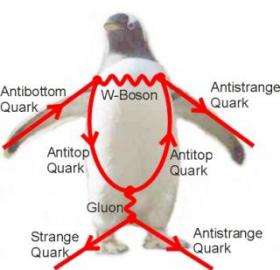
A tiny flaw has caught the attention of physicists: the Standard Model (SM) predicts that the B meson mixing phase should be measured at nearly the same result using two different classes of decay modes. However, observations of the two different decay modes recently gave very different values, resulting in an unexpectedly large discrepancy in the B mixing phase.
Scientists Rahul Sinha, Basudha Misra and Wei-Shu Hou have tried to explain the discrepency, and have shown that it is not possible to reconcile the deviation between the measurements, revealing a possible glitch in the stubbornly persistent SM.
"At present, it is not possible to specify the kind of NP [New Physics] that might be implied," Sinha told PhysOrg.com. "We not only need larger data sample of B meson decays, but also more theoretical studies. It could be supersymmetry, or something else."
The two classes of B meson decay modes that Sinha and his colleagues analyzed involved decays resulting in a strange quark, along with two other particles (either a charm and anti-charm quark, or a "q" and anti-"q" quark, where q could be either an up, down or strange quark). The neutral B meson has a very special property: it can mix with its anti-particle, the anti-B meson, which results in a phase called the "B-meson mixing phase." According to the SM, B mesons decay via weak interactions, and decays that result in strange quarks receive two contributions with different weak phases.
Scientists expect some deviation to exist when measuring the mixing phase of the B meson decay from different decay modes. However, the SM predicts a deviation of only a few degrees, while the measured deviation is significantly larger--about 13 degrees. Moreover, it is in the opposite direction.
To confront the discrepancy between the SM and the observed decays, which was first observed at the Stanford Linear Accelerator Center and the High Energy Accelerator Research Organization in Japan, and was reported by Hazumi with further evidence at a conference this summer in Moscow, Sinha and his group investigated the possibilities that might explain the results within the SM. Using a model-independent approach, they showed both numerically and geometrically that the deviation of the B mixing phase must always be less than the weak phase of one of the contributions. The only alternative SM-compliant explanation they could find was that large destructive interference resulting from fine-tuned cancellations between two large contributions--contributions that are even larger than the decay rates themselves--might cause the observed deviation. However, the scientists say that this option is "rather unlikely, given the relative successful understanding of B decays."
"Without making any hadronic assumptions, we have shown that it is impossible to explain within SM the observed discrepancy in [the B meson] mixing phase measured using the [two] modes," Sinha et al. wrote in their study.
To confirm that the large deviation is indeed NP, Sinha said that more observations are needed.
"We need to collect larger data sets of B mesons at the B factories at SLAC and KEK, and also seriously consider the future upgrades to firm up the statistical significance of the deviation," he said. "The small phase (referred to as 'beta_s' in the paper) might be measured directly in the future."
If the SM cannot explain this observation, scientists may get a lead toward NP--physics beyond the SM. Although the SM has assisted physicists since its development in the 1970s, with its elegant explanations and predictions for several previously unknown particles, the model has arguably reached its limits. It can't explain many areas (e.g. dark matter, gravity and particle masses), and therefore doesn't offer much help in further discoveries. Even a small inaccuracy such as this wrongly predicted B mixing phase may yield greater understanding of the particles and forces that compose the universe. As Sinha mentions, of course, there are also several other potential candidates for NP:
"Although supersymmetry is the most popular scenario for possible NP, it has not yet been seen," he mused. "Neutrino mass has been established, but accommodating neutrino mass with SM requires only a trivial extension beyond SM. It provides no clear evidence of the dynamics beyond SM. There has been a hint of NP seen in the muon magnetic moment measurements where there is a slight discrepancy between theory and experiment. However, due to hadronic uncertainty or strong interaction effects (akin to nuclear binding), we are unable to say with any certainty that the discrepancy is a signal of NP.
"In our approach, which works very well to study weak decays of mesons, there is no hadronic uncertainty," Sinha continued. "The only reason that this discrepancy might not be NP would be that, as more data is collected, the discrepancy might disappear. The experimentalists talk in terms of statistical significance of the data. They quote a significance of 2.6 sigma for this discrepancy (in other words, it means less than one percent chance that this discrepancy is a statistical fluctuation). Without being biased, since there is no hadronic uncertainty in our approach, I feel that this discrepancy is the strongest evidence for NP. There are some other hints of NP also being seen in B meson decays, but none are as compelling and, unlike this discrepancy, we are not sure that they are not due to hadronic contributions. These are all topics of vigorous research by several physicists."
Citation: Sinha, Rahul, Misra, Basudha and Hou, Wei-Shu. "Has New Physics Already Been Seen in Bd Meson Decays?" Physical Review Letters. 97, 131802 (2006).
By Lisa Zyga, Copyright 2006 PhysOrg.com


