Polarized particles join toolbox for building unique structures
October 12, 2006 Polarized particles join toolbox for building unique structures

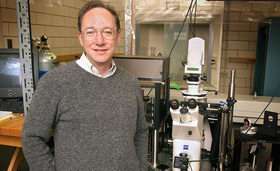
Steve Granick, a professor of materials science and engineering, of chemistry and of physics, and his colleagues have created polarized, spherical particles that spontaneously self-assemble into clusters with specific shapes and distributions of electric charge. University of Illinois Photo

Researchers at the University of Illinois at Urbana-Champaign have created polarized, spherical particles that spontaneously self-assemble into clusters with specific shapes and distributions of electric charge. The polarized particles can be used in the directional self-assembly of intricate shapes and unique structures.

"The world abounds with particles that have traditionally been treated as geometrically symmetric, chemically isotropic and electrically uniform," said Steve Granick, a professor of materials science and engineering, chemistry and physics. "We have muddied the waters a bit by asking: 'What happens when we build clusters from particles that have an uneven distribution of electric charge?' "

The polarized spheres are called Janus particles; Janus was the Roman god of change, often portrayed with two faces gazing in opposite directions. The spheres offer new opportunities in particle engineering for building particular structures. The clusters may also prove useful as simple systems in which to explore the role of charge interactions in determining how proteins aggregate.

Granick and his collaborators describe their work in a paper accepted for publication in the journal Nano Letters, and posted on its Web site.

To make their Janus particles, the researchers begin with negatively charged beads one micron in diameter. Using electron beam deposition, they coat one hemisphere of the beads with a gold film, which is then made positively charged.

When placed in solution, the particles spontaneously self-assemble into specific geometrical shapes depending on the number of particles. For example, clusters of seven particles resemble a flywheel, which can revolve around a polar axle.

The compact shapes differ fundamentally from the strings and rings formed by magnetic particles, said Granick, who also is a researcher at the Frederick Seitz Materials Research Laboratory and at the Beckman Institute for Advanced Science and Technology.

"The observed shapes are in excellent agreement with computer simulations," said Erik Luijten, a professor of materials science and engineering, and a corresponding author of the paper. "The simulations not only show you the shapes, they also show you how the particles are oriented in the cluster."

Surprisingly, the charge distribution of the initial Janus particles is preserved in the clusters. One half of each cluster tends to be positively charged; the other half negatively charged. This uneven distribution of surface charge could be utilized, perhaps, in the directional self-assembly of particles into more elaborate and intricate shapes.

"Future work could consider particles whose shape is not just spherical, but also rod-like or oblate," Granick said. "This is just the beginning of something that will catch a lot of people's imaginations."

Source: University of Illinois at Urbana-Champaign


print this article email this article download pdf blog this article bookmark this article     Stumble it Digg this share on Facebook retweet share on Reddit add to delicious
Rate this story - 4 /5 (8 votes)


October 12, 2006 all stories

Comments: 0

4 /5 (8 votes)
  • Stumble this up

  • Digg this

  • share this

  • hide
  • Related Stories


  • hide
  • Relevant PhysicsForums posts

  • B4A26 Steel?
    created Dec 15, 2009
  • Li-ion battery chemistry
    created Dec 13, 2009
  • Paris' Law Coefficients for Steel
    created Dec 12, 2009
  • Mass & Energy Balance Question Help
    created Dec 12, 2009
  • More from Physics Forums - Materials & Chemical Engineering

Other News

Watching Proteins Direct Crystal Growth One Step at a Time (w/ Video)

Watching Proteins Direct Crystal Growth One Step at a Time (w/ Video)

Nanotechnology / Nanophysics

created 17 hours ago | popularity 5 / 5 (1) | comments 0

(PhysOrg.com) -- Scientists at Berkeley Lab's Molecular Foundry imaged the growth of protein-studded mineral surfaces with unprecedented resolution and provided a glimpse into how living systems engineer key ...


Thermochemical nanolithography now allows multiple chemicals on a chip

Thermochemical nanolithography now allows multiple chemicals on a chip

Nanotechnology / Nanophysics

created 18 hours ago | popularity 4.5 / 5 (4) | comments 0

(PhysOrg.com) -- Scientists at Georgia Tech have developed a nanolithographic technique that can produce high-resolution patterns of at least three different chemicals on a single chip at writing speeds of ...


Behavior modification could ease concerns about nanoparticles

Behavior modification could ease concerns about nanoparticles

Nanotechnology / Bio & Medicine

created 9 hours ago | popularity 5 / 5 (2) | comments 0

In an advance that could help ease health and environmental concerns about the emerging nanotechnology industry, scientists are reporting development of technology for changing the behavior of nanoparticles ...


Growing Europe's nanowires

Growing Europe's nanowires

Nanotechnology / Nanophysics

created 15 hours ago | popularity 4.5 / 5 (2) | comments 0

(PhysOrg.com) -- European researchers have developed state-of-the-art nanowire 'growing' technology, opening the way for faster, smaller microchips and creating a promising new avenue of research and industrial ...


Scientists use nanosensors for first time to measure cancer biomarkers in blood

Scientists use nanosensors for first time to measure cancer biomarkers in blood

Nanotechnology / Bio & Medicine

created Dec 13, 2009 | popularity 5 / 5 (13) | comments 3

A team led by Yale University researchers has used nanosensors to measure cancer biomarkers in whole blood for the first time. Their findings, which appear December 13 in the advanced online publication of ...