Fossilized liquid assembly: Nanomaterials research tool
October 12, 2006 Fossilized liquid assembly: Nanomaterials research tool

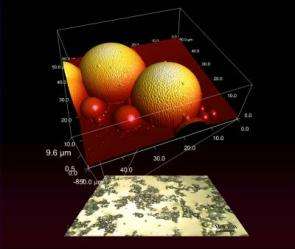
Optical microscope image (lower plane) shows spheres at mutiple size scales self-arranging in complex "super-assemblies" in NIST's hierarchical topology modeling system. Atomic-force microscopy (detail) shows the textured surface formed by the spheres. Credit: NIST

From a butterfly's iridescent wing to a gecko's sticky foot, nature derives extraordinary properties from ordinary materials like wax and keratin. Its secret is hierarchical topology: macroscale structures assembled from microscale components of varying sizes.

Borrowing a page from nature's playbook, researchers at the National Institute of Standards and Technology (NIST) have developed a novel platform for the self-assembly of experimental hierarchical surfaces in a fluid. Their work offers diverse industries a new way to generate and measure self-assembly at the nano-scale.

A butterfly's wings shimmer because light plays upon tiny rows of scales, like tiles on a Spanish roof. The gecko sticks to surfaces because its feet are patterned with microscopic hairs, each hair tipped with hundreds of even tinier projections. Beads of water roll off the lotus's leaf because its surface is streaked with microscopic peaks, each with a finer structure, that makes the surface "super hydrophobic." These enhanced properties--other possibilities include super adhesion and low friction--have attracted the attention of design engineers for applications from bioengineered tissues to photonic crystals to submarines that slice through water with minimal drag.

Creating these topologically complex, self-assembled surfaces for study has been a challenge. If the components are mixed on a surface, that substrate affects how they assemble; if mixed in a solvent and dried, the drying process similarly distorts the results. In a recent paper*, the NIST team detailed a much simpler and faster system they dubbed "fossilized liquid assembly" to create experimental models of hierarchical topologies in which the components are allowed to mix and assemble freely in a fluid, and then quickly "frozen" in place for study. The key is the use of solutions of water and a special monomer that polymerizes--links together--when exposed to ultraviolet light. Like an oil-water mixture, the fluid forms liquid interfaces that can be manipulated to create a desired hierarchical structure and then suddenly solidified with a burst of UV light.

Lead researcher and physicist Alamgir Karim estimates that it takes about five minutes to make a sample of self-assembling particles using NIST's approach. Other methods, he notes, not only are more complicated and costly, but also do not allow the structures to form as freely. With the new technique, engineers also will be able to build complex dynamic structures and freeze them into solid form, studying self-assembly under the microscope. "How do you take a snapshot of shampoo in action?" asks physicist Jason Benkoski, first author of the paper. "We can now directly observe these small, mobile, delicate structures."

The researchers also are using the new platform to better understand the fundamental physics behind the formation of hierarchical topology, studying, for example how different forces dominate at different scales of length. Looking ahead, the NIST team plans to build on this study, expanding the technology as a 3D imaging platform.

Citation: J.J. Benkoski, H. Hu, and A. Karim. Generation of hierarchical topologies from photocrosslinkable, particle-stabilized emulsions. Macromolecular Rapid Communications. Aug. 2, 2006

Source: NIST


print this article email this article download pdf blog this article bookmark this article     Stumble it Digg this share on Facebook retweet share on Reddit add to delicious
Rate this story - 4 /5 (5 votes)


October 12, 2006 all stories

Comments: 0

4 /5 (5 votes)
  • Stumble this up

  • Digg this

  • share this

  • hide
  • Related Stories

  • Three of a kind: Revealing language’s universal essence
    created Nov 20, 2009 | popularity not rated yet | comments 0
  • The power of doctors makes elderly patients passive
    created Oct 27, 2009 | popularity not rated yet | comments 0
  • Researchers find new route to nano self-assembly
    created Oct 22, 2009 | popularity not rated yet | comments 0
  • What's the semantic organization of human language?
    created Aug 11, 2009 | popularity not rated yet | comments 0
  • Community-driven, open source solution for B2B transactions
    created Jul 31, 2009 | popularity not rated yet | comments 0


  • hide
  • Relevant PhysicsForums posts

  • Thin Film Laboratory resources
    created 2 hours ago
  • Theoretical air URGENT
    created 13 hours ago
  • photoconductivity of polymers
    created Nov 25, 2009
  • Heat pipe for high temperature
    created Nov 24, 2009
  • More from Physics Forums - Materials & Chemical Engineering

Other News

Nanowire Formation

Nanowires key to future transistors, electronics

Nanotechnology / Nanophysics

created 14 hours ago | popularity 4.8 / 5 (6) | comments 1

(PhysOrg.com) -- A new generation of ultrasmall transistors and more powerful computer chips using tiny structures called semiconducting nanowires are closer to reality after a key discovery by researchers ...


Nanotube defects equal better energy and storage systems

Nanotube defects equal better energy and storage systems

Nanotechnology / Nanomaterials

created Nov 19, 2009 | popularity 4.4 / 5 (10) | comments 2

(PhysOrg.com) -- Most people would like to be able to charge their cell phones and other personal electronics quickly and not too often. A recent discovery made by UC San Diego engineers could lead to carbon ...


Water droplets direct self-assembly process in thin-film materials

Nanotechnology / Nanomaterials

created Nov 23, 2009 | popularity 5 / 5 (4) | comments 2

You can think of it as origami - very high-tech origami. Researchers at the University of Illinois have developed a technique for fabricating three-dimensional, single-crystalline silicon structures from thin films by coupling ...


Using superconducting probes to get a picture of what it's like inside CNTs

Nanotechnology / Nanophysics

created Nov 20, 2009 | popularity 4.4 / 5 (9) | comments 0

(PhysOrg.com) -- "Carbon nanotubes are exciting for fundamental physics, and for potential technological applications," Nadya Mason tells PhysOrg.com. "However, we are generally limited in the way that we can study them. ...


Fast, easy, and highly sensitive arsenic detection with gold nanoparticles

Nanotechnology / Nanomaterials

created Nov 25, 2009 | popularity 5 / 5 (1) | comments 0

(PhysOrg.com) -- Mention of arsenic poisoning usually brings to mind underhanded murder. However, the danger of arsenic poisoning from contaminated drinking water is far greater. Low concentrations of arsenic are found in ...