Day and night temps measured on an extrasolar planet
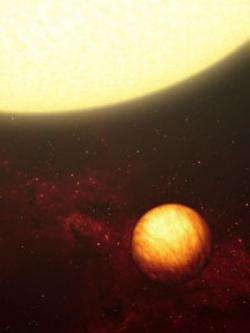
For the first time, astronomers have measured the day and night temperatures of a planet outside our solar system. The team revealed that a giant Jupiter-like gas planet orbiting very close to its star is blisteringly hot on one side, and frigid on the other.
The finding, made using NASA's Spitzer Space Telescope, represents the first time that any kind of variation has been seen across the surface of a planet outside our solar system. Previous studies of such planets--known to astronomers as "extrasolar" planets--have described whole-globe traits such as size and mass.
The results appear online today in Science Express, and will also be presented at the 38th meeting of the Division for Planetary Sciences of the American Astronomical Society in Pasadena, California.
"This observation completely changes our thinking about hot gas giant exoplanets," Seager said. "Most astronomers expected them to be more uniformly heated, much like Jupiter. But this planet clearly has a hot side and a cool side."
The gas giant planet, named Upsilon Andromeda b, is a so-called "hot-Jupiter" that circles closely around its scorching star every 4.6 days. Seager and her colleagues determined that the temperature variation between the planet's light side and its dark side is about 2,550 degrees Fahrenheit.
"This planet has a giant hot spot in the hemisphere that faces the star," said lead author Joe Harrington of the University of Central Florida, Orlando. "The temperature difference between the day and night sides tells about how energy flows in the planet's atmosphere. Essentially, we're studying weather on an exotic planet."
The team believes that the planet is "tidally locked" to its star, meaning that the planet rotates slowly enough that the same side always faces its star--much like our tidally locked moon never reveals its "dark side" to the Earth. However, since the planet is made of gas, not rock, its outer atmosphere could move faster than its locked interior.
The extreme temperature difference between the two sides could mean that the atmosphere of Upsilon Andromeda b absorbs and re-radiates sunlight rapidly, allowing the circling gases to quickly cool off as they move from light side to dark side. Jupiter, on the other hand, maintains an even temperature all around.
"If you were moving across the planet from the night side to day side, the temperature jump would be equivalent to leaping into a volcano," said the project's principal investigator, Brad Hansen of the University of California, Los Angeles.
The team used Spitzer's heat-seeking infrared eyes to periodically stare at the Upsilon Andromeda planetary system over a period of about five days. They found that the system's light dimmed and brightened in time with Upsilon Andromeda b's orbit; this change in observed light, or heat, is the result of the planet showing its different faces as it travels around the star. When the planet's sunlit side was in Earth's view, Spitzer detected more light from the system; when its dark side was facing us, Spitzer picked up less light. The technique takes advantage of the fact that planets stand out better relative to their stars when viewed in infrared light.
"This is a spectacular result," said Michael Werner, project scientist for Spitzer at NASA's Jet Propulsion Laboratory, Pasadena, Calif. "When we designed Spitzer years ago, we did not anticipate that it would be revolutionizing extrasolar-planet science."
Upsilon Andromeda b was discovered in 1996 around the star Upsilon Andromeda, which is 40 light-years away and visible to the naked eye at night in the constellation Andromeda. The star is circled by two other known planets, both located farther out than Upsilon Andromeda b. The plane of this planetary system is tilted relative to our solar system, such that the planets are always in Earth's line of sight.
Other authors of this work include: Statia H. Luszcz of Cornell University, Ithaca, N.Y., and University of California, Berkeley; Drs. Drake Deming and Jeremy Richardson of NASA's Goddard Space Flight Center, Greenbelt, Md., Dr. Kristen Menou of Columbia University, New York, N.Y.; Dr. James Y-K. Cho of University of London, U.K.
Source: Carnegie Institution


