Molecular Spintronic Action Confirmed in Nanostructure
October 12, 2006 Molecular Spintronic Action Confirmed in Nanostructure

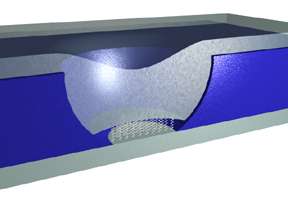
NIST researchers made the first confirmed "spintronic" device incorporating organic molecules using a nanoscale pore test structure, which consisted of self-assembled molecules (shown in white within the middle blue layer in the illustration) sandwiched between nickel and cobalt electrodes (gray top and bottom layers). The pore structure, less than 40 nanometers in diameter, confines the molecules to a very small area, thus enabling good molecule-metal contacts and limiting defects.

Researchers at the National Institute of Standards and Technology have made the first confirmed “spintronic” device incorporating organic molecules, a potentially superior approach for innovative electronics that rely on the spin, and associated magnetic orientation, of electrons. The physicists created a nanoscale test structure to obtain clear evidence of the presence and action of specific molecules and magnetic switching behavior.

Whereas conventional electronic devices depend on the movement of electrons and their charge, spintronics works with changes in magnetic orientation caused by changes in electron spin (imagine electrons as tiny bar magnets whose poles are rotated up and down). Already used in read-heads for computer hard disks, spintronics can offer more desirable properties—higher speeds, smaller size—than conventional electronics.

Spintronic devices usually are made of inorganic materials. The use of organic molecules may be preferable, because electron spins can be preserved for longer time periods and distances, and because these molecules can be easily manipulated and self-assembled. However, until now, there has been no experimental confirmation of the presence of molecules in a spintronic structure. The new NIST results are expected to assist in the development of practical molecular spintronic devices.

The experiments, described in the October 9 issue of Applied Physics Letters, used a specially designed nanoscale “pore” in a silicon wafer. A one-molecule-thick layer of self-assembled molecules containing carbon, hydrogen and sulfur was sandwiched in the pore, between nickel and cobalt electrodes. The researchers applied an electric current to the device and measured the voltage levels produced as electrons “tunneled” through the molecules from the cobalt to the nickel electrodes. (Tunneling, observed only at nanometer and atomic dimensions, occurs when electrons exhibit wave-like properties, which permit them to penetrate barriers.)

The pore structure stabilized and confined the test molecules and enabled good molecule-metal contacts, allowing the scientists to measure accurately temperature-dependent behavior in the current and voltage that confirm electron tunneling through the molecular monolayer. Some electrons can lose energy while tunneling, which corresponds to vibration energies unique to the chemical bonds within the molecules.

The NIST team used this information to identify and unambiguously confirm that the assembled molecules remain encapsulated in the pore and are playing a role in the device operation. In addition, by varying the magnetic field applied to the device and measuring the electrical resistance, the researchers identified magnetic switching in the electrodes from matching to opposite polarities.

Citation: W. Wang and C.A. Richter. Spin-polarized inelastic electron tunneling spectroscopy of a molecular magnetic tunnel junction. Applied Physics Letters. Oct. 9, 2006.

Source: NIST


print this article email this article download pdf blog this article bookmark this article     Stumble it Digg this share on Facebook retweet share on Reddit add to delicious
Rate this story - 4.3 /5 (29 votes)


October 12, 2006 all stories

Comments: 0

4.3 /5 (29 votes)
  • Stumble this up

  • Digg this

  • share this

  • hide
  • Related Stories

  • Tapering a Free-Electron Laser to Extract More Juice
    created Nov 20, 2009 | popularity not rated yet | comments 0
  • New study confirms exotic electric properties of graphene
    created Nov 17, 2009 | popularity not rated yet | comments 0
  • Diamonds May Be the Ultimate MRI Probe, Say Quantum Physicists
    created Sep 22, 2009 | popularity not rated yet | comments 0
  • Magnetism observed in gas for the first time
    created Sep 17, 2009 | popularity not rated yet | comments 0
  • Molecules on a string, and why size isn't the only thing that matters for data storage
    created Sep 14, 2009 | popularity not rated yet | comments 0


  • hide
  • Relevant PhysicsForums posts

  • two-dimensional collision
    created 1hour ago
  • I Need Help Selecting a Good Text Book to Learn the Basics
    created 2 hours ago
  • The acceleration of mass using light
    created 3 hours ago
  • Badminton
    created 4 hours ago
  • More from Physics Forums - General Physics

Other News

In the Brain, Seven Is A Magic Number

In the Brain, Seven Is A Magic Number

Physics / General Physics

created 7 hours ago | popularity 4.2 / 5 (14) | comments 4

Having a tough time recalling a phone number someone spoke a few minutes ago or forgetting items from a mental grocery list is not a sign of mental decline; in fact, it's natural.


Scientists react as they stand in front of a screen at CERN

First atoms reported smashed in Large Hadron Collider (Update)

Physics / General Physics

created 9 hours ago | popularity 4.8 / 5 (16) | comments 6

Two circulating beams on Monday produced the first particle collisions in the world's biggest atom smasher, the Large Hadron Collider (LHC), three days after its restart, scientists announced.


Visual assistance for cosmic blind spots

Visual assistance for cosmic blind spots

Physics / General Physics

created 10 hours ago | popularity 4 / 5 (2) | comments 0

A bit of imagination on the part of a measuring instrument wouldn't be a bad thing. It could help to add data from areas where the instrument is unable to measure. However, it must do so constructively. In ...


A mechanical model of vocalization

Physics / General Physics

created 6 hours ago | popularity not rated yet | comments 0

When people speak, sing, or shout, they produce sound by pushing air over their vocal folds -- bits of muscle and tissue that manipulate the air flow and vibrate within it. When someone has polyps or some other problem with ...


Big Bang atom smasher sends beams in 2 directions (AP)

Large Hadron Collider sends beams in 2 directions

Physics / General Physics

created 13 hours ago | popularity 4.9 / 5 (9) | comments 0

(AP) -- The world's largest atom smasher made another leap forward Monday by circulating beams of protons in opposite directions at the same time in the $10 billion machine after more than a year of repairs, ...