Mimicking Nature Creates Self-Cleaning Coatings
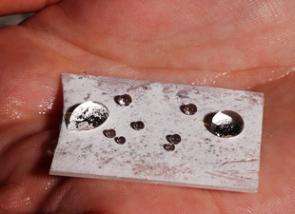
Researchers at the Georgia Institute of Technology are mimicking one of Nature’s best non-stick surfaces to help create more reliable electric transmission systems, photovoltaic arrays that retain their efficiency, MEMS structures unaffected by water and improved biocompatible surfaces able to prevent cells from adhering to implanted medical devices.
Based on a collaboration of materials scientists and chemical engineers, the research aims to duplicate the self-cleaning surfaces of the lotus plant, which grows in waterways of Asia. Despite growing in muddy conditions, the leaves and flowers remain clean because their surfaces are composed of micron- and nano-scale structures that – along with a waxy coating – prevent dirt and water from adhering. Despite their unusual surface properties, the rough surfaces allow photosynthesis to continue in the leaves.
“When rain hits the leaves of the lotus plant, it simply beads up,” noted C.P. Wong, a Regents Professor in Georgia Tech’s School of Materials Science and Engineering. “When the leaves are also tilted at a small angle, the beads of water run off instantaneously. While the water is rolling off, it carries away any dirt on the surface.”
The self-cleaning action of the lotus plant has intrigued researchers for decades, and recent studies done by researchers in several different groups have demonstrated the reasons behind the plant’s unique abilities.
The plant’s ability to repel water and dirt results from an unusual combination of a superhydrophobic (water-repelling) surface and a combination of micron-scale hills and valleys and nanometer-scale waxy bumps that create rough surfaces that don’t give water or dirt a chance to adhere.
“Because of the combination of nano-scale and micron-scale structures, water droplets can only contact about three percent of the surface,” Wong said. “They’re just not touching very much of the lotus surface as compared to a smooth surface.”
To address several unique applications, Georgia Tech researchers have attempted to duplicate the two-tier lotus surface using a variety of materials, including polybutadiene. But that organic compound isn’t suitable for coatings that are exposed to sunlight because ultraviolet radiation breaks down its carbon bonds. So to address their first lotus application – self-cleaning insulators used on high-voltage power lines – the researchers had to develop another material.
Supported by the National Electric Energy Testing Research and Applications Center (NEETRAC), that project would solve a problem that plagues electric utilities. The build-up of dirt and dust on ceramic or silicone insulators used by high-voltage power lines can eventually create a short circuit that can damage the electric distribution network. It’s impractical to manually clean the insulators.
Wong and collaborators Yonghao Xiu, Lingbo Zhu and Dennis Hess have developed a lotus surface able to withstand ultraviolet radiation using a combination of silicone, fluorocarbons, and inorganics such as titanium dioxide and silicon dioxide. Their prototype coating has shown excellent durability in long-term testing.
Supported by the National Science Foundation, NASA and other agencies, Georgia Tech is also pursuing other work based on lotus applications:
• Use of carbon nanotube bundles to create the surface bumps needed to prevent dust from accumulating on the surfaces of photovoltaic (PV) cells, space suits and other equipment intended for use on the moon or Mars – where there’s no rain. Arranging patterns of nanotube bundles a few microns apart and applying a weak electrical charge should help keep dust away and maintain maximum efficiency in the PV cells that power space missions.
• Application of lotus coatings to prevent “stiction,” which is the strong adhesive force that can form between the structures of micro-electromechanical systems (MEMS) and substrates. The magnitude of these forces can be enough to deform the structures, resulting in device failure. With its superhydrophobicity and surface roughness, a lotus surface coating can prevent stiction, Wong said.
• A two-tier surface system composed of hexagonally-packed silica spheres on which gold nanoparticles were deposited. The resulting chemical and physical structures were studied to establish the impact of surface hydrophobicity and roughness on the measured contact angles on the rough surfaces.
• Lotus surfaces for use in implantable medical devices to prevent cells from attaching to form blood clots. If successful, this application could replace anti-clotting materials that are coated onto implantable devices such as stents used to hold blood vessels open.
The lotus plant is yet another example of how researchers can learn surprising lessons from what Nature has provided, Wong noted.
“It’s not easy to get dust and dirt off a smooth surface,” he said. “Though it seems counterintuitive, the roughness actually helps the cleaning process. We believe this lotus surface will have many potential applications.”
Source: by John Toon, Georgia Institute of Technology


