Rapid Growth of Huge Northern Bog Complex May Have Helped Kick-Start Past Global Warming
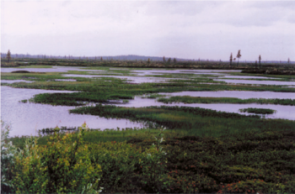
Methane gas released by peat bogs in the northern-most third of the globe probably helped fuel the last major round of global warming, which drew the ice age to a close between 11,000 and 12,000 years ago, UCLA and Russian Academy of Sciences scientists have concluded.
But the new information in no way lets human sources of greenhouse gases off the hook for the present round of global warming, warn the team of researchers whose findings appear in the Oct. 13 issue of Science.
"If anything, our findings show just how sensitive the planet's environment is to change and just how complex the results of these changes may be," said Glen M. MacDonald, the lead author of the study and a UCLA climate change scholar.
As the incipient bogs were strong producers of methane, the findings help solve a long-standing mystery about the source of a massive infusion of atmospheric methane that helped raise the Earth's surface temperature following the ice age.
"Scientists have long known that the northern bogs produce methane, but until now they were generally dismissed as the source of this change at the close of the last ice age because they were thought to have formed too slowly and too late to be a factor," said Laurence C. Smith, a UCLA professor of geography and study coauthor. "The initial development of the huge complex of northern bogs that now cover 1.54 million square miles occurred earlier than previously thought."
With funding from the National Science Foundation, MacDonald, Smith and four other researchers cored 84 peat bogs in Siberia. By radiocarbon dating the samples, they were able to reconstruct the timing of initial bog development. The researchers then assembled previously gathered radiocarbon dates for an additional 1,432 peat bogs throughout Northern Europe, Asia and North America, including Greenland.
They then compared the formation dates for these 1,516 bogs with high-resolution ice core records of the Earth's atmosphere and temperature from two locations: Dome C, a half-mile ice core from Antarctica dating back 32,000 years; and the Greenland Ice Core Project 2, a 1.9-mile ice core dating back 110,000 years. As they formed, the ice caps captured miniscule air bubbles that reveal the amount of carbon dioxide and methane gas in the atmosphere and provide information on surface temperature at any given time in the past.
Peat bogs sequester vast amounts of carbon by preventing plant material from decaying aerobically — that is, with oxygen. Today, these peatlands are thought to hold about one-third of globe's store of sequestered soil carbon.
But, in addition to tying up carbon, the bogs release methane gas as a byproduct of plant decomposition that takes place without oxygen. Like carbon dioxide, methane is a greenhouse gas. But, molecule for molecule, it is said to be up to 23 times more potent as a greenhouse gas than carbon dioxide. So while peatlands do sequester carbon, their methane emissions can offset any potential drop in greenhouse gases. Yet, the rate of emissions is not steady.
"Newly formed peatlands are often typified by systems dominated by sedge plants — systems that tend to produce a large amount of methane," said Dave W. Beilman, a UCLA post-doctoral researcher and study coauthor. "But over time, peat moss-dominated systems develop, and they emit less of the gas."
The UCLA-Russian Academy of Sciences team found no peatland dates earlier than about 16,500 years ago, suggesting that no large northern peatland complex existed before that time. At that time, methane levels hovered around 360 parts per billion by volume and the Earth was still in a deep freeze. But as surface temperatures and atmospheric methane levels rose, northern bogs appeared in lockstep, the team found.
Over the course of the next 2,500 years, atmospheric methane levels doubled and temperatures in central Greenland — where the ice core is located — jumped 18 degrees Fahrenheit.
Between 8,000 to 12,000 years ago, the area covered by peatlands increased dramatically and methane levels rose to 750 parts per billion by volume — a level they would not reach again until the Industrial Revolution. Temperatures over Greenland likewise jumped an additional 7 degrees Fahrenheit, reflecting a period of warming which in turn thawed more ice, particularly in North America, and freed up more land for bog formation, MacDonald said.
In the past, scientists have attributed the 8,000-to-12,000-year-old methane release to wetlands in the tropics or liquefied deposits of very cold methane buried deep in the ocean. What — if any — part was played by tropical wetlands is still unclear, but the role of ocean deposits has been disputed by two recent studies.
"It is now clear that the northern peatlands have to be considered a major part of this prolonged early rise in methane," said MacDonald, who is chair of the UCLA Geography Department and a professor in the UCLA Department of Ecology and Evolutionary Biology.
In addition to pinpointing a new source of methane that helped end the ice age, the team's work has established a much earlier date for the formation of these bogs. Until a related discovery announced two years ago by the same researchers, scientists had thought that the northern peatlands did not start forming until 8,000 years ago. But the new research suggests that by that time, 50 percent of today's northern peatlands were already formed.
Over the past 8,000 years, the rate of bog formation has steadily declined, the new research shows. Meanwhile, starting 6,000 years ago methane levels began to steadily increase before jumping dramatically by between 2.5 and 3.0 times following the start of the Industrial Revolution about 200 years ago. Some researchers have attributed the latter increase to human activities, including early rice cultivation, cattle domestication and biomass burning. Other researchers have suggested the increased growth of northern peatlands is responsible.
The human role in the increase 6,000 years ago remains controversial, but major increased expansion of northern peatlands is probably not the culprit, MacDonald said.
"The rate of development of these peatlands has been slowing down and they have been maturing into low-methane producing moss bogs, so they don't seem to be responsible for the steady growth of atmospheric methane that began 6,000 years ago," MacDonald said. "The source of that methane — human or otherwise — remains an important question."
In addition to MacDonald, Smith and Bielman, other researchers on the team were Konstantine V. Kremenetski, UCLA research scientist; Yongwei Sheng, UCLA assistant professor of geography; and Andrei A. Velichko, director of the Laboratory of Evolutionary Geography of the Russian Academy of Sciences.
Source: UCLA


