Giant Pandas See in Color
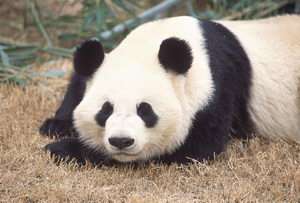
They may be black and white, but new research at the Georgia Institute of Technology and Zoo Atlanta shows that giant pandas can see in color. Graduate researcher Angela Kelling tested the ability of two Zoo Atlanta pandas, Yang Yang and Lun Lun, to see color and found that both pandas were able to discriminate between colors and various shades of gray. The research is published in the psychology journal Learning and Behavior, volume 34 issue 2.
“My study shows that giant pandas have some sort of color vision,” said Kelling, graduate student in Georgia Tech’s Center for Conservation Behavior in the School of Psychology. “Most likely, their vision is dichromatic, since that seems to be the trend for carnivores.”
Vision is not a well-studied aspect of bears, including the giant pandas. It has long been thought that bears have poor vision, perhaps, Kelling said, because they have such excellent senses of smell and hearing. Some experts have thought that bears must have some sort of color vision as it would help them in identifying edible plants from the inedible ones, although there’s been little experimental evidence of this. However, one experiment on black bears found some evidence that bears could tell blue from gray and green from gray. Kelling used this study’s design as the basis to test color vision in Zoo Atlanta’s giant pandas.
Over a two-year period, Kelling investigated whether giant pandas can tell the difference between colors and shades of gray. In separate tests, the two pandas (Lun Lun, the female, and Yang Yang, the male) were presented with three PVC pipes, two hanging under a piece of paper that contained one of 18 shades of gray and one that contained a color – red, green or blue. If the panda pushed the pipe located under a color, it received a reward. If it pushed one of the pipes under the gray paper, it received nothing.
Kelling tested each color separately against gray. In the green versus gray tests, the bears’ performance in choosing green was variable, but mostly above chance. In the red versus gray tests, both bears performed above chance every single time. Only Lun Lun completed the blue versus green tests because Yang Yang had a tooth problem that prevented him from eating the treats used as reinforcement. For this trial, Lun Lun performed below chance only once.
“While this study shows that giant pandas have some color vision, it wasn’t conclusive as to what level of color vision they have,” said Kelling. “From this study, we can’t tell if the pandas can tell the difference between the colors themselves, like red from blue, or blue from green. But we can see that they can determine if something is gray or colored. That ability and the accompanying visual acuity could lead to the pandas being better able to forage for bamboo. For instance, to determine whether to head for a bamboo patch that is healthy and colorful as opposed to one that is brown and dying.”
Source: Georgia Institute of Technology


