Physicist's Snowflake Images Get Stuck
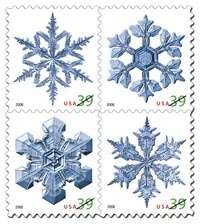
Physicist Kenneth Libbrecht’s snowflake images have gotten stuck--on a stamp. Last week the United States Postal Service issued four new 39-cent commemorative postage stamps based on Libbrecht’s high-resolution microscope images of snowflakes.
Snowflake crystals begin as a water droplet inside a cloud that freezes into a tiny ice particle. As water vapor gathers on the ice particle, the particle spreads out and becomes a small prism with six sides. As it gathers more vapor, the prism sprouts branches and starts to look more like a crystal. Inside the cloud, the newly born snowflake crystal is bounced around amid temperature and humidity changes that can affect its shape. "This is why no two snowflakes are alike," says Libbrecht.
According to Libbrecht, there are 35 different types of snowflake crystals, but the stamps feature two specific types: stellar dendrite snowflake crystals (upper left, upper right, and lower right stamps), which are plate-like and have branches. These are the most popular snow crystal type. The other stamp is a sectored plate snowflake crystal (lower left stamp) that has broad branches with prominent, distinctive ridges.
Ironically, Libbrecht is based at the California Institute of Technology in Pasadena, CA -- a place that almost never sees snow. Libbrecht’s images were taken from snowfalls in Michigan, Alaska and Ontario.
Collecting the fragile snowflake crystals to photograph is a delicate business. After gathering the crystals, Libbrecht uses a small paintbrush to carefully transfer the snowflake crystals onto a glass slide. Then he captures the images using a digital camera attached to a high-resolution microscope. In order to keep the snowflake crystals from melting, Libbrecht does most of his work outside. "The crystals evaporate away slowly under the lights of my microscope, but it usually takes several minutes before the crystal changes significantly," says Libbrecht.
With Libbrecht’s stamps, anyone can get stuck on snowflake crystals — even if you’ve never seen snow.
Dr. Libbrecht’s Snowflakes and Snow Crystals website: www.snowcrystals.com/
Source: American Institute of Physics


