Hairy feet stick better to wet ceilings
Researchers at the Max Planck Institute for Metals Research show that humidity strengthens the adhesive force of the tiny hairs on gecko feet
Now, for the first time, scientists from the Max Planck Institute for Metals Research in Stuttgart have succeeded in examining, in the smallest detail, the adhesive mechanisms on the soles of gecko feet – with about a billion nanohairs per foot – using high resolution microscopy and certain special tricks.
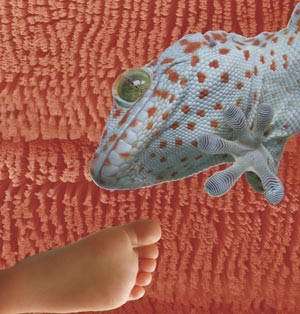
Image: Nanostructures on the soles of gecko feet. Thanks to about one billion hierarchically organised nanohairs, the gecko can go for a walk on walls and ceilings, unlike people. Image: Max Planck Institute for Metals Research
The researchers have discovered that, at the nanoscale, the adhesiveness of geckos increases with the amount of humidity. It is an important finding for the bio inspired development of artificial adhesive systems– for example, new kinds of self-adhesive tapes. (PNAS, Early Edition, November 8, 2005 [1]).
On the sole of a gecko's feet there are some one billion 'spatulae'. These are tiny adhesive hairs, about 200 nanometres in both width and length. These hairs put the gecko in direct physical contact with its environment. They sit in a three-part, hierarchically-ordered adhesive system on top of 'setae', which are about one-tenth the diameter of a human hair, about 100 micrometres long and six micrometres wide. The setae lie in a row and together form lamellae, which, at 400 to 600 micrometres in length, are visible to the naked eye.
The adhesive system, whose branches become increasingly smaller over three levels, allows the gecko to stick to just about any ceiling and walk with its feet over its head. Until now, scientists were uncertain as to what mechanism was responsible for the extreme adhesive ability of the gecko. What was clear is that the adhesive system was 'dry' – in other words, that it functioned without secreting anything of its own. It uses rather water, which is present as a thin film on every terrestrial surface.
Until now, experiments had been carried out only at the level of single lamellae and setae (100 to 1000 spatulae). The Max Planck researchers in Stuttgart, however, used an Atomic Force Microscope (AFM) to measure the adhesive ability of individual spatulae. The research was published in March 2005 [2]. More recently. the scientists measured the adhesive force at substrates at various levels of hydrophilicity (tendency to bond with water), as well as at various levels of air humidity.
The researchers first removed individual setae from the foot of a Gekko gecko, using the point of a needle. Under a binocular microscope, they fixed the isolated hair with a drop of glue to a cantilever, and then set it perpendicular. The drop was about the size of the end of a human eyelash. The researchers manipulated the probe with a Focussed Ion Beam (FIB). To prevent the probe from being damaged, they used a low beam current of only 11 picoamperes. Starting at the location of the glue, they cut a branch off of each hairy branching along the seta. This way, they reduced the number of spatulae, from what was originally hundreds, to fewer than five.
The force measurements led the scientists to experiment with specially prepared wafer surfaces and glass plates at various levels of air humidity. These surfaces, which either tended to bond with water or to repel it, were different in their degree of wetting. The measurements showed that the more hydrophilic the substrate is, the greater the adhesive force. The modified surface chemistry itself does not clearly determine what the relative effects are of the capillary force and the van der Waals force. Understanding this required further adhesive experiments at various levels of air humidity. They showed that as humidity increases, the capillary forces strengthen. Only taken together do these results make it clear that ultra-thin water layers, like those between a gecko spatula and a substrate, influence the strength of adhesive forces. The researchers were able to explain the data they collected using a theoretical model.
The newest results give clear insight into which adhesive mechanisms have an effect on the bottom of a gecko's feet at the nanoscale, and help in the development of new, reusable adhesive tapes.
[1] Huber, G., Mantz, H., Spolenak, R., Mecke, K., Jacobs, K., Gorb, S. and Arzt, E., Evidence for capillarity contributions to gecko adhesion from single spatula nanomechanical measurements, PNAS, vol. 102, no. 45, 16293 - 16296, November 8, 2005
[2] Huber, G., Gorb, S., Spolenak, R. and Arzt, E., Resolving the nanoscale adhesion of individual gecko spatulae by atomic force microscopy, Biol. Lett., vol. 1, no. 1, 2 - 4, March 22, 2005
Source: Max-Planck-Gesellschaft


