Star on the run
November 9, 2005
Speeding star observed with VLT hints at massive black hole
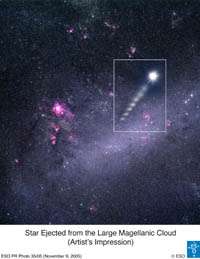
Using ESO’s Very Large Telescope, astronomers have recorded a massive star moving at more than 2.6 million kilometres per hour.
Stars are not born with such large velocities. Its position in the sky leads to the suggestion that the star was kicked out from the Large Magellanic Cloud, providing indirect evidence for a massive black hole in the Milky Way’s closest neighbour. These results will soon be published in the Astrophysical Journal Letters.
“At such a speed, the star would go around the Earth in less than a minute!”, says Uli Heber, one of the scientists at the Dr. Remeis-Sternwarte (University of Erlangen-Nьrnberg, Germany) and the Centre for Astrophysics Research (University of Hertfordshire, UK) who conducted the study.
The hot massive star, (named HE 0437-5439), was discovered in the framework of the Hamburg/ESO sky survey far out in the halo of the Milky Way, towards the Doradus Constellation (“the Swordfish”).
“This is a rather unusual place for such a star: massive stars are ordinarily found in the disc of the Milky Way”, explains Ralf Napiwotzki, another member of the team. “Our data obtained with the UVES instrument on the Very Large Telescope, at Paranal (Chile), confirm the star to be rather young and to have a chemical composition similar to our Sun.”
The data also revealed the high speed of the star, solving the riddle of its present location: the star did not form in the Milky Way halo, but happens to be there while on its interstellar – or intergalactic – travel.
“But when we calculated how long it would take for the star to travel from the centre of our Galaxy to its present location, we found this to be more than three times its age”, says Heber. “Either the star is older than it appears or it was born and accelerated elsewhere”, he adds.
As a matter of fact, HE0457-5439 lies closer to one of the Milky Way satellite galaxies, the Large Magellanic Cloud, located 160,000 light-years away from us. The astronomers find it likely for the star to have reached its present position had it been ejected from the centre of the LMC. This could imply the existence of a massive black hole inside the LMC, in order to have imparted the speeding star the necessary kick.
Another explanation would require the star to be the result of the merging of two stars. In this case, the star could be older that presently thought, giving it time to have travelled all the way from the Milky Way Centre. This scenario, however, requires quite some fine-tuning. The astronomers are now planning new observations to confirm one of the two scenarios.
Source: European Southern Observatory (ESO)
-
VLT takes most detailed infrared image of the Carina Nebula
Feb 08, 2012 |
5 / 5 (6) |
3
-
New images capture 'stealth merger' of dwarf galaxies
Feb 08, 2012 |
4.3 / 5 (4) |
0
-
Remnant of an explosion with a powerful kick?
Feb 02, 2012 |
not rated yet |
1
-
Hubble zooms in on a magnified galaxy
Feb 02, 2012 |
5 / 5 (13) |
11
-
Citizen scientist project finds thousands of ‘star bubbles’
Jan 17, 2012 |
4.8 / 5 (8) |
0
-
Engineers build first sub-10-nm carbon nanotube transistor
Feb 01, 2012 |
4.9 / 5 (31) |
30
-
Something old, something new: Evolution and the structural divergence of duplicate genes
Jan 31, 2012 |
4.6 / 5 (7) |
1
-
The hidden nanoworld of ice crystals: Revealing the dynamic behavior of quasi-liquid layers
Jan 30, 2012 |
5 / 5 (3) |
1
-
Stock market network reveals investor clustering
Jan 27, 2012 |
3.9 / 5 (23) |
8
-
Of microchemistry and molecules: Electronic microfluidic device synthesizes biocompatible probes
Jan 26, 2012 |
5 / 5 (1) |
0
More news stories
Europe stakes billion-dollar bet on new rocket
A pencil-slim rocket is scheduled to lift into space from South America on Monday, carrying a billion-dollar bet that Europe can grab a juicy slice of the market to place satellites in low orbit.
Space & Earth / Space Exploration
1 hour ago |
3.5 / 5 (2) |
0
NASA sees wide-eyed cyclone Jasmine
Cyclone Jasmine's eye has opened wider on NASA satellite imagery, as it moves through the Southern Pacific Ocean.
Space & Earth / Earth Sciences
17 hours ago |
3.5 / 5 (2) |
2
NASA sees Giovanna reach cyclone strength, threaten Madagascar
Tropical Storm 12S built up steam and became a cyclone on February 10, 2012 as NASA's Terra satellite passed overhead. Residents of east-central Madagascar should prepare for this cyclone to make landfall ...
Space & Earth / Earth Sciences
17 hours ago |
not rated yet |
0
Humans may have helped the decline of African rainforests 3000 years ago
(PhysOrg.com) -- Large areas of rainforests in Central Africa mysteriously disappeared over three thousand years ago, to be replaced by savannas. The prevailing theory has been that the cause was a change ...
Political leaders play key role in how worried Americans are by climate change: study
More than extreme weather events and the work of scientists, it is national political leaders who influence how much Americans worry about the threat of climate change, new research finds.
Feb 06, 2012 |
5 / 5 (6) |
68
Walney offshore wind farm is world's biggest (for now)
(PhysOrg.com) -- The Walney wind farm on the Irish Sea--characterized by high tides, waves and windy weather--officially opened this week. The farm is treated in the press as a very big deal as the Walney ...
GPS court ruling leaves US phone tracking unclear
A US Supreme Court decision requiring a warrant to place a GPS device on the car of a criminal suspect leaves unresolved the bigger issue of police tracking using mobile phones, legal experts say.
Study finds that anti-diabetic medication can prevent the long-term effects of maternal obesity
In a study to be presented today at the Society for Maternal-Fetal Medicine's annual meeting, The Pregnancy Meeting, in Dallas, Texas, researchers will report findings that show that short therapy with the anti-diabetic medication ...
Netflix settlement trims 14 pct off 4Q earnings
(AP) -- Netflix pressed the rewind button on its fourth-quarter earnings after settling allegations that the video subscription service violated a consumer-privacy law.
Anonymous briefly knocks CIA website offline (Update 2)
The website of the Central Intelligence Agency was briefly inaccessible on Friday after the hacker group Anonymous claimed to have knocked it offline.
Amateur football players not always keen on returning to play after ACL injuries
Despite the known success rates of reconstructive Anterior Cruciate Ligament (ACL) surgery, the number of high school and collegiate football players returning to play may not be as high as anticipated, say researchers presenting ...