Researchers find a neural signature of bilingualism
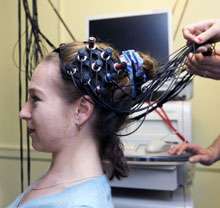
Dartmouth researchers have found areas in the brain that indicate bilingualism. The finding sheds new light on decades of debate about how the human brain's language centers may actually be enhanced when faced with two or more languages as opposed to only one. The study was presented at the Society for Neuroscience's annual meeting on October 14-18 in Atlanta, Ga.
The researchers used an optical imaging technology called Near Infrared Spectroscopy (or NIRS) as a new "microscope" into the human brain's higher cognitive capacities, and they are among the first to take advantage of this technology in this way. NIRS has been used in the detection of, for example, breast tumors and heart blood flow. The Dartmouth team used NIRS to measure changes in the brain's oxygen levels while people performed specific language and cognitive tasks.
Authors of the study are Mark Shalinsky, former post-doctoral fellow at Dartmouth now a research fellow at Massachusetts General Hospital; Ioulia Kovelman, formerly a Dartmouth graduate student currently a post-doctoral fellow at MIT; Melody Berens, currently a post-doctoral fellow at Dartmouth; and Laura-Ann Petitto, the study's senior scientific director, and professor and chair of the Department of Education at Dartmouth.
"NIRS provides much the same information as functional magnetic resonance imaging or 'fMRI,' but has several advantages over fMRI," says Shalinsky, the study's electro-neurophysiologist who created the analysis programs to use NIRS technology in this new way. NIRS technology is quiet, small and portable. It's only about the size of a desktop computer. It's child friendly, and it tolerates a participant's body movements, which makes it ideal for studying language where participants move their mouths to speak."
The NIRS showed similar increased brain activity across all people—monolinguals and bilinguals—in the brain's classic left-hemisphere language regions when they were speaking in only one language (that is, in "monolingual mode"), involving the left Broca's area and left dorsolateral prefrontal cortex (DLPFC), which are brain areas key to language and verbal working memory, respectively.
When bilinguals were simultaneously processing each of their two languages and rapidly switching between them (that is, in "bilingual mode"), they showed an increase in brain activity in both the left and the right hemisphere Broca's area, with greater activation in the right equivalent of Broca's area and the right DLPFC. This finding emerged as the key indicator of the brain's bilingual signature.
The researchers examined 20 people ranging from 18 to 30 years old (average age was 21.1 years). Ten participants were monolingual (who spoke only English), and ten were bilingual (who spoke both English and Spanish from around birth). Language processing tasks were given to monolingual people speaking their one language while undergoing NIRS brain recordings. The monolingual speakers' behavioral and brain activity were then compared to the bilingual speakers' behavioral and brain activity while performing identical language processing tasks in "monolingual mode" (that is, in Spanish, and in English) or in "bilingual mode" (that is, when simultaneously processing and rapidly switching between their two languages). The Dartmouth team used the Hitachi ETG-4000 NIRS system.
"For decades, people have wondered whether the brains of bilingual people are different from monolinguals. People also worry that the brains of bilingual children are somehow negatively impacted by early experience with two languages," explains Petitto, who also holds the John Wentworth Endowed Chair in the Social Sciences. "The present findings are significant because they show that the brains of bilinguals and monolinguals are similar, and both process their individual languages in fundamentally similar ways. The one fascinating exception is that bilinguals appear to engage more of the neural landscape available for language processing than monolinguals, which is a very good thing."
The team proposes that bilingual language processing provides a new window into the extent of what nature's neural architecture for language processing could be, if only we used it. Petitto adds, "The irony is that we may find it is the monolingual that is not taking full advantage of the neural landscape for language and cognitive processing than nature could have potentially made available."
She says that this research advances the path for using NIRS brain imaging technology both to understand the neural underpinnings of all human language and especially to discover the secrets of the bilingual brain.
Source: Dartmouth College


