More Than a Meteor Likely Killed Dinosaurs 65 Million Years Ago
October 17, 2006 More Than a Meteor Likely Killed Dinosaurs 65 Million Years Ago

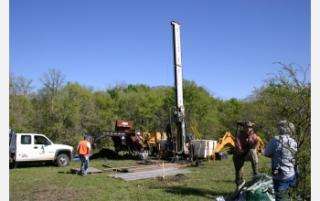
Geologists drilling in the Brazos River region of Texas have found new evidence for what killed the dinosaurs 65 million years ago. Credit: Gerta Keller

Growing evidence shows that the dinosaurs and their contemporaries were not wiped out by the famed Chicxulub meteor impact alone, according to a paleontologist who says multiple meteor impacts, massive volcanism in India and climate changes culminated in the end of the Cretaceous Period.

The Chicxulub impact may have been the lesser and earlier of a series of meteor impacts and volcanic eruptions that pounded life on Earth for more than 500,000 years, say Princeton University paleontologist Gerta Keller and her collaborators Thierry Adatte from the University of Neuchatel, Switzerland, and Zsolt Berner and Doris Stueben from Karlsruhe University in Germany.

A final, much larger and still unidentified impact 65.5 million years ago appears to have been the last straw, said Keller, exterminating two-thirds of all species in one of the largest mass extinction events in the history of life. It's that impact - not Chicxulub - that left the famous extraterrestrial iridium layer found in rocks worldwide that marks the impact that finally ended the Age of Reptiles, Keller believes.

"The Chicxulub impact alone could not have caused the mass extinction," said Keller, "because this impact predates the mass extinction."

Keller is scheduled to present that evidence at the annual meeting of the Geological Society of America (GSA) in Philadelphia, on Tuesday, October 24, 2006.

"Chicxulub is one of thousands of impact craters on Earth's surface and in its subsurface," said H. Richard Lane, program director in the National Science Foundation (NSF) Division of Earth Sciences, which funded the research. "The evidence found by Keller and colleagues suggests that there is more to learn about what caused the major extinction event millions of years ago, and the demise of the dinosaurs at the end of the Cretaceous."

Marine sediments drilled from the Chicxulub crater itself, as well as from a site in Texas along the Brazos River and from outcrops in northeastern Mexico, reveal that Chicxulub hit Earth 300,000 years before the mass extinction. Microscopic marine animals were left virtually unscathed, said Keller.

"In all these localities we can analyze their microfossils in the sediments directly above and below the Chicxulub impact layer, and cannot find any significant biotic effect," said Keller. "We cannot attribute any specific extinctions to this impact."

The story that seems to be taking shape, according to Keller, is that Chicxulub, though violent, actually conspired with the prolonged and gigantic volcanic eruptions of the Deccan Flood Basalts in India, as well as with climate change, to nudge species towards the brink. They were then pushed over with a second large meteor impact.

The Deccan volcanism released vast amount of greenhouse gases into the atmosphere over a period of more than a million years leading up to the mass extinction. By the time Chicxulub struck, the oceans were already 3-4 degrees warmer, even at the bottom, Keller said.

"On land it must have been 7-8 degrees warmer," she said. "This greenhouse warming is well-documented. The temperature rise was rapid over about 20,000 years, and it stayed warm for about 100,000 years, then cooled back to normal well before the mass extinction."

Where's the crater? "I wish I knew," said Keller.

Source: NSF


print this article email this article download pdf blog this article bookmark this article     Stumble it Digg this share on Facebook retweet share on Reddit add to delicious
Rate this story - 4.1 /5 (70 votes)


October 17, 2006 all stories

Comments: 0

4.1 /5 (70 votes)
  • Stumble this up

  • Digg this

  • share this

  • hide
  • Related Stories

  • Geoscientist offers new evidence that meteorite did not wipe out dinosaurs
    created May 04, 2009 | popularity not rated yet | comments 0
  • New Blow for Dinosaur-Killing Asteroid Theory
    created Apr 27, 2009 | popularity not rated yet | comments 0
  • Dinosaur Deaths Outsourced to India?
    created Oct 29, 2007 | popularity not rated yet | comments 0
  • The art of persuasion: Are consumers interested in abstract or concrete features?
    created Aug 24, 2009 | popularity not rated yet | comments 0
  • Nearly 1 million gallons of runoff, raw sewage spills into San Francisco Bay
    created Feb 25, 2009 | popularity not rated yet | comments 0


  • hide
  • Relevant PhysicsForums posts

  • Random variability of wind patterns
    created 13 hours ago
  • Record precipitation in the UK
    created 17 hours ago
  • How to move cloud from one time to another..
    created Nov 22, 2009
  • Which countries around the world cause the most destruction to the rain forest
    created Nov 21, 2009
  • More from Physics Forums - Earth

Other News

Intensive land management leaves Europe without carbon sinks

Intensive land management leaves Europe without carbon sinks

Space & Earth / Earth Sciences

created 2 hours ago | popularity 3 / 5 (4) | comments 0

A new calculation of Europe's greenhouse gas balance shows that emissions of methane and nitrous oxide tip the balance and eliminate Europe's terrestrial sink of greenhouse gases.


Using new technique, scientists find 11 times more aftershocks for 2004 quake

Space & Earth / Earth Sciences

created 1hour ago | popularity not rated yet | comments 0

(PhysOrg.com) -- Using a technique normally used for detecting weak tremor, scientists at the Georgia Institute of Technology discovered that the 2004 magnitude 6 earthquake along the Parkfield section of the San Andreas ...


Astronauts take spacewalk No. 3 after suit snag (AP)

Astronauts take spacewalk No. 3 after suit snag

Space & Earth / Space Exploration

created 2 hours ago | popularity not rated yet | comments 0

(AP) -- A pair of astronauts stepped out on the third and final spacewalk of their shuttle mission Monday, helping to install an enormous oxygen tank at the International Space Station.


Scientist: Leak of climate e-mails appalling

Space & Earth / Environment

created 2 hours ago | popularity 3.2 / 5 (5) | comments 2

(AP) -- A leading climate change scientist whose private e-mails are included in thousands of documents that were stolen by hackers and posted online said Sunday the leaks may have been aimed at undermining next month's ...


Is global warming unstoppable?

Space & Earth / Environment

created 8 hours ago | popularity 3 / 5 (12) | comments 16

In a provocative new study, a University of Utah scientist argues that rising carbon dioxide emissions - the major cause of global warming - cannot be stabilized unless the world's economy collapses or society builds the ...