Portable, Life-Saving Seat Belt Created Following Tragic Crash
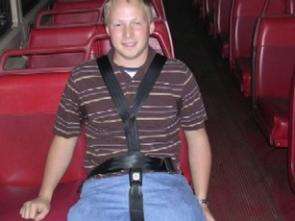
A lightweight, portable seat belt that could save many of the hundreds of lives lost each year by Americans traveling abroad, has been created by a group of engineering undergraduates at the University of Massachusetts Amherst. The seat belts could also lower the international toll of vehicle accidents, a leading cause of death and disability in both developed and developing countries worldwide.
The inspiration for the portable seat belts was the tragic death of an American student traveling abroad ten years ago. On March 27, 1996, Georgetown University junior Sara Schewe, one of thousands of American students studying abroad that year, was killed in a bus crash in India when her vehicle overturned on a dark road.
Her parents, Charles Schewe, a faculty member at the Isenberg School of Management at UMass Amherst, and Anne Schewe, have since started a philanthropic organization dedicated to their daughter and named Sara’s Wish Foundation. One purpose of the foundation is to bring greater awareness to improving safety in travel, especially in student study-abroad programs.
“When one’s child is taken from you, many decide to go into a room and not come out,” says Charles Schewe, about the inspiration for the foundation. “Anne and I decided not to follow that road but rather to become committed to making the study abroad community a safer group of global travelers.”
As part of the foundation’s activities, the Schewes contacted Sundar Krishnamurty of the mechanical and industrial engineering department at UMass Amherst to see if his sophomore design class could conceive and build portable seat belts that travelers could take with them abroad and use in all kinds of vehicles. If Sara and her fellow passengers had these devices, perhaps she and the six other people who died on her bus might have survived the crash.
“The idea of a portable seat belt came quite naturally as we understood the surging statistics on road crash injuries and fatalities, like with our Sara,” notes Schewe. “It was just a thought, a hope, that these bright, young engineers have grasped and are making a reality. Such a seat belt will go a long way to keeping our children safe and whole. And we know that would be Sara’s Wish!”
The result is a lightweight, portable seat belt—suitable for carrying in luggage—that can be easily and quickly attached to any kind of vehicle seat and thus anchor the user quite snugly and securely.
The design consists of a lap belt and over-the-shoulder-belts, which are sewn to a fabric carrying case with a semi-flexible plastic infrastructure. Two retractable seat belts are bolted to a steel plate, which is connected to the carrying case by a single belt. The two retractable belts are sewn together around a single male buckle component, creating a V-structure over the passengers’ torso when buckled to the female buckle between the legs. The seat belt is compatible with at least three different models of bus seats and resists the force of collision.
“This project was based on the needs of real people and a human interest story that truly touched all our students,” says Krishnamurty, noting the profound effect of the Schewes’ presentation to his class. “There were so many students affected by the presentation and the challenge of creating a portable seat belt that would save lives. As a result, seven teams ended up working on this idea.”
At the end of the course, Krishnamurty booked a large conference room in the College of Engineering and invited nine judges (including the Schewes) to referee a competition among the design teams. The judges chose one design, created by mechanical engineering students Ronald Leung, Joshua Doolittle and Clint Walton as the best and most practical of the seven prototypes. The winning team members each received a $100 gift certificate from Sensata Technologies of Attleboro, Mass., a company that also supplied $800 to help all seven teams construct prototype seat belts in the machine shop.
Meanwhile, Sara’s Wish Foundation has expressed interest in facilitating the patenting and marketing of portable seat belts and having at least one of the teams give a presentation at the next annual meeting of the organization in June. Charles Schewe has also invited members from the design teams to take his marketing course at the School of Management, titled Tools for Professional Success, where they will investigate consumer reactions to the design and develop a marketing plan.
As one design team described its motivation for tackling the concept suggested by Sara’s Wish Foundation: “Our main focus on this project is to make a safe, easy-to-use seat belt that will save as many lives as soon as possible.”
For additional information, go to: www.saraswish.org/
Source: University of Massachusetts Amherst


