Einstein's relativity theory proven with the 'lead' of a pencil
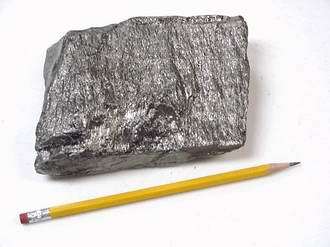
November 9, 2005 Pencil and Graphite

Scientists at The University of Manchester have discovered a new way to test Einstein's theory of relativity using the 'lead' of a pencil.

Until now it was only possible to test the theory by building expensive machinery or by studying stars in distant galaxies, but a team of British, Russian and Dutch scientists has now proven it can be done in the lab using an ultra-thin material called Graphene.

The group, led by Professor Andre Geim of the School of Physics and Astronomy, discovered the one atom thick material last year. Graphene is created by extracting one atom thick slivers of graphite via a process similar to that of tracing with a pencil.

Professor Geim, said: "To understand implications of the relativity theory, researchers often have to go considerable lengths, but our work shows that it is possible to set up direct experiments to test relativistic ideas. In theory, this will speed up possible discoveries and probably save billions of pounds now that tests can be set up using Graphene and relatively inexpensive laboratory equipment."

In a paper published in Nature (November 10, 2005), the team describes how electric charges in Graphene appear to behave like relativistic particles with no mass (zero rest mass). The new particles are called massless Dirac fermions and are described by Einstein's relativity theory (so-called the Dirac equation).

The team also reports several new relativistic effects. They have shown that massless Dirac fermions are pulled by magnetic fields in such a manner that they gain a dynamic (motion) mass described by the famous Einstein's equation E=mc2. This is similar to the case of photons (particles of light) that also have no mass but can still feel the gravitational pull of the Sun due their dynamic mass described by the same equation.

Dr Kostya Novoselov, a key investigator in this research, added: "The integer and fractional quantum Hall effects are two of the most remarkable discoveries of the late 20th century. It is not easy to explain their significance but both discoveries led to Nobel prizes. One can probably appreciate the importance of our present work in terms of fundamental physics, if I mention that one of the phenomena we report is a new, relativistic type of the quantum Hall effect."

Source: University of Manchester


print this article email this article download pdf blog this article bookmark this article     Stumble it Digg this share on Facebook retweet share on Reddit add to delicious
Rate this story - 4.4 /5 (44 votes)


November 9, 2005 all stories

Comments: 0

4.4 /5 (44 votes)
  • Stumble this up

  • Digg this

  • share this

  • hide
  • Related Stories

  • New study confirms exotic electric properties of graphene
    created Nov 17, 2009 | popularity not rated yet | comments 0
  • Graphene gazing gives glimpse of foundations of universe
    created Apr 03, 2008 | popularity not rated yet | comments 0
  • A line on string theory
    created Nov 12, 2009 | popularity not rated yet | comments 0
  • Do we need dark matter?
    created Nov 12, 2009 | popularity not rated yet | comments 0
  • Seattle team wins $900,000 in Space Elevator Games
    created Nov 07, 2009 | popularity not rated yet | comments 0


Other News

Nuclear weapons: Predicting the unthinkable

Physics / General Physics

created 20 hours ago | popularity 2.3 / 5 (4) | comments 3

If a nuclear weapon were detonated in a metropolitan area, how large would the affected area be? Where should first responders first go? According to physicist Fernando Grinstein, we have some initial understanding to address ...


Aquatic creatures mix ocean water

Physics / General Physics

created 17 hours ago | popularity 5 / 5 (3) | comments 0

Understanding mixing in the ocean is of fundamental importance to modeling climate change or predicting the effects of an El Niņo on our weather. Modern ocean models primarily incorporate the effects of winds and tides. However, ...


Generating electricity from air flow

Physics / General Physics

created 20 hours ago | popularity 3.9 / 5 (8) | comments 2

A group of researchers at the City College of New York is developing a new way to generate power for planes and automobiles based on materials known as piezoelectrics, which convert the kinetic energy of motion into electricity. ...


Restored machine to explore mysteries of Big Bang (AP)

Restored machine to explore mysteries of Big Bang

Physics / General Physics

created Nov 21, 2009 | popularity 4.6 / 5 (18) | comments 20

(AP) -- Scientists are preparing the world's largest atom smasher to explore the depths of matter after successfully restarting the $10 billion machine following more than a year of repairs.


nuclear power plant

Doubts raised on nuclear industry viability

Physics / General Physics

created Nov 19, 2009 | popularity 3.1 / 5 (20) | comments 19

(PhysOrg.com) -- The investment in nuclear power has been growing around the world over the last few years, being viewed as a means for countries to control their energy security, avoid the price fluctuations ...