Researchers give name to ancient mystery creature
October 18, 2006 Researchers give name to ancient mystery creature

The oddly shaped teeth of a prehistoric mystery creature are responsible for its new name.

For the first time, researchers at the University of Alberta have been able to put a name and a description to an ancient mammal that still defies classification.

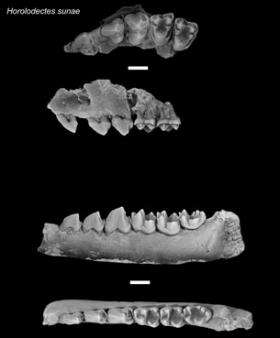
The findings, published recently in the Journal of Paleontology provide the first and only comprehensive account of the creature, named Horolodectes sunae, for the unusual shape of the crowns of the teeth. Horolodectes lived about 60 million years ago, soon after the dinosaurs went extinct, in a period known for its rapid diversification of small mammals. Based on careful examination of tooth and jaw fragments that have been unearthed over the past 30 years, the U of A researchers have now determined Horolodectes was a small fur-bearing animal that measured 10 centimetres in length and, due to its powerful jaws, likely had a strong bite.

Most confounding are the animal's teeth, which resemble in superficial ways those of primitive relatives of ungulates, the group of mammals which includes horses and cows. Despite the link to ungulates, which are traditionally herbivores, Horolodectes was thought to have dined on small insects and grubs.

"It had sharp crests on the teeth which formed blades, indicating it was likely carnivorous," said Craig Scott, a PhD candidate and lead author of the study.

Horolodectes means 'hourglass biter,' in reference to the creature's peculiar hourglass-shaped pre-molars, the teeth between the canine and the molars. The very tall, sharp pre-molars are unlike any others so far discovered in the mammal world. "There is nothing else with teeth quite like it," Craig said.

"In an area of North America that's been fairly well studied, it's unusual to have a critter like this pop up. It's not known anywhere else, just in Alberta. And it's quite distinct. There's no mistaking it," Scott said.

The first dental specimens of the creature were unearthed by U of A paleontologists 30 years ago from the banks of the Blindman River. About 10 years ago, more teeth were discovered at a dig site near Drayton Valley and on the banks of the Blindman. But the creature mystified the researchers, who could not positively identify it, and exactly where it fits into the evolutionary ladder is still unknown. Horolodectes remains an enigma to this day.

"It's just too bizarre to place in any group that we've known about previously," said Scott. "It's an open question until we can find more of it. We have no information from a skull or other parts of the body."

Source: University of Alberta


print this article email this article download pdf blog this article bookmark this article     Stumble it Digg this share on Facebook retweet share on Reddit add to delicious
Rate this story - 4.1 /5 (27 votes)


October 18, 2006 all stories

Comments: 0

4.1 /5 (27 votes)
  • Stumble this up

  • Digg this

  • share this


  • hide
  • Relevant PhysicsForums posts

  • Is there a gay gene?
    created 13 hours ago
  • Super quick question about Starling forces?
    created Nov 22, 2009
  • Questions about diffusion
    created Nov 22, 2009
  • Human Leukocyte Antigen (HLA) typing
    created Nov 21, 2009
  • More from Physics Forums - Biology

Other News

As robots become more common, Stanford experts consider the legal challenges

Other Sciences / Social Sciences

created 4 hours ago | popularity 4 / 5 (1) | comments 0

(PhysOrg.com) -- They already detect and defuse bombs, control traffic patterns and do some basic household chores. And scientists predict that pretty soon, robots will be using artificial intelligence to play a larger role ...


Climate change could boost incidence of civil war in Africa

Other Sciences / Social Sciences

created 6 hours ago | popularity 1.6 / 5 (7) | comments 4

Climate change could increase the likelihood of civil war in sub-Saharan Africa by over 50 percent within the next two decades, according to a new study led by a team of researchers at University of California, Berkeley, ...


The cause behind the characteristic shape of a long leaf revealed

The cause behind the characteristic shape of a long leaf revealed

Other Sciences / Mathematics

created 6 hours ago | popularity 5 / 5 (1) | comments 0

Applied mathematicians dissected the morphology of the plantain lily (Hosta lancifolia), a characteristic long leaf with a saddle-like arc midsection and closely packed ripples along the edges. The simple ...


Do kids benefit from homework?

Do kids benefit from homework?

Other Sciences / Social Sciences

created 2 hours ago | popularity not rated yet | comments 0

(PhysOrg.com) -- Homework is as old as school itself. Yet the practice is controversial as people debate the benefits or consider the shortcomings and hassles. Research into the topic is often contradictory ...


5-day delivery no sure cure for postal woes, economist says

Other Sciences / Economics

created 3 hours ago | popularity not rated yet | comments 0

Scaling back mail delivery from six days a week to five may be the best bet to stem mounting U.S. Postal Service losses, but could still be a gamble, says a University of Illinois economist who has studied the agency's persistent ...