Moon's South Pole: No Evidence For Ice Sheets
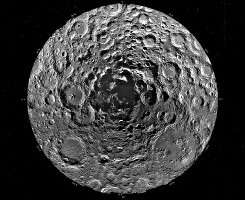
October 18, 2006 This undated photo shows the South Pole of the Moon

Using the highest resolution radar-signal images ever made of the moon – images from the National Science Foundation’s (NSF) Arecibo Telescope in Arecibo, P.R., and the NSF’s Robert C. Byrd Telescope in Green Bank, W.Va. – planetary astronomers have found no evidence for ice in craters at the lunar south pole. Cornell University, Smithsonian Institution and Australian scientists report the findings in the latest Nature (Oct. 19, 2006).

“These new results do not preclude ice being present as small grains in the lunar soil based on the Lunar Prospector’s discovery of enhanced hydrogen concentrations at the lunar poles,” said Donald Campbell, Cornell professor of astronomy and a principal investigator. “There is always the possibility that concentrated deposits exist in a few of the shadowed locations not visible to radars on Earth, but any current planning for landers or bases at the lunar poles should not count on this.”

Echoes from radar signals transmitted to the moon from the giant Arecibo telescope were received at the Green Bank telescope. These echoes allowed scientists from Cornell, the Smithsonian Institution and the Defence Science and Technology Organization in Australia to create images, offering the best view ever of the shadowed terrain at the lunar south pole.

Since the 1960s, theories have suggested that ice may exist deep inside impact craters in permanent shadow from the sun, where temperatures on the moon’s surface do not exceed minus 280 degrees Fahrenheit (or minus 173 Centigrade), at the poles. The theory was bolstered in 1992 when Earth-based radar telescopes located “ice deposits” inside impact craters at the poles of the planet Mercury.

The Lunar Prospector orbiter discovered concentrations of hydrogen at the moon’s poles. If this hydrogen were in the form of water molecules – still a subject of debate - then it would correspond to an average of 1 to 2 percent of water ice in the lunar soil in the shadowed terrain.

However, Earth-based radar measurements since the 1990s have consistently failed to detect ice deposits similar to those on Mercury. Since water ice would be a significant resource for any future lunar base, many of the instruments on NASA’s 2008 Lunar Reconnaissance Orbiter/Lunar Crater Observation and Sensing Satellite mission seek to learn if water ice is present in permanently shadowed craters.

Even in the lunar summer at the south pole, the sun barely edges above the horizon, thus the bottom impact craters never see the sun. Because of the tilt of the moon’s orbital plane relative to the Earth’s equatorial plane, the Earth can rise much higher above the horizon at the lunar south pole than the sun, so telescopes on the Earth can “see” some of the shadowed area. However, since that area is permanently in shadow, only radar can image that terrain.

Donald Campbell and Jean-Luc Margot of Cornell University, Bruce Campbell and Lynn Carter of the Smithsonian Institution, and Nicholas Stacy of the Australian Defence Science and Technology Organization conducted the research.

Source: Cornell University


print this article email this article download pdf blog this article bookmark this article     Stumble it Digg this share on Facebook retweet share on Reddit add to delicious
Rate this story - 3.6 /5 (13 votes)


October 18, 2006 all stories

Comments: 0

3.6 /5 (13 votes)
  • Stumble this up

  • Digg this

  • share this

  • hide
  • Related Stories

  • LCROSS Impact Finds Water on the Moon
    created Nov 13, 2009 | popularity not rated yet | comments 0
  • Cooking Up Water From the Moon? NASA Studies Water Extraction With Microwaves
    created Oct 19, 2009 | popularity not rated yet | comments 0
  • NASA probes hit moon twice (Update 2)
    created Oct 09, 2009 | popularity not rated yet | comments 0
  • Goddard Visualization Team Previews Lunar Impact
    created Oct 08, 2009 | popularity not rated yet | comments 0
  • Southern Arizona Telescopes Will Point at Lunar Impact Early Friday
    created Oct 07, 2009 | popularity not rated yet | comments 0


  • hide
  • Relevant PhysicsForums posts

  • Some help with a X-Ray astronomy question please!
    created 12 hours ago
  • Help with Images and Optical Instrument Question..
    created Nov 26, 2009
  • Redshift as a distance indicator
    created Nov 26, 2009
  • Question about 2-body gravity
    created Nov 24, 2009
  • More from Physics Forums - General Astronomy

Other News

Fermi Telescope Peers Deep into Microquasar

Fermi Telescope Peers Deep into Microquasar (w/ Video)

Space & Earth / Astronomy

created 6 hours ago | popularity 4.3 / 5 (3) | comments 0

(PhysOrg.com) -- NASA's Fermi Gamma-ray Space Telescope has made the first unambiguous detection of high-energy gamma-rays from an enigmatic binary system known as Cygnus X-3. The system pairs a hot, massive ...


The Energy Sources of Ultraluminous Galaxies

The Energy Sources of Ultraluminous Galaxies

Space & Earth / Astronomy

created 6 hours ago | popularity 4.3 / 5 (7) | comments 0

(PhysOrg.com) -- Ultraluminous infrared galaxies ((ULIRGs) are galaxies whose luminosity exceeds that of a trillion suns; for comparison, the Milky Way galaxy has a typical (and much more modest) luminosity ...


Space shuttle Atlantis, 7 astronauts back on Earth (AP)

Space shuttle Atlantis, 7 astronauts back on Earth

Space & Earth / Space Exploration

created 7 hours ago | popularity not rated yet | comments 0

(AP) -- Space shuttle Atlantis and its seven astronauts returned to Earth with a smooth touchdown Friday to end an 11-day flight that resupplied the International Space Station.


Herschel takes a peek at the ingredients of the galaxies

Herschel takes a peek at the ingredients of the galaxies

Space & Earth / Astronomy

created 5 hours ago | popularity 5 / 5 (1) | comments 0

(PhysOrg.com) -- The European Space Agency has today released spectacular new observations from the Herschel Space Observatory, including the UK-led SPIRE instrument. Spectrometers on board all three Hershel ...


New radar helps monitor site of century-old tragedy

New radar helps monitor site of century-old tragedy

Space & Earth / Earth Sciences

created 6 hours ago | popularity not rated yet | comments 0

(PhysOrg.com) -- A University of Alberta researcher has turned the site of a southern Alberta rockslide tragedy into the proving ground for new equipment meant to avert such a disaster in the future.