Methane devourer discovered in the Artic
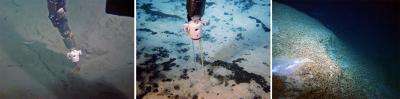
Not lava, but muds and methane are emitted from the Arctic deep-water mud volcano Haakon Mosby. When it reaches the atmosphere, methane is an aggressive greenhouse gas, 25-times more potent than carbon dioxide. Fortunately, some specialised microorganisms feed on methane and thereby reduce emissions of this greenhouse gas.
For the first time, a German-French research team showed which methane consuming microorganisms thrive in the ice-cold Arctic deep-sea. In an article in the journal Nature, the scientists also describe which environmental parameters control their activity - with a surprising result: High flow velocities of mud volcano water in the seafloor reduce the efficiency of the natural gas filter by 60%.
In 1990, the Haakon Mosby mud volcano was discovered by an international research team on the continental slope of the Barents Sea. The scientists chose its name in honour of the famous Norwegian oceanographer Haakon Mosby. The mud volcano covers an area of a about 1 square km and is located at a water depth of 1250 m. The centre emits muds, water and methane that rise from a depth of about 2 km below the mud volcano. Helge Niemann and Tina Lösekann from the Max Planck Institute for Marine Microbiology in Bremen, Germany investigated in their PhD thesis which methanotrophic microorganisms could thrive in the -1°C cold Arctic deep-sea.
Haakon Mosby is a rather flat mud volcano rising only 10 m above the ocean floor. Visual inspection by the German and French researchers distinguished three distinct concentric ring-shaped zones: the centre, surrounded by a zone covered with sulphur bacteria and then the outer rim inhabited by tubeworms.
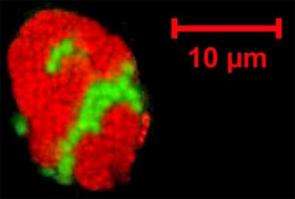
Although these habitats differ, methane is the primary food source for most microorganisms thriving in the ocean floor. At the surface of the centre, the scientists discovered formerly unknown bacteria that use oxygen to feed on methane. In sediment layers below the sulphur bacteria, Helge Niemann and Tina Lösekann found a new group of methane-consuming Archaea that live in symbiosis with bacteria. This community does not use oxygen but sulphate to oxidize methane. This process is called the anaerobic oxidation of methane (AOM) and is investigated in the research project MUMM. To their surprise, the scientists discovered that the majority of methane is consumed in the tubeworm habitat and not in the centre.
Why methane escapes the microbial filter
With their measurements, the scientists were able to show that only 40% of the rising methane is consumed by microorganisms. This is less than in most methane-rich habitats. Until now, scientists assumed that higher fluxes of methane lead to greater numbers of methane consuming microorganisms. At Haakon Mosby, very little methane is consumed in the gassy centre of the mud volcano.
The marine biologist Helge Niemann explains this phenomenon: "The methane consuming microorganisms need oxygen or sulphate from the seawater to oxidise methane. In the mud volcano water that flows upwards through the ocean floor both compounds are missing. Since the flow velocity of this water is so high, very little oxygen and sulphate from the seawater can penetrate the ocean floor and therefore the microorganisms in the centre and bacteria mat zone just don't get enough energy.
At the rim of the volcano, the situation is very different: Tubeworms grow about 60 cm deep into the seafloor and actively pump seawater into deeper layers. Microorganisms living at the roots of the worms profit from this situation. Here, Helge Niemann and Tina Lösekann found the highest consumption rates of methane indicating an efficient biological filter against the potential greenhouse gas methane.
Helge Niemann and Tina Lösekann were supported by a German-French research team who mapped the volcano with sonar and video systems and analysed geochemical processes. The utilisation of the deep-water robot Victor 6000 of the French research institute IFREMER, Brest was crucial for the two highly successful expeditions to the mud volcano with the research vessels "L’Atalante" of IFREMER and "Polarstern" of the German Alfred Wegener Institute.
Citation: Helge Niemann, Tina Lösekann, Dirk de Beer, Marcus Elvert, Thierry Nadalig, Katrin Knittel, Rudolf Amann, Eberhard J. Sauter, Michael Schlüter, Michael Klages, Jean Paul Foucher, Antje Boetius, Novel microbial communities of the Haakon Mosby mud volcano and their role as a methane sink, Nature, October 19, 2006
Source: Max-Planck-Gesellschaft


