The star, the dwarf and the planet
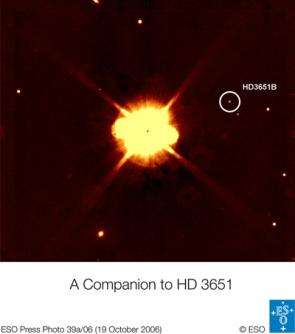
Astronomers have detected a new faint companion to the star HD 3651, already known to host a planet. This companion, a brown dwarf, is the faintest known companion of an exoplanet host star imaged directly and one of the faintest T dwarfs detected in the Solar neighbourhood so far. The detection yields important information on the conditions under which planets form.
"Such a system is an interesting example that might prove that planet and brown dwarf can form around the same star", said Markus Mugrauer, lead author of the paper presenting the discovery.
HD 3651 is a star slightly less massive than the Sun, located 36 light-years away in the constellation Pisces (the "Fish"). For several years, it has been known to harbour a planet less massive than Saturn, sitting closer to its parent star than Mercury is from the Sun: the planet accomplishes a full orbit in 62 days.
Mugrauer and his colleagues first spotted the faint companion in 2003 on images from the 3.8-m United Kingdom Infrared Telescope (UKIRT) in Hawaii. Observations in 2004 and 2006 using ESO's 3.6 m New Technology Telescope (NTT) at La Silla provided the crucial confirmation that the speck of light is not a spurious background star, but indeed a true companion. The newly found companion, HD 3651B, is 16 times further away from HD 3651 than Neptune is from the Sun.
HD 3651B is the dimmest directly imaged companion of an exoplanet host star. Furthermore, as it is not detected on the photographic plates of the Palomar All Sky Survey, the companion must be even fainter in the visible spectral range than in the infrared, meaning it is a very cool low-mass sub-stellar object. Comparing its characteristics with theoretical models, the astronomers infer that the object has a mass between 20 and 60 Jupiter masses, and a temperature between 500 and 600 degrees Celsius. It is thus ten times colder and 300 000 less luminous than the Sun. These properties place it in the category of cool T-type brown dwarfs.
"Due to their faintness even in the infrared, these cool T dwarfs are very difficult to find", said Mugrauer. "Only two other brown dwarfs with similar brightness are presently known. Their study will provide important insights into the atmospheric properties of cool sub-stellar objects."
More than 170 stars are currently known to host exoplanets. In some cases, these stars were also found to have one or several stellar companions, showing that planet formation can also take place in a dynamically more complex environment than our own Solar System where planet formation occurred around an isolated single star.
In 2001, Mugrauer and his colleagues started an observational programme to find out whether exoplanet host stars are single or married. In this programme, known exoplanet host stars are systematically imaged at two different epochs, at least several months apart. True companions can be distinguished from coincidental background objects as only they move together with the stars over time. With this effective search strategy several new companions of exoplanet host stars have been detected. Most of the detected companions are low-mass stars in the same evolutionary state as the Sun. In two cases, however, the astronomers found the companions to be white dwarfs, that is, stars at the end of their life. These intriguing systems bear evidence that planets can even survive the troubled last moments in the life of a nearby star.
The planet host star HD 3651 is thus surrounded by two sub-stellar objects. The planet, HD 3651b, is very close, while the newly found brown dwarf companion revolves around the star 1500 times farther away than the planet. This system is the first imaged example that planets and brown dwarfs can form around the same star.
These results were first presented in August at the IAU General Assembly in Prague and are in press in the Monthly Notices of the Royal Astronomical Society (Mugrauer et al., astro-ph/0608484). The discovery was later confirmed by another team, using the Spitzer space telescope (Luhman et al., astro-ph/0609464). The spectral classification was confirmed by additional follow-up spectroscopy of the companion (Burgasser, astro-ph/0609556).
Source: European Southern Observatory


