Genetic repair mechanism clears the way for sealing DNA breaks
October 19th, 2006 Genetic repair mechanism clears the way for sealing DNA breaks

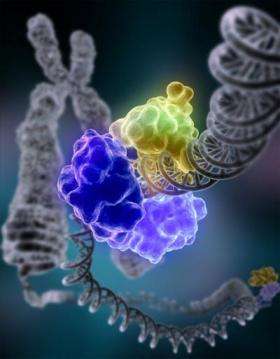
In this illustration, DNA ligase (in color) encircles the DNA double helix.

Scientists investigating an important DNA-repair enzyme now have a better picture of the final steps of a process that glues together, or ligates, the ends of DNA strands to restore the double helix.

The enzyme, DNA ligase, repairs the millions of DNA breaks generated during the normal course of a cell's life, for example, linking together the abundant DNA fragments formed during replication of the genetic material in dividing cells.

"Our study shows that DNA ligase switches from an open, extended shape to a closed, circular shape as it joins DNA strands together," says the study's senior author Tom Ellenberger, D.V.M, Ph.D., the Raymond H. Wittcoff Professor and head of the Department of Biochemistry and Molecular Biophysics at Washington University School of Medicine in St. Louis. "The ligase resembles a wristwatch that latches around the DNA ends that are being joined."

DNA is surprisingly reactive and under continuous assault from environmental toxins and reactive cellular metabolites. A means of repairing DNA damage is vital to maintaining the integrity of the genetic blueprint.

When these repair processes go awry, cells can malfunction, die or become cancerous, so researchers would like to know how "DNA mechanics" do their jobs. DNA ligases are attractive targets for the chemotherapy of cancer and other diseases.

DNA ligase works in concert with another ring-shaped protein known as a sliding clamp. Sliding clamps, such as the human PCNA protein, are master regulators of DNA repair, providing docking sites that recruit repair enzymes to the site of damage.

"When ligase stacks against PCNA and encircles the DNA, we think this interaction ejects other repair proteins from PCNA," says Ellenberger. "In this role, ligase may serve as the final arbiter of DNA repair, certifying that the DNA is in pristine condition and ready for the final step of DNA end joining."

In this study of DNA ligase, published in the Oct. 20 issue of Molecular Cell, Ellenberger's research group teamed with scientists from The Scripps Research Institute (TSRI), the University of Maryland School of Medicine and Lawrence Berkeley National Laboratory (LBNL).

To visualize the complicated and dynamic structures of DNA ligase and PCNA, both separately and in a complex, Ellenberger and his group worked closely with LBNL scientists to take advantage of the intense X-rays and advanced technologies of the SIBYLS synchrotron beamline at the Berkeley lab Advanced Light Source.

The researchers used a combination of X-ray crystallography and small angle X-ray scattering (SAXS). They conducted their studies with a model organism called Sulfolobus solfataricus that has many of the same biochemical characteristics of multicelled organisms, including humans.

"We expected that DNA ligase would latch shut when bound to the ring-shaped PCNA protein," says Ellenberger. "However, the SAXS experiment clearly shows that ligase remains in an open conformation enabling other repair proteins to bind PCNA until the DNA is engaged and ligase snaps shut."

Co-author John Tainer, Ph.D., professor at LBNL and TSRI, says the results reveal for the first time how these proteins can dynamically assemble and change their shape to join DNA ends during replication and repair.

The closed conformation of DNA ligase bound to DNA was imaged in a separate study previously reported by Ellenberger's group. Ellenberger says that the challenge for the future is to study the molecular choreography of ligase, PCNA and DNA in the same experiment, which will require new methods of analyzing the SAXS data.

"The SAXS methods offer a powerful means of visualizing large proteins and protein complexes that are difficult or impossible to crystallize," says Ellenberger. "Imaging of complex processes will require a variety of tools that address different levels of biological organization from the molecular level to whole animals."

Research on biological imaging is one aspect of the University's BioMed21 initiative, which calls for converting knowledge of genetic mechanisms into practical applications.

Source: Washington University School of Medicine


print this article email this article download pdf blog this article bookmark this article     Digg this Stumble it share on Facebook share on Reddit add to delicious save to Yahoo! bookmarks
4.5/5 after 13 votes


October 19th, 2006 all stories
Biology /

Comments: 0
Rank: 4.5/5 after 13 votes

  • Stumble this up

  • Digg this

  • Share it:
  • share on Facebook
  • share on MySpace
  • share on Slashdot
  • rss-newsfeed
  • share on Google
  • share on Reddit
  • add to delicious
  • save to Yahoo! bookmarks
  • share on Windows Live
  • Add to Mixx!
Rating: 4.5/5 after 13 votes

  • Related Stories

  • New protein that repairs DNA under extreme conditions
    created Jun 25, 2008 | popularity not rated yet | comments 0
  • Unique protein from an extremophilic organism discovered
    created Jun 17, 2008 | popularity not rated yet | comments 0
  • The structure of XPD sheds light on cancer and aging
    created May 29, 2008 | popularity not rated yet | comments 0
  • DNA damage to stem cells is central to ageing
    created Jun 08, 2007 | popularity not rated yet | comments 0
  • Rampant helper syndrome: Methane-producing molecule can also repair DNA
    created Jul 02, 2009 | popularity not rated yet | comments 0

Tags


  • Physicists Demonstrate Quantum Memory with Matter Qubits
    Physicists Demonstrate Quantum Memory with Matter Qubits
    Physics / General Physics
    created Jul 03, 2009 | popularity 4.4 / 5 (17) | comments 1
  • 'Holey' Nanosheets for Wastewater Dye Removal
    Nanotechnology / Nanomaterials
    created Jul 01, 2009 | popularity 5 / 5 (5) | comments 1
  • Jellyfish Robot Swims Like its Biological Counterpart
    Jellyfish Robot Swims Like its Biological Counterpart
    Electronics / Robotics
    created Jun 26, 2009 | popularity 4.4 / 5 (8) | comments 1
  • Could Maxwell's Demon Exist in Nanoscale Systems?
    Could Maxwell's Demon Exist in Nanoscale Systems?
    Physics / General Physics
    created Jun 24, 2009 | popularity 4.4 / 5 (18) | comments 29
  • Living Safely with Robots, Beyond Asimov's Laws
    Living Safely with Robots, Beyond Asimov's Laws
    Electronics / Robotics
    created Jun 22, 2009 | popularity 4.6 / 5 (52) | comments 40
  • Other News

    Researchers uncover the potential for super-sized abalone

    Biology / Microbiology

    created 2 hours ago | popularity not rated yet | comments 0

    (PhysOrg.com) -- Designer abalone could be an option in the foreseeable future, thanks to a project conducted at UQ's Heron Island Research Station and the St Lucia campus.


    Scientists 'rebuild' giant moa using ancient DNA

    Biology / Plants & Animals

    created Jul 01, 2009 | popularity 5 / 5 (10) | comments 12

    (PhysOrg.com) -- Scientists have performed the first DNA-based reconstruction of the giant extinct moa bird, using prehistoric feathers recovered from caves and rock shelters in New Zealand.


    Pacific Giant Salamander (Dicamptodon tenebrosus)

    Salamanders, regenerative wonders, heal like mammals, people

    Biology / Microbiology

    created Jul 01, 2009 | popularity 5 / 5 (20) | comments 11

    The salamander is a superhero of regeneration, able to replace lost limbs, damaged lungs, sliced spinal cord -- even bits of lopped-off brain. But it turns out that remarkable ability isn't so mysterious after ...


    California water plan aims to save Puget Sound orcas

    Biology / Ecology

    created 18 hours ago | popularity not rated yet | comments 0

    A plan to restore salmon runs on California's Sacramento River also could help revive killer whale populations 700 miles to the north in Puget Sound, as federal scientists struggle to protect endangered species in a complex ...


    Genetically modified trees

    Anti-biotech groups obstruct forest biotechnology

    Biology / Biotechnology

    created Jun 30, 2009 | popularity 3.7 / 5 (7) | comments 5

    The potential of forest biotechnology to help address significant social and environmental issues is being "strangled at birth" by the rigid opposition of some groups and regulations that effectively preclude ...